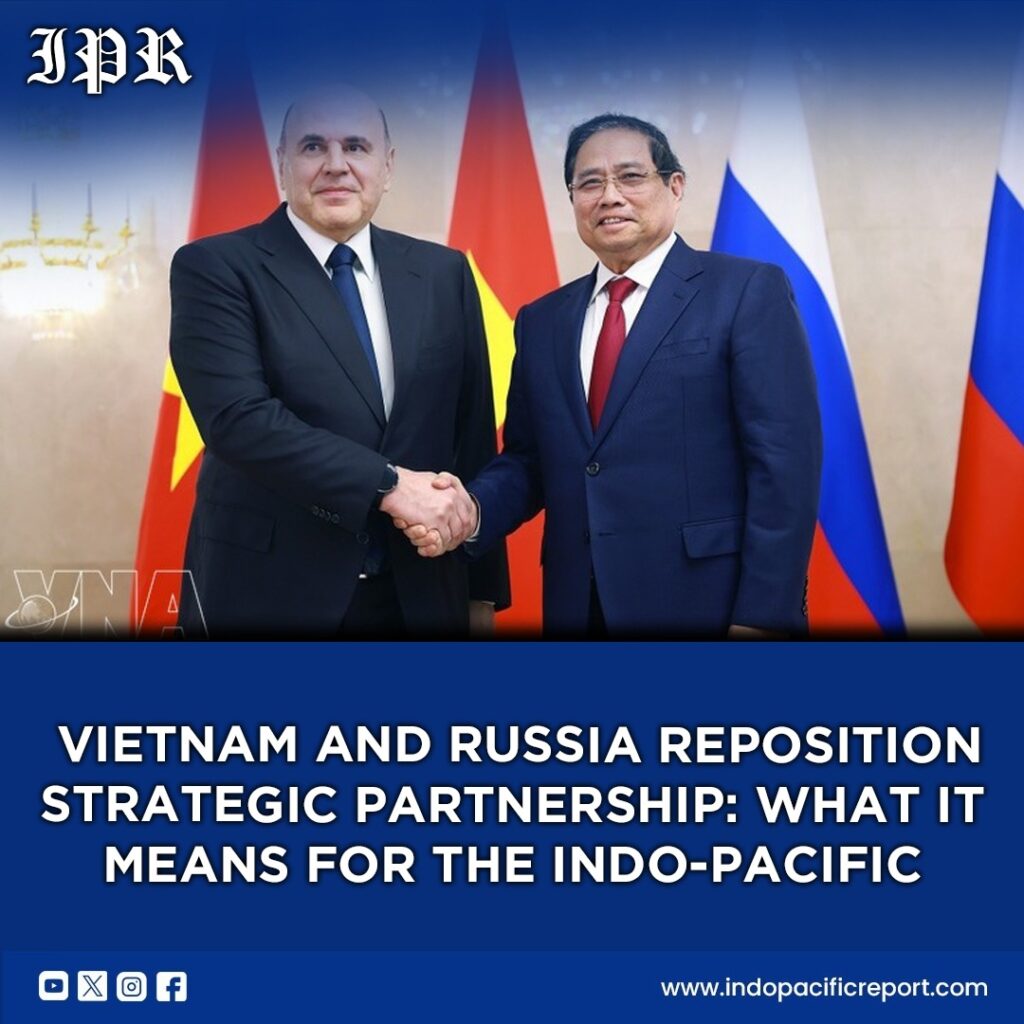
Vietnamese Prime Minister Pham Minh Chinh’s visit to Moscow and his meeting with Russian Security Council Secretary Sergey Shoigu highlight the continuing evolution of the Vietnam–Russia Comprehensive Strategic Partnership. Both sides emphasized their intent to “reposition and elevate” the relationship in the current global context, signaling that Hanoi and Moscow see mutual advantage in deepening cooperation across defense, energy, trade, and scientific collaboration.
From a great-power competition perspective, this visit reflects Russia’s desire to maintain influence in Southeast Asia amid the ongoing U.S.-China strategic rivalry. By strengthening ties with Vietnam—a key Indo-Pacific player with strategic proximity to the South China Sea—Moscow can project presence, diversify partnerships, and hedge against increasing geopolitical isolation stemming from Western sanctions. For Hanoi, deeper engagement with Moscow provides an additional strategic counterweight in a region dominated by Chinese maritime assertiveness.
On regional security architecture, Vietnam and Russia are signaling an expansion of defense and military-technical collaboration. The discussions on military-technical cooperation, human resources training, and scientific research reinforce Hanoi’s capacity to modernize its armed forces while maintaining a balanced approach to major powers. This enables Vietnam to safeguard its maritime interests and support a rules-based order in the South China Sea, without over-dependence on any single ally.
Economic and energy cooperation was another pillar of the meeting. Russia’s willingness to support Vietnam in energy security, oil and gas development, and nuclear power projects addresses Hanoi’s long-term development needs. It also underscores how strategic partnerships in the Indo-Pacific are increasingly multi-dimensional, blending defense, energy, technology, and diplomacy. Such partnerships are vital for medium powers like Vietnam to strengthen autonomy while navigating competition between the U.S., China, and other regional actors.
The emphasis on people-to-people links and overseas Vietnamese communities also has strategic significance. Moscow is signaling openness to soft-power influence and integration of diaspora networks to consolidate long-term bilateral ties. For Hanoi, encouraging its diaspora to contribute to Russia’s development strengthens mutual trust and cultural alignment, providing additional channels for strategic cooperation beyond formal government-to-government agreements.
In the broader Indo-Pacific context, the Vietnam–Russia dialogue demonstrates that medium powers are actively diversifying partnerships to avoid strategic dependency on any single great power. As the region faces intensifying security challenges—from the South China Sea disputes to the economic leverage of major powers—Vietnam’s engagement with Russia reinforces its position as a pivot state capable of hedging and balancing. For Moscow, expanding ties with countries like Vietnam enhances its relevance in a region where its direct military influence is limited.
Forward-looking implications: This visit suggests that Vietnam–Russia relations will likely continue to expand in multi-sector strategic cooperation, providing Hanoi with alternative security, technology, and energy options. It also underscores how Russia seeks to remain engaged in the Indo-Pacific, leveraging historical ties and strategic partnerships to maintain influence amid the U.S.-China competition. Both sides are preparing to use diplomacy, economic ties, and defense collaboration as tools for regional resilience and strategic hedging.
Will Vietnam’s deepening partnership with Russia strengthen its strategic autonomy, or could it complicate Hanoi’s relations with the U.S. and other Indo-Pacific allies?