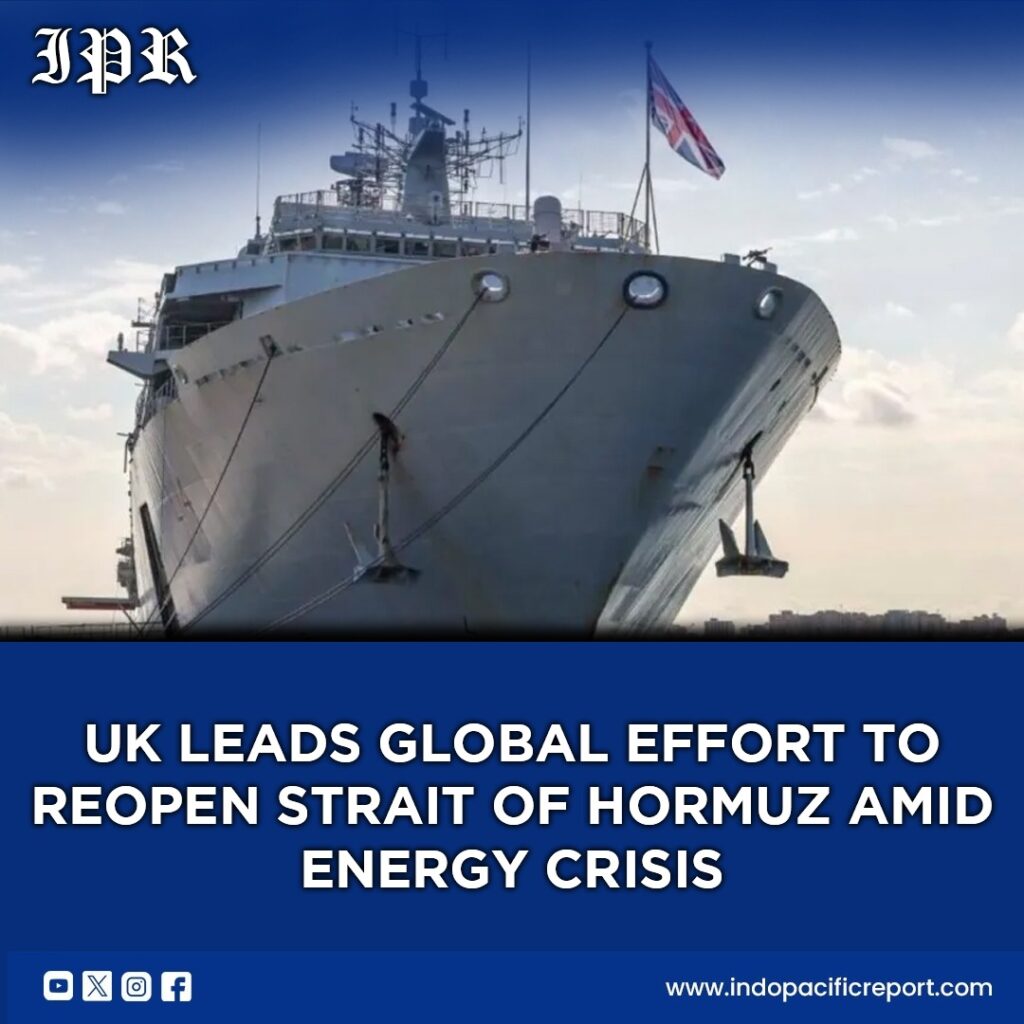
The United Kingdom has offered to host an international summit aimed at reopening the Strait of Hormuz, the world’s most critical oil chokepoint, as the ongoing conflict involving the U.S., Israel, and Iran continues to disrupt global energy flows. With roughly 20% of global oil passing through the strait, Tehran’s threats of retaliation have effectively halted commercial shipping, sending oil prices and inflation spiraling worldwide. The UK’s move to convene more than 30 nations—including France, Germany, Canada, Australia, and Gulf partners—reflects a recognition that multilateral coordination is urgently needed to restore economic and strategic stability.
From the perspective of great-power competition, the crisis highlights how regional conflicts can be exploited by global competitors. China and Russia stand to benefit economically and strategically from Western disarray, while the U.S.’s unpredictable military engagement strains alliances and undermines confidence in American-led security guarantees. By offering to host a summit, the UK is asserting a proactive role in shaping outcomes, signaling that European actors are willing to assume leadership when U.S. actions appear erratic or unilateral.
The initiative also underscores regional security architecture and the need for cooperative mechanisms to safeguard maritime chokepoints. The proposed summit aims to align military planning, including the deployment of mine-hunting drones and other naval assets, across allied states. It demonstrates that security of the global commons—particularly energy transit routes—cannot rely on one nation alone, and that coalition-building is critical to managing both kinetic and non-kinetic threats in sensitive waterways.
In terms of alliance dynamics, the UK’s approach illustrates the evolution of European defense pragmatism. While Washington has historically led Gulf security, hesitancy to deploy forces in a high-risk environment has created operational gaps. London’s offer to coordinate military planning and convene allied chiefs signals both a hedge against U.S. unpredictability and a commitment to ensure that allied partners can act collectively without overdependence on a single dominant power.
Maritime and economic strategy are central to this effort. Securing the Strait of Hormuz is not only about preventing disruption to oil supplies but also about safeguarding the global economic system. Elevated energy prices and supply shocks ripple across Europe, Asia, and emerging markets, threatening inflation control and economic growth. The UK-led coalition, by creating a “viable, collective plan” to keep the strait open, is effectively linking military operations to economic resilience—an approach increasingly relevant in the Indo-Pacific, where similar chokepoints like the Malacca Strait or the South China Sea could face geopolitical disruption.
Looking at Implications for the Indo-Pacific, the UK initiative offers several lessons. First, strategic chokepoints are critical leverage points for global powers and regional actors alike. Second, the initiative reinforces the value of coalition-based responses in high-stakes security environments, providing a model that Indo-Pacific states could replicate in the South China Sea or Taiwan Strait. Finally, it highlights a broader trend: middle powers, like the UK or Australia, are increasingly stepping into leadership roles when great powers demonstrate unpredictability, reinforcing multipolar dynamics across maritime security theaters.
Forward-looking assessment: The proposed summit positions the UK as a convenor of collective security while emphasizing that maritime chokepoints are international assets requiring coordination beyond bilateral alliances. If successful, this initiative could stabilize oil flows, reduce economic disruption, and provide a blueprint for multinational crisis management in both the Middle East and the Indo-Pacific. Failure, however, could embolden adversaries, exacerbate global inflation, and signal fractures in traditional Western security structures.
Audience Debate Question: Can Europe and its partners realistically secure global chokepoints without relying on unpredictable U.S. military leadership?