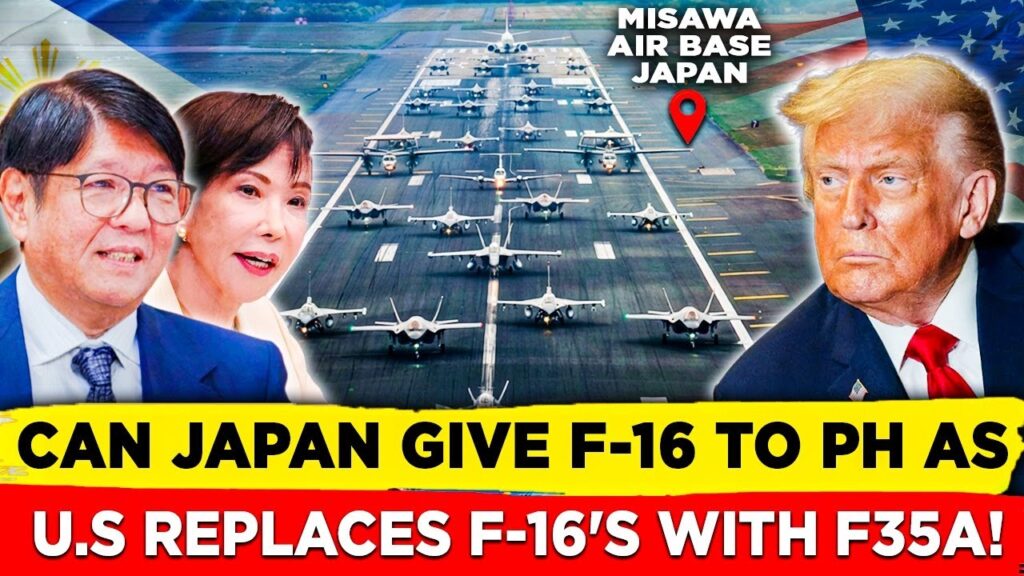
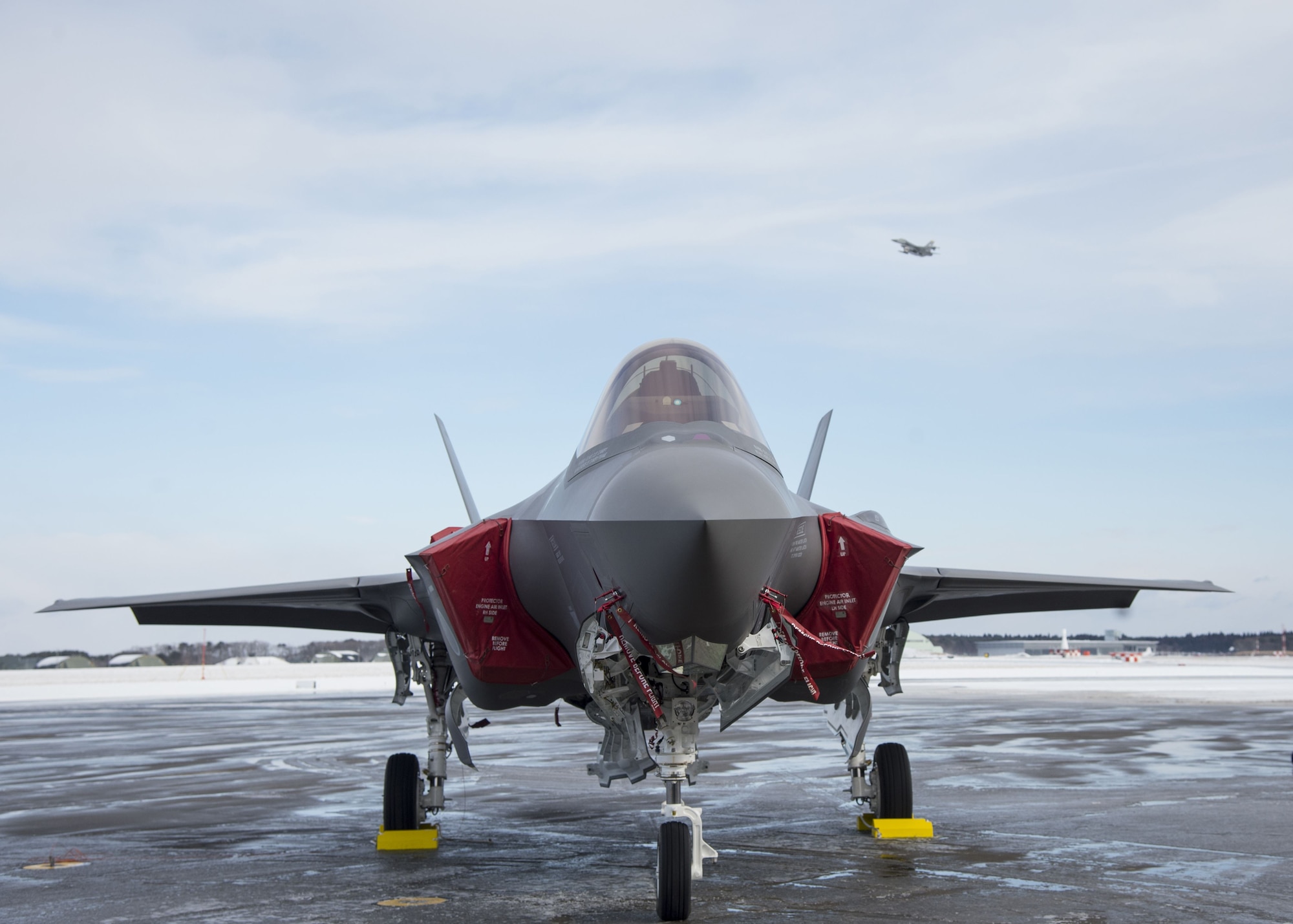
U.S. Deploys F-35A Stealth Fighters at Misawa: Strategic Shift Opens Path for Philippine F-16 Acquisition
What looks, at first glance, like a routine basing decision in northern Japan is anything but routine. When the U.S. Air Force quietly confirmed that 48 F-35A Lightning II stealth fighters will deploy to Misawa Air Base starting in spring 2026, replacing 36 legacy F-16 Fighting Falcons, it signaled more than a simple upgrade in aircraft. It marked a strategic pivot in how Washington intends to fight, deter, and shape airpower dynamics across the Indo-Pacific’s most contested airspace.

On paper, this is a straightforward modernization move. Fifth-generation fighters replace fourth-generation jets, stealth replaces visibility, sensors replace speed as the decisive edge. But zoom out, and the implications widen fast. Misawa sits at a critical junction facing Northeast Asia, within operational reach of the Korean Peninsula, the East China Sea, and the Western Pacific. By stationing F-35As there, the United States is effectively hardening its forward air posture against both China’s growing air and missile forces and North Korea’s unpredictable escalation cycles. This is deterrence through dominance, quiet, credible, and technologically overwhelming.
Here is where the strategic domino falls. F-35s do not simply arrive; they displace. The F-16s rotating out of Misawa do not vanish into storage, they enter the global pool of available, combat-proven aircraft that U.S. allies actively seek. For countries modernizing under tight budgets and urgent timelines, this matters. And few fit that profile more cleanly than the Philippines.
For the Philippine Air Force, locked into its ReHorizon 3 modernization phase, the Misawa transition opens a rare opportunity window. Manila has been clear about its need for multi-role fighters that can perform air defense, maritime strike, and interoperability missions with U.S. forces. Brand-new aircraft take time and political capital. Surplus or transferred F-16s, already integrated into U.S. doctrine and regional operations, offer a faster, more realistic pathway to credible airpower.
So what appears to be a technical basing adjustment in Japan is, in reality, a strategic chain reaction. The U.S. strengthens its first-line air dominance with stealth fighters. Allies gain access to proven platforms. And Southeast Asia, particularly the Philippines, may find itself with an unexpected opening to leap forward in air combat capability. In today’s Indo-Pacific, even “routine” rotations carry strategic consequences and this one could redraw airpower equations far beyond Misawa’s runway.
Strategic Background & Regional Context
Misawa Air Base has always been more than just another dot on the U.S. Air Force’s global basing map. Sitting in northeastern Honshu, it occupies a quietly powerful position, close enough to the Korean Peninsula to respond rapidly to escalation, well placed to monitor and contest activity in the East China Sea, and far enough east to serve as a launchpad into the wider Pacific. Geography does a lot of the work here, which is exactly why Misawa has remained central to U.S. air strategy in Asia for decades.
Until now, that role has been carried by 36 F-16CM Block 50 fighters under the 35th Fighter Wing. These aircraft are anything but obsolete; they are combat-tested, precision-strike capable, and deeply integrated into joint and allied operations. But the regional air environment has changed. Advanced surface-to-air missiles, fifth-generation fighters, and dense sensor networks are becoming the norm, not the exception. In that context, survivability and information dominance matter as much as payload and range.
That is the strategic logic behind the shift beginning in spring 2026. The replacement of those F-16s with 48 F-35A Lightning II fighters transforms Misawa from a forward operating base into a cornerstone of long-term U.S. fifth-generation airpower in Asia. The jump in numbers alone is notable, but the real shift lies in capability. Stealth, sensor fusion, and networked operations allow the F-35 to shape the air battle before adversaries even realize.
U.S. Air Force officials have framed the transition carefully, emphasizing continuity rather than disruption. During the handover period, rotational fighter deployments will ensure there is no capability gap, underscoring what they describe as a long-standing mission: defending Japan while sustaining an open and free Indo-Pacific. That phrasing matters. It signals reassurance to allies, restraint toward rivals, and a clear message that this upgrade is about stability, not escalation.
In practical terms, Misawa’s evolution reflects the broader regional reality. Airpower in the Indo-Pacific is no longer about who shows up first, it is about who can operate, survive, and coordinate in the most contested environments. By anchoring fifth-generation fighters at Misawa, the United States is aligning geography with technology, and quietly reinforcing the air balance across Northeast Asia and beyond.
The F-35A Program & Capabilities
To understand why the move from F-16s to F-35As at Misawa matters, you have to look past the airframe and into how air combat itself has changed. The F-16 Fighting Falcon has been the workhorse of the U.S. Air Force for decades, fast, agile, combat-proven, and endlessly adaptable. It won wars, deterred rivals, and set the standard for fourth-generation multirole fighters. But the battlespace it was designed for no longer exists in its. https://indopacificreport.com/should-taiwan-expose-beijings-airspace-and-eez-violations-like-the-philippines-does-in-the-south-china-sea/
The F-35A Lightning II is built for an era where the first shot may be fired by sensors, not pilots, and where survival depends on remaining unseen as much as outmaneuvering an opponent. Its stealth design dramatically lowers its radar cross-section, allowing it to operate inside heavily defended airspace where legacy fighters would be detected and targeted early. In regions saturated with advanced surface-to-air missiles and modern interceptors, that survivability gap is decisive.
Equally transformative is the F-35’s sensor fusion. Rather than forcing pilots to manage multiple data streams from separate systems, the aircraft integrates radar, electro-optical, electronic warfare, and off-board inputs into a single, coherent picture. The result is situational awareness that borders on information dominance. Pilots do not just see more, they understand more, faster. In a contested Indo-Pacific environment, that clarity can mean the difference between controlling the fight and reacting to it.
Then there is the networking effect. The F-35 is not designed to fight alone. It acts as a flying sensor node, sharing real-time targeting and threat data with other aircraft, ships, and ground forces, including allied platforms. This turns individual jets into part of a wider kill web, multiplying the effectiveness of both fifth- and fourth-generation assets operating alongside them. In practice, this makes the entire force smarter, not just stealthier.
None of this diminishes what the F-16 has represented. As Lt. Col. Michael Ress, an F-16 squadron commander transitioning to the F-35A, put it, the Fighting Falcon has been “the backbone of the Air Force for over 50 years.” That legacy still matters. But his conclusion is the key takeaway: in today’s threat environment, fifth-generation capability is no longer a luxury, it is what decisive airpower now demands. Misawa’s transition reflects that reality, and signals where the future of regional air dominance is headed.
Operational Details of the Misawa F-35A Deployment
The mechanics of the Misawa transition reveal just how deliberate this shift in U.S. airpower really is. This is not a symbolic swap or a temporary rotation, it is a structural upgrade designed to lock in fifth-generation capability for the long haul. Under the current plan, the 35th Fighter Wing will gradually draw down its 36 F-16s throughout 2025, ensuring continuity of operations while setting the stage for a clean handover. Beginning in spring 2026, 48 F-35A Lightning II aircraft will start arriving, ultimately becoming a permanently based force at Misawa.
The numbers matter, and they are not accidental. Moving from 36 to 48 aircraft represents more than a platform upgrade; it signals an expansion in both capacity and operational depth. More aircraft mean greater sortie generation, more persistent presence, and increased resilience in a high-tempo contingency. In practical terms, Misawa is not just getting stealthier, it is getting heavier in combat power at a time when air dominance in Northeast Asia is increasingly contested.

From an operational planning perspective, the transition is being managed to avoid any deterrence gap. As F-16s phase out, rotational fighter deployments will backfill capability, maintaining readiness and alliance commitments. Defense planners have been careful to frame this as continuity rather than escalation: a necessary modernization aligned with the evolving threat environment, not a sudden shift in posture.
At the local level, the announcement has naturally raised concerns, particularly around aircraft noise and community adjustment. These reactions are not new and have accompanied nearly every major basing change in Japan’s post-war history. U.S. and Japanese officials have acknowledged these issues while emphasizing the broader strategic rationale. For planners in Washington and Tokyo, the calculus is clear: enhanced deterrence, survivability, and operational reach outweigh the short-term frictions that accompany any major force upgrade.
https://www.youtube.com/watch?v=GnJYKnKH-Wk
Taken together, the operational details show a simple reality. Misawa is being reshaped into a core node of U.S. airpower in the Indo-Pacific, with more aircraft, more advanced capabilities, and a long-term mission set. The shift from F-16s to F-35As is not just about replacing jets, it is about redefining what forward-based airpower looks like in an era of great-power competition.
Strategic Rationale: Indo-Pacific Security Dynamics
The Misawa F-35A deployment cannot be seen in isolation, it is a response to an evolving security landscape in the Indo-Pacific. China’s rapid air modernization, including the fielding of stealthy J-20 fighters and other advanced platforms, has dramatically increased the region’s aerial threat environment. At the same time, North Korean missile tests and occasional airspace incursions show the need for credible, forward-based deterrence. Against this backdrop, positioning fifth-generation fighters in Japan sends a clear signal to allies and adversaries alike: the United States is serious about defending its partners and maintaining operational freedom in contested airspace.https://youtu.be/GnJYKnKH-Wk?si=7a0sNaIu0DyCxwV4
U.S. defense officials have emphasized this dual purpose. The Department of Defense describes the F-35 deployment as reflective of an “ironclad U.S. commitment to the defense of Japan and both countries’ shared vision of a free and open Indo-Pacific.” By embedding advanced capabilities at Misawa, the United States is not only preparing for potential contingencies but also reassuring treaty partners that regional stability and deterrence are non-negotiable priorities.
A Philippine Opportunity: F-16s and ReHorizon 3
The strategic ripple from Misawa extends beyond Japan. As the U.S. transitions F-16s out of Misawa, the Philippines sees a rare opportunity to accelerate its air force modernization under ReHorizon 3, a broad, ₱2 trillion (USD 35 billion) defense initiative aimed at enhancing territorial defense, maritime reach, and aerial deterrence. Currently, the Philippine Air Force (PAF) operates a small fleet of 12 FA-50 light fighter trainers, which limits its ability to conduct advanced air superiority missions.
In April 2025, the U.S. approved the proposed sale of 20 F-16 aircraft (16 F-16C and 4 F-16D Block 70/72 jets) to the Philippines as part of a $5.58 billion package, which also includes weapons and support systems. Manila has stressed that the acquisition is intended to strengthen defensive capability and interoperability with U.S. forces, not to provoke any nation. Lockheed Martin has also highlighted the F-16’s global footprint, over 3,100 aircraft operating in 28 countries and its adaptability to Asia-Pacific security needs.
The benefits are clear: immediate capability enhancement, faster delivery compared with entirely new jets, and closer integration with allied training and operational standards. Challenges remain, however. Older jets require robust maintenance, logistics, and infrastructure support, and the PAF will need to expand pilot and technical training pipelines to fully leverage the platform.
Implications for Regional Security
The combined effect of the U.S. F-35 deployment and potential Philippine F-16 acquisition strengthens the air deterrent posture across the Indo-Pacific. Misawa becomes a forward hub for fifth-generation airpower, while Manila gains a credible, multirole fighter capability to secure its airspace and maritime approaches. The arrangement also reinforces alliance integration, strengthening interoperability and readiness with Japan, the U.S., and Southeast Asian partners, while maintaining a careful diplomatic balance amid ongoing territorial disputes with China.
Conclusion
The transition of F-35As to Misawa is far more than a hardware upgrade; it represents a deliberate strategic shift in airpower posture, combining advanced technology, forward basing, and alliance signaling to reinforce regional deterrence. For the Philippines, the knock-on effect could be transformative: surplus U.S. F-16s may serve as a cornerstone of the PAF’s ReHorizon 3 modernization plan, giving Manila enhanced defensive and strike capabilities while deepening interoperability with the United States. Together, these moves strengthen the regional security architecture, balancing deterrence and cooperation in a highly contested airspace.
The Misawa deployment and Philippine opportunity illustrate a central lesson of contemporary Indo-Pacific strategy: modernization and partnerships are mutually reinforcing, and even routine rotations of aircraft can have outsized geopolitical consequences.
https://youtu.be/o9xiWlmXRj4?si=Od494KhtXQjB7sy_