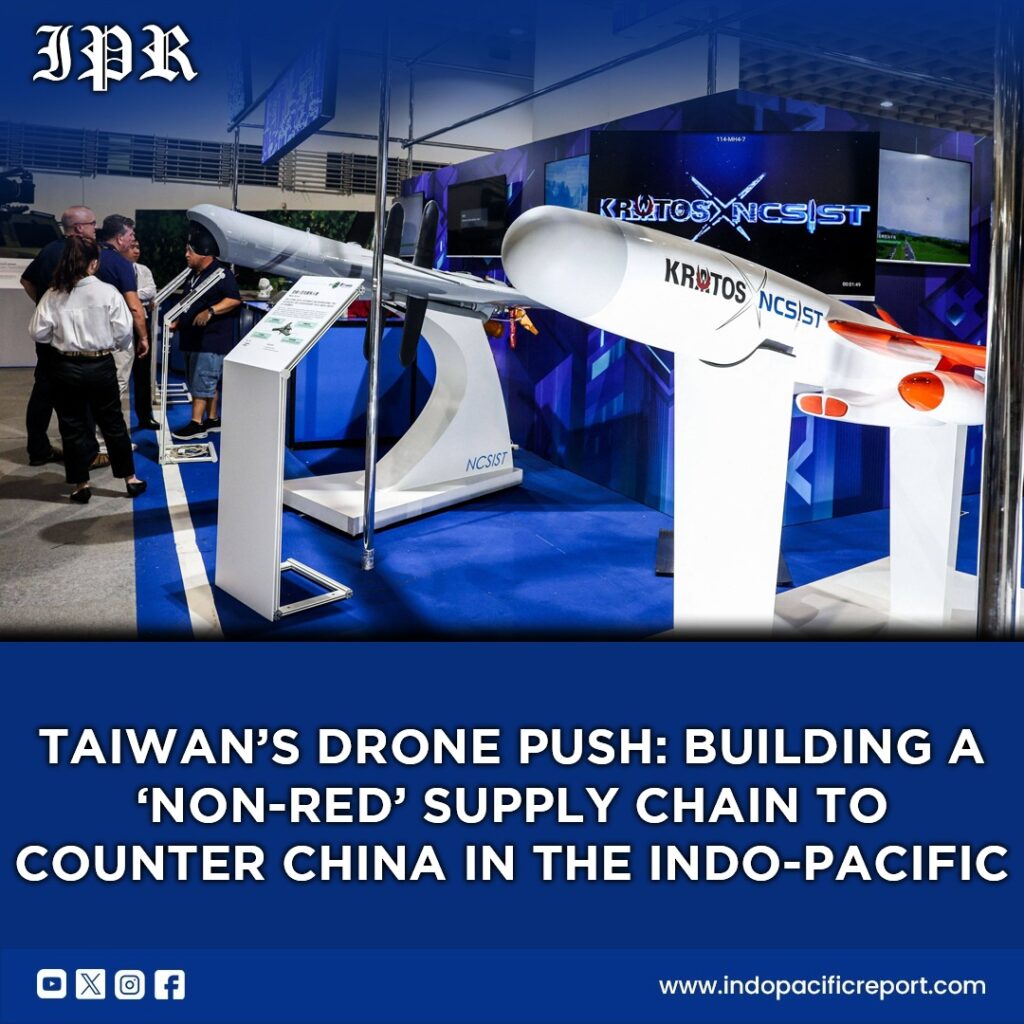
Taiwan’s drive to become an Asia-Pacific hub for drone production is more than an industrial strategy—it is a deliberate geopolitical maneuver. By building a drone ecosystem decoupled from mainland China, Taipei seeks to integrate itself into a broader “democratic supply chain” network. This strategy aligns with the U.S. and like-minded partners aiming to secure resilient defense and industrial capacity in the Indo-Pacific. Taiwan plans to invest NT$44.2 billion (US$1.38 billion) from 2025 to 2030, targeting annual output of NT$40 billion, and is collaborating with U.S. firms like Kratos Defense and Security Solutions to accelerate capabilities.
From a great-power competition perspective, the move is defensive and strategic. A supply chain independent of China reduces Taiwan’s vulnerability to coercion, sanctions, or embargoes. It also signals to Beijing that Taipei can sustain its defense-industrial base despite regional pressure. At the same time, this positions Taiwan as a critical node in a broader U.S.-led strategy to integrate “trusted” industrial partners across the Indo-Pacific, enhancing deterrence by ensuring allied access to advanced unmanned systems.
In the regional security architecture, Taiwan’s drone ambitions strengthen asymmetric capabilities. High-speed attack and reconnaissance drones provide cost-effective force multipliers that can monitor maritime approaches and support early-warning operations across the East and South China Seas. This complements Taiwan’s conventional military, making it more resilient against a larger adversary while offering potential technological support to regional partners like Japan, Australia, and the Philippines.
Alliance dynamics are also being recalibrated. Partnerships with U.S. companies, along with potential collaboration with other democracies, create a distributed defense-industrial network. This network not only produces drones but also reinforces Taiwan’s strategic relevance to allies seeking supply chain security. By embedding its industrial output into a trusted network, Taipei converts technological capability into geopolitical leverage—enhancing both deterrence and diplomatic influence.
From a maritime and economic strategy lens, drones are a strategic asset in contested waters. They extend Taiwan’s surveillance reach, support maritime domain awareness, and act as force multipliers in potential gray-zone conflicts. Economically, a domestically anchored, “non-red” drone supply chain stimulates high-tech manufacturing, skilled labor, and innovation, while insulating critical defense infrastructure from geopolitical disruption. This dual utility—defense and industrial resilience—strengthens Taiwan’s strategic posture.
However, significant challenges remain. Taiwan must secure critical components, rare-earth materials, and high-tech electronics from trusted partners, while avoiding bottlenecks that could slow production. Political timing is delicate: an accelerated push risks provoking Beijing, which may interpret the initiative as a security threat. Moreover, scaling the industry to meet both domestic and regional demand requires careful coordination with allies, efficient technology transfer, and robust financing.
Forward-looking implications: If Taiwan successfully executes its drone hub strategy, it could redefine the regional defense-industrial map, providing allies with a secure, politically aligned supply chain for unmanned systems. This would strengthen the resilience of Indo-Pacific security architectures and reinforce deterrence against coercive behavior in contested waters. Conversely, failure to manage industrial and diplomatic complexities could limit Taiwan’s influence and heighten cross-strait tensions.
Can Taiwan realistically build a fully independent, “non-red” drone supply chain without triggering an escalatory response from Beijing?