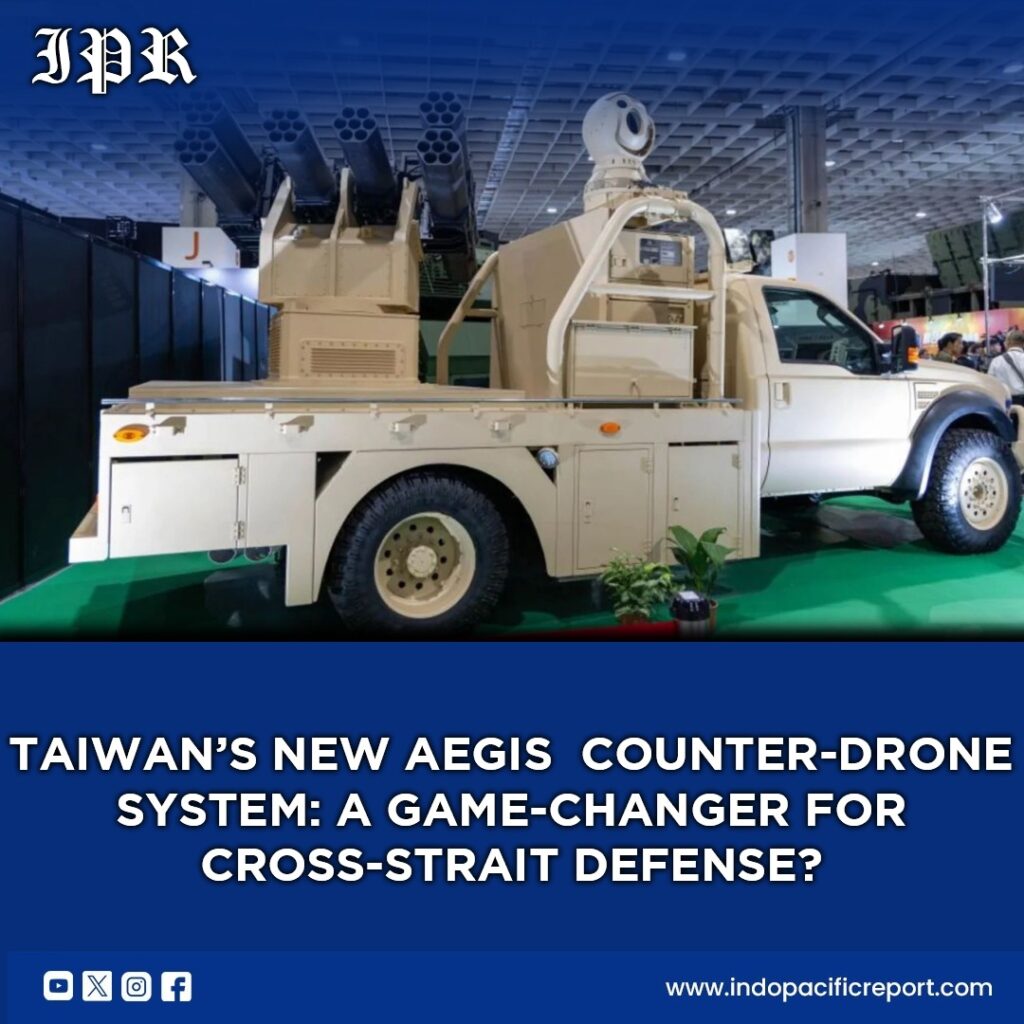
Taiwan is deploying the Aegis counter-drone system, developed by Cub Elecparts in collaboration with international partners, to protect its air bases and critical infrastructure from small and medium-sized UAV threats. This move comes as the People’s Liberation Army (PLA) increasingly employs drones for surveillance, electronic warfare, and potential swarm attacks across the Taiwan Strait. By combining millimeter-wave radar, RF detection, and electro-optical sensors, Aegis is designed to detect, track, and neutralize drones before they can threaten fixed sites. This represents a shift in air defense thinking, focusing on low-cost, high-volume threats that traditional missile systems cannot efficiently address.
From the lens of great-power competition, Taiwan’s investment in counter-UAS technologies reflects the asymmetric nature of cross-strait deterrence. Small drones are inexpensive, proliferating, and capable of saturating defenses, creating a scenario where conventional interceptors would be overtaxed. Aegis provides a cost-effective layer of deterrence that raises the operational risk for Beijing’s UAV deployments while signaling Taiwan’s ability to adapt to evolving PLA tactics.
The system also reshapes the regional security architecture. By integrating early-warning detection through RF signals and millimeter-wave radar, Taiwan can defend vital air bases, ports, and energy infrastructure. The ability to intercept drones before they enter the airspace ensures that Taiwan maintains operational continuity even under intense UAV pressure. These defensive layers complement broader air and missile defense networks, including F-16Vs and SkyGuardian drones, creating a multi-tiered resilience strategy in the first island chain.
Aegis deployment has implications for alliance and industrial dynamics. By partnering with international tech firms while retaining domestic integration, Taiwan reduces dependence on foreign supply chains and ensures operational independence—a key factor in sustaining credible deterrence. For U.S. and regional partners, Taiwan’s counter-drone capabilities signal innovative, cost-efficient force multiplication, which can be shared through joint exercises or cooperative research, enhancing collective regional readiness.
From a maritime and economic security perspective, the system reinforces Taiwan’s ability to safeguard critical infrastructure and trade routes. The Taiwan Strait is a vital corridor for global shipping and semiconductor exports; defending key nodes against swarm UAV threats protects both national security and economic stability. This operational layer also forces potential aggressors to rethink strategies that rely on low-cost aerial harassment, changing the cost-benefit calculus for PLA operations.
Strategically, Taiwan is demonstrating how asymmetric technologies can shift the Indo-Pacific balance of power. While Aegis is not a game-changer in conventional air combat, it addresses the emerging “cost-exchange ratio” problem where low-cost drones threaten high-value assets. Integrating domestic innovation with international expertise, Taiwan is building resilience and signaling sophistication in air defense planning—actions likely to shape both PLA tactics and broader regional defense investments.
As Taiwan scales up counter-drone defenses, does this reduce the risk of conflict in the Taiwan Strait, or will it provoke Beijing to escalate further with new tactics?