A Taiwan Invasion Would Be an Emergency for Japan, the Philippines, and South Korea — Why Prime Minister Takaichi Is Right
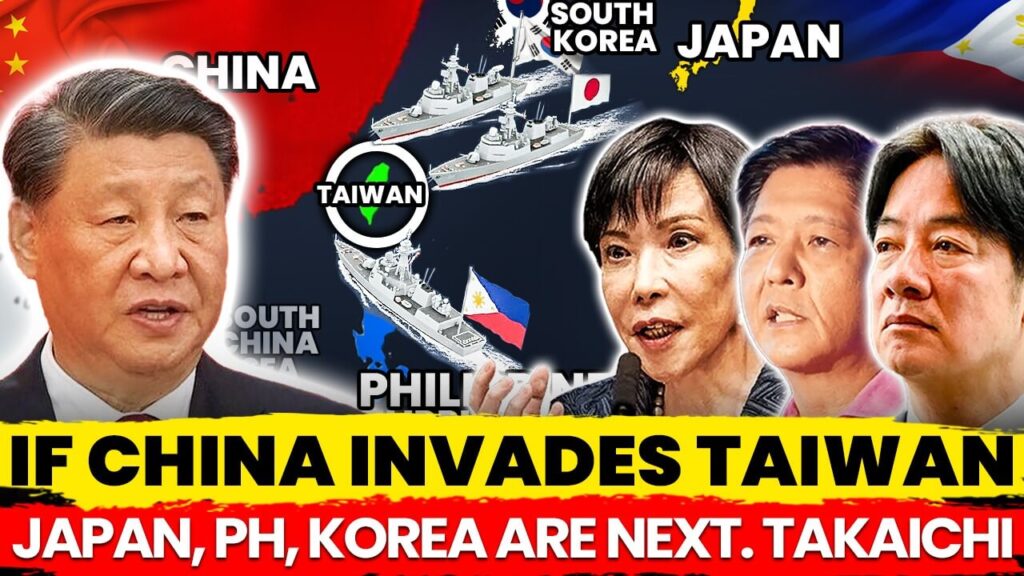
When Prime Minister Sanae Takaichi declared that “a Chinese invasion of Taiwan would be an emergency for Japan, the Philippines, and South Korea and Japan will support the United States in the defence of Taiwan”, she did more than restate a policy position. She crystallized a new strategic era in East Asia. Her statement cuts through decades of ambiguity and signals a historic shift: a Taiwan conflict would not be a local crisis, it would instantly engulf the region’s major democracies.
Takaichi’s words carry weight because of who she is and the moment in which she speaks. Becoming Japan’s prime minister in October 2025, she is known for a clear-eyed, hawkish approach to China and unwavering support for Taiwan’s security. Building on Shinzo Abe’s famous line “A Taiwan emergency is a Japan emergency” she has taken the doctrine further, openly committing Japan to stand alongside the United States in a Taiwan contingency. Few Japanese leaders have spoken with such strategic clarity, and even fewer at a time when China is accelerating military pressure across the first island chain.
Beijing’s reaction made the significance unmistakable. Within hours of her comments, China unleashed a wave of diplomatic protests, state-media attacks, and economic pressure targeting Japan, including propaganda campaigns invoking Okinawa and narratives portraying Japan as a regional destabilizer. For all the noise, the message behind China’s overreaction is simple: Beijing understands that any assault on Taiwan now risks triggering a multi-country emergency, pulling Japan, the U.S., and potentially other allies into a fast-escalating conflict. Takaichi’s doctrine reshapes the strategic equation and China knows it.
The thesis is clear: a Chinese invasion of Taiwan would not stop at Taiwan. Japan would face an existential threat and an alliance-defining moment. The Philippines would be exposed on its northern frontier, with EDCA bases and sea lanes turning into immediate targets. South Korea would confront a dual crisis, Chinese aggression to the south and a potential North Korean provocation fueled by chaos. Takaichi is not issuing a theoretical warning; she is articulating a new security reality that the Indo-Pacific must now confront.
WHY TAIWAN IS THE GEOSTRATEGIC PIVOT — MAKING TAKAICHI’S LOGIC UNAVOIDABLE
To understand why Prime Minister Takaichi’s warning resonates across the Indo-Pacific, one must first understand Taiwan’s unique geostrategic position. Taiwan is not just an island, it is the hinge of the entire First Island Chain, the natural defensive wall stretching from Japan’s Okinawa Islands down to the northern Philippines. If China were ever to seize Taiwan, it would not simply change the local balance; it would crack open the gateway to the vast Pacific. A PLA-controlled Taiwan allows Chinese naval and air forces to slip between Okinawa and Taiwan into the Philippine Sea, turning a previously contained coastline into a launchpad for blue-water power projection.

From there, China could extend military pressure deep into the Bashi Channel and Luzon Strait, the Philippines’ northern lifelines, while outflanking the sea lanes South Korea and Japan depend on for energy, food, and trade. Geography alone makes Taiwan the pivot on which regional security turns.
But geography is only part of the equation. Taiwan is also the world’s most indispensable technological chokepoint, the so-called “Silicon Shield.” More than 60% of the world’s semiconductors are made in Taiwan, and over 90% of the most advanced chips vital for AI, advanced weapons systems, satellites, telecom networks, and global finance come from a single island. TSMC, Taiwan’s industrial titan, holds more than 90% of global advanced-node capacity. U.S. Marines Deploy Drone Unit to the Philippines for South China Sea Patrols
If a conflict were to halt operations there, the impact would be immediate and catastrophic: markets would crash, supply chains would freeze, and global militaries, including those of Japan, the U.S., and South Korea, would face unprecedented constraints. In this sense, Taiwan is not merely a strategic location; it is the beating technological heart of the modern world.
History provides a preview of what is at stake. During the 1995–96 Taiwan Strait Crisis, China fired test missiles near Taiwan and conducted large-scale exercises. Even these limited actions were enough to rattle global markets, trigger emergency alliance consultations, and prompt Washington to deploy two carrier strike groups to stabilize the situation. And that was in an era before global economies became deeply dependent on Taiwanese chips. A full-scale invasion in the 2020s, with today’s interlocked supply chains and semiconductor reliance, would not be a regional disturbance; it would be a global shockwave.
This is why leaders from Tokyo to Manila to Seoul increasingly describe a Taiwan conflict as an “emergency,” not a distant or isolated issue. The stakes are too high, the geography too vital, and the economic consequences too vast for any regional power to remain untouched.
JAPAN — FROM “TAIWAN EMERGENCY” TO “EXISTENTIAL EMERGENCY”
Japan does not view a Taiwan crisis as a distant geopolitical event, it sees it as a direct threat to national survival. The geography alone makes neutrality impossible. Yonaguni Island sits barely 110 kilometers from Taiwan, and the Okinawa archipelago hosts some of the most important U.S. military bases in the Pacific, including Kadena Air Base and Futenma. In any Chinese invasion of Taiwan, Japanese airspace and maritime zones would immediately be pressured. PLA missiles, fighters, and naval vessels would either cross or skirt Japan’s Air Defense Identification Zones, forcing constant intercepts and heightening the risk of miscalculation.
Worse, if China chooses to strike U.S. bases in Japan, a plausible scenario in any Taiwan contingency, Japan’s post-2015 security laws would obligate Tokyo to exercise collective self-defense. In other words, geography ensures that Japan is already inside the battlespace before a single decision is made in Tokyo.
This perception did not begin with Prime Minister Takaichi. It builds on a decade of evolving strategic thought. Former Prime Minister Shinzo Abe famously declared, “A Taiwan emergency is a Japanese emergency, and therefore an emergency for the Japan–US alliance.” But while Abe’s line served as a warning, Takaichi has transformed it into doctrine. Her position is not abstract: she has publicly stated that Japan will support the United States militarily if Taiwan is attacked. This transition, from conditional rhetoric to explicit commitment, marks the sharpest articulation of Japan’s Taiwan policy in modern history. Under Takaichi, Tokyo is no longer hinting at involvement; it is preparing for it.
Japan’s growing military capabilities reinforce this shift. Tokyo is on track to reach 2% of GDP in defense spending, which would make it the world’s third-largest defense budget, surpassing Russia. This investment is not symbolic. Japan is acquiring long-range strike missiles capable of hitting ships and bases far from its shores, expanding integrated air and missile defense systems designed to counter China’s rocket force, and conducting joint operational planning with the United States specifically for a Taiwan scenario. These steps show a nation systematically preparing for a conflict that could redefine the Indo-Pacific balance of power. Philippines Economic Prospects for Year 2025
The stakes became clear during the 2025 China–Japan diplomatic crisis. After Takaichi reiterated her willingness to defend Taiwan, Beijing launched a fierce political backlash: propaganda campaigns questioning Japanese sovereignty over Okinawa, diplomatic threats, and targeted economic pressure. Rather than isolate Takaichi, the pressure affirmed her point, China itself now assumes Japan will not stay neutral in a Taiwan conflict. When Beijing overreacts, it is a sign that the strategic calculus has fundamentally shifted.
Japan has moved from describing a Taiwan contingency as merely “serious” to recognizing it as existential. Under Takaichi, the era of ambiguity is over.
THE PHILIPPINES — WHY A TAIWAN WAR IS AN “EMERGENCY” ON DAY ONE
For the Philippines, a Taiwan conflict is not a distant flashpoint, it is a frontline emergency from the very first hour. The geography makes this unavoidable. Northern Luzon and the Batanes Islands sit directly beneath Taiwan, separated only by the narrow waters of the Bashi Channel and Luzon Strait. Any clash between the PLA, U.S., and Japan would unfold across these same waters, placing the Philippines inside the battlespace by sheer proximity. Philippine airspace and Exclusive Economic Zone would be vulnerable to military overflight, missile trajectories, electronic warfare, and naval maneuvering.
Even without a direct attack, Manila would face the immediate risks of blockade spillover, disrupted sea lanes, and militarized activity around its northern maritime approaches. Geography ensures that a Taiwan contingency instantly becomes a Philippine contingency.
The Enhanced Defense Cooperation Agreement (EDCA) between the U.S. and the Philippines, which expanded in 2023 to include nine locations, integrates the Philippines into the defense strategy for Taiwan. Key infrastructure improvements are underway, such as runway extensions and equipment stockpiling, with discussions about Taiwan funding upgrades for Philippine bases to prepare for potential crises. Consequently, the Philippines is evolving from a passive role to a crucial logistical and operational hub for U.S. and allied responses.
Beyond strategy, the Philippines faces a profound human emergency in the event of a Taiwan war. More than 170,000 Filipinos live and work in Taiwan, forming one of the island’s largest migrant communities. The Philippines’ 2023–2028 National Security Policy identifies their safety as a top priority in any cross-strait escalation. A conflict would trigger an enormous evacuation and humanitarian challenge, disrupt billions of pesos in remittances, and create immediate domestic pressure on the government to act. This demographic reality turns a Taiwan invasion from a geopolitical concern into a direct social and economic crisis that touches Filipino families nationwide.
Manila’s policy evolution reflects this understanding. Recent analyses by the Lowy Institute and local security think tanks emphasize that China’s threats to Taiwan and its coercion in the West Philippine Sea are interconnected problems. The Philippines no longer sees these as separate theatres; it views them as two fronts shaped by a single strategic actor. This is why Manila has increased joint exercises with the U.S. and Japan, accelerated EDCA construction, and strengthened basing in northern Luzon.
Like Prime Minister Takaichi, Philippine policymakers increasingly recognize that Taiwan’s fate has a direct and immediate bearing on Philippine security. In practice, and increasingly in doctrine, Manila is aligning with the logic that a Taiwan emergency is inevitably a Philippine emergency too.
SOUTH KOREA — THE “QUIET FRONT-LINE” IN A DUAL CONTINGENCY
South Korea rarely features in public debates about a Taiwan conflict, but Seoul increasingly acknowledges that the island’s fate is tied directly to its own national security. Senior South Korean officials have stated openly that stability in the Taiwan Strait has a “direct impact” on South Korea’s national interest, a position reinforced in multiple joint U.S.–ROK statements emphasizing the need to maintain peace in the Strait. This is a significant shift for a country traditionally cautious about provoking Beijing.
It reflects a deeper strategic realization: a Taiwan crisis would reverberate across the Korean Peninsula within hours, not weeks. Seoul now understands that the shockwaves of conflict in the Taiwan Strait would not sweep around Korea, they would hit Korea first.
The greatest challenge South Korea faces is what analysts call the dual-contingency problem. In a Taiwan war, South Korea’s most important role may not be deploying forces toward Taiwan, but deterring North Korea from launching an opportunistic attack while U.S. forces redeploy southward. Multiple studies warn that China and North Korea could coordinate pressure, forcing Washington to divide its military attention between defending Taiwan and stabilizing the Korean Peninsula.
For Seoul, this scenario is deeply dangerous: a Taiwan conflict could turn North Korea into a second front, even if South Korea itself takes no provocative action. The logic is simple but brutal, if Taiwan burns, Korea must brace.
Economically, South Korea is more exposed than almost any other U.S. ally. As one of the world’s leading semiconductor producers, South Korea is intertwined with Taiwan’s chip ecosystem, sharing supply chains, manufacturing equipment, and markets. A disruption in Taiwan would reverberate immediately through Korean tech giants like Samsung and SK Hynix. Beyond chips, South Korea’s energy imports and trade routes pass through the South China Sea and Taiwan Strait, making them vulnerable to blockades, missile coverage, or naval militarization.
Even a limited conflict would jolt Korean financial markets and threaten its export-driven economy. For a country whose prosperity is built on stable sea lanes and global trade, a Taiwan war is not a peripheral issue, it is a direct economic threat.
President Yoon Suk-yeol made this connection explicit in 2023 when he compared Taiwan to the North Korea challenge, describing it as a global, systemic security issue, not merely a China–Taiwan disagreement. His comments mirror the strategic framework that Prime Minister Takaichi now articulates: a Taiwan invasion would destabilize the entire Indo-Pacific, triggering crises that no regional power can avoid. South Korea may not be the loudest voice in cross-strait debates, but it stands on the quiet front-line of a conflict that could reshape the peninsula, the alliance structure, and the economic foundations of Northeast Asia.
JAPAN WILL SUPPORT THE UNITED STATES” — HOW THAT LOOKS IN PRACTICE
Prime Minister Takaichi’s declaration that “Japan will support the United States in the defence of Taiwan” is not symbolic rhetoric; it is grounded in the legal and operational architecture Japan has spent a decade building. Under Japan’s post-2015 security laws, Tokyo can exercise collective self-defense when two conditions are met: an ally is attacked, and Japan’s survival is threatened.
A Chinese strike on U.S. forces operating from Japanese bases during a Taiwan contingency meets both thresholds unambiguously. In such a scenario, the fight would not be happening “over there” it would be occurring from Japanese soil, across Japanese airspace, and directly threatening the safety and continuity of the Japanese state. This legal framework turns Takaichi’s statement from a political message into a binding strategic trajectory.
In practical terms, Japan’s support would be decisive. The United States would rely heavily on access to its bases in Okinawa, Kyushu, and mainland Japan for air operations, maritime patrols, refueling, repair, and logistics. Japan would simultaneously provide integrated air and missile defense, shielding both its own population and U.S. forces from PLA ballistic and cruise missile attacks.
Japanese Maritime Self-Defense Force destroyers would conduct escort missions, anti-submarine warfare patrols, and intelligence, surveillance, and reconnaissance operations throughout the East China Sea and Philippine Sea. Far from sending troops directly into combat over Taiwan, Japan’s real contribution would be enabling the U.S. to fight at all, keeping sea lanes open, protecting bases, and ensuring the joint force can operate under fire.
These assumptions are not speculative; they are backed by years of U.S. wargames and naval analyses. Repeated studies, including those published by the U.S. Naval Institute and major defense think tanks, conclude that a U.S. defense of Taiwan is extremely difficult, if not impossible, without Japanese basing access, logistics depth, and coordinated operations. Japan is the unsinkable aircraft carrier that anchors the northern flank of the first island chain.
Takaichi’s public endorsement of this role transforms what used to be an unspoken assumption of strategists into declared policy, which explains the ferocity of Beijing’s diplomatic backlash. China understands the implication: if it attacks Taiwan, it will not just face Taiwan, it will face a U.S.–Japan operational machine designed to fight as one.
WHY TAKAICHI’S VIEW IS STRATEGICALLY CORRECT
For South Korea, a war in the Taiwan Strait would generate a dangerous dual-front scenario: the risk of North Korean opportunism combined with a massive economic shock to its semiconductor-driven, export-dependent economy. Seen together, the picture is not regional, it is systemic.
Takaichi’s logic also fits the structure of America’s alliance network. U.S. security commitments in Asia are not isolated treaties; they are interlinked pillars of a single deterrence architecture. A failure to uphold commitments in one theater, Taiwan, would undermine credibility in all others: the U.S.–Japan alliance, the U.S.–Philippines Mutual Defense Treaty, and the U.S.–ROK alliance. This is precisely the danger Shinzo Abe warned of when he said that “a Taiwan emergency is a Japan emergency,” and Takaichi is now extending that warning across the region. If the U.S. falters in defending Taiwan, the strategic foundations of Asia’s security order begin to crumble and every ally knows it.
The bottom line is clear: a Chinese invasion of Taiwan is not merely Taipei’s problem, it is a joint emergency that would immediately activate Japanese and American responses and inevitably pull in Manila and Seoul. Takaichi’s position codifies what military planners and intelligence analysts have long understood: Taiwan sits at the center of a networked security system, and its fall would trigger cascading crises that no U.S. ally in East Asia could escape. Her statement is not provocative; it is a rare moment of strategic honesty.
Philippine Air Force Receives 5 New Black Hawks in a Major Upgrade
And the line that captures this new era best, the one you can use to close your video or article, is this: “In the 2020s, the question is no longer whether a Taiwan war would be everyone’s crisis, it’s whether Asian democracies admit it openly and prepare together. Takaichi’s statement does exactly that.”