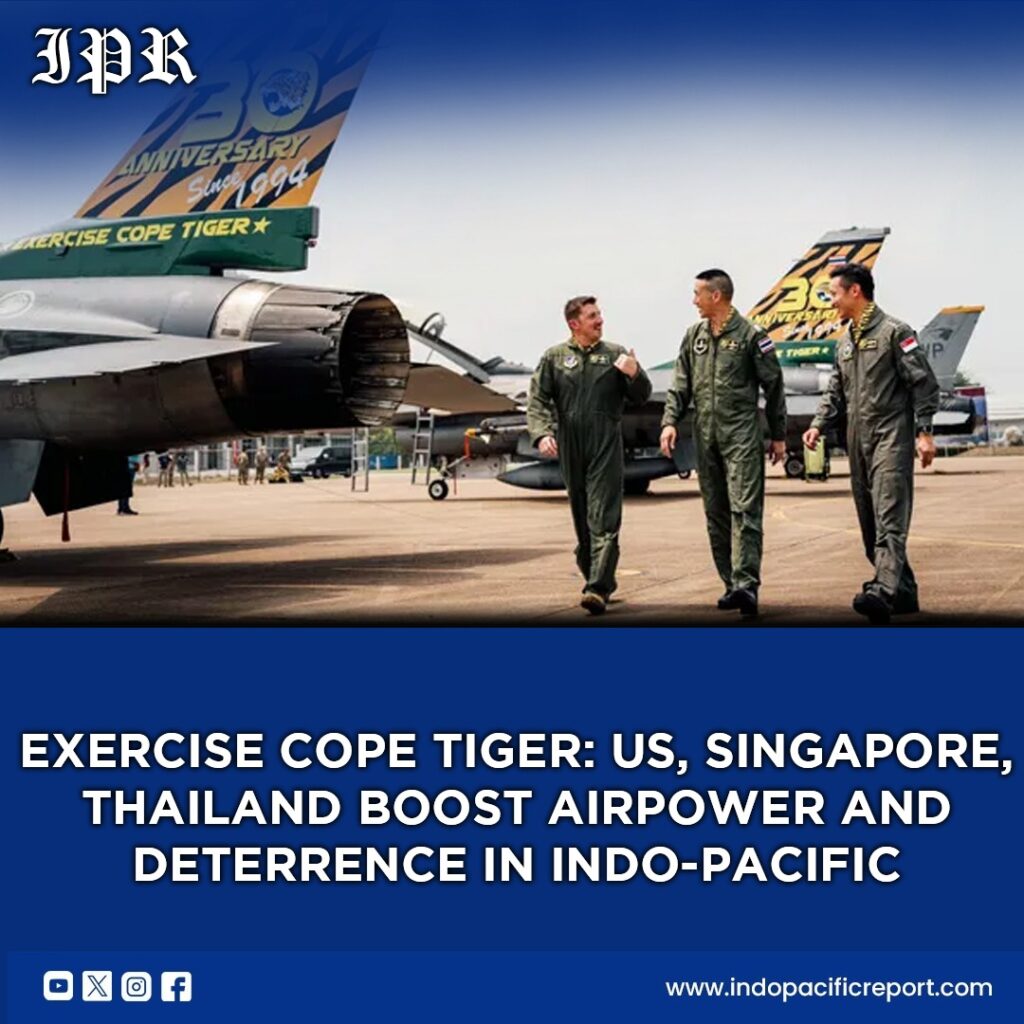
The 32nd edition of Exercise Cope Tiger is currently underway in Thailand, bringing together the Singapore Air Force (RSAF), the Royal Thai Air Force (RTAF), and the US Air Force (USAF). Running from March 15–27, the exercise involves 30 aircraft, 12 ground-based air defense systems, and over 700 personnel from Singapore alone. Beyond combat drills, participants are also engaging in joint civic programs in local communities, underlining the exercise’s broader soft-power dimension.
From a strategic perspective, this exercise signals the enduring commitment of the United States to maintain its operational presence and deterrence posture in Southeast Asia. In the context of China’s growing air and naval modernization, joint training with regional partners reassures smaller states and projects a credible defense signal across key air and maritime corridors in the Indo-Pacific.
The exercise strengthens regional security architecture. Thailand’s role as host reflects its strategic location at the heart of Indochina, linking Southeast Asia to broader maritime routes. The focus on integrated air combat and air defense readiness is designed to prepare participants for both conventional conflicts and asymmetric threats in contested airspace, contributing to overall regional resilience.
Alliance dynamics are reinforced as Singapore and Thailand deepen interoperability with US forces. For Singapore, participation demonstrates forward-deployed capabilities and rapid-response readiness. Thailand gains advanced operational exposure while cementing its position as a hub for multinational training. For the US, the exercise enhances trust, standardizes joint procedures, and ensures that regional forces can operate seamlessly with American doctrines in crisis scenarios.
From a maritime and economic strategy viewpoint, securing airspace is vital to safeguarding regional trade routes. Exercise Cope Tiger, by enhancing air defense and strike capabilities, indirectly protects critical shipping lanes in the Gulf of Thailand and approaches to the South China Sea—key arteries for Southeast Asia’s trade-dependent economies.
Looking at regional balance of power, the exercise serves as both a deterrent and a confidence-building measure. It signals that Southeast Asian states are capable of coordinating with a global power to manage potential crises, strengthening the rules-based order while demonstrating collective operational capability. As the Indo-Pacific becomes more contested, exercises like Cope Tiger will likely grow in scale and complexity to maintain strategic equilibrium without escalating tensions.
Can regular multinational exercises strengthen regional deterrence without provoking China, or do they risk triggering an arms competition?