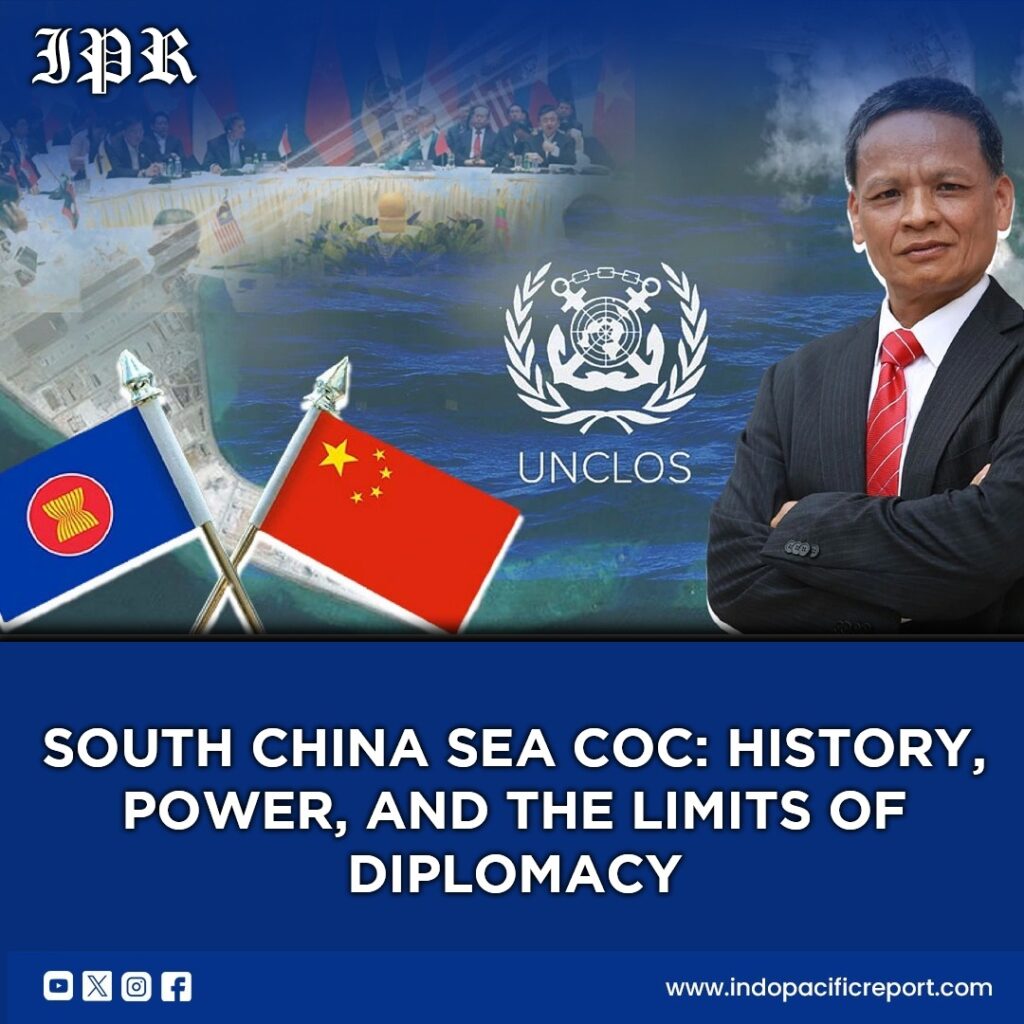
Recent narratives framing the South China Sea Code of Conduct (COC) as a sudden diplomatic breakthrough misrepresent decades of history. The disputes over the Nansha (Spratly) Islands and Ren’ai Reef predate China’s 1992 territorial law and are rooted in long-standing claims and proactive occupations by multiple states, including the Philippines, Vietnam, and Malaysia. Incidents in the 1990s—such as the 1995 Mischief Reef standoff and subsequent Philippine landings on Scarborough Shoal—were not reactions to Chinese “assertiveness” but rather deliberate attempts to alter the status quo. China’s response during this period was marked by restraint and sustained diplomacy, highlighting a measured approach in balancing sovereignty, strategic interests, and regional relations.
From a great-power competition perspective, the COC debate reflects the broader contest for influence in the Indo-Pacific. The Philippines and other ASEAN claimants have sought to leverage international law and multilateral pressure to counterbalance China’s superior naval and coast guard capabilities. Beijing, meanwhile, emphasizes historical sovereignty, operational control, and patient diplomacy, underscoring a strategic calculation that power projection, rather than legal rhetoric alone, shapes regional realities. This dynamic illustrates a recurring principle: in maritime disputes, historical presence and operational control often outweigh legal adjudications.
In terms of regional security architecture, the COC must be seen as an instrument for crisis management rather than a tool to selectively constrain one party. The 2002 Declaration on Conduct of Parties (DOC) established a dual-track framework: sovereignty disputes remain for bilateral resolution, while maritime stability is a shared responsibility. Any legally binding COC should reflect this approach. Applying the code unevenly, or prioritizing one state’s claims over another’s, risks undermining ASEAN cohesion, destabilizing the South China Sea, and creating friction in an already tense strategic environment.
Alliance dynamics are central to understanding pressures around the COC. U.S. and other external partnerships with ASEAN claimants often amplify perceptions of coercion or imbalance. While alliances provide deterrence and operational reassurance to smaller states, they can also complicate the negotiation environment, creating incentives for selective narratives that portray China as the sole source of instability. For China, maintaining consistency in diplomacy while asserting operational control is a means to safeguard sovereignty and counterbalance external alignment efforts without triggering direct confrontation.
From a maritime and economic strategy lens, the South China Sea remains vital. Its shipping lanes carry significant global trade, and its fishing and hydrocarbon resources are critical to regional economies. Misrepresentation of historical events risks turning the COC into a political instrument rather than a stabilizing mechanism. A durable code must prioritize the management of maritime operations, resource-sharing mechanisms, and crisis de-escalation protocols to protect economic flows and reduce the likelihood of unintended confrontations.
Implications for the Indo-Pacific balance of power are clear. The COC’s effectiveness will depend less on narratives of “restraint” or “pressure” and more on consistent, equitable adherence by all claimants. The South China Sea is evolving toward managed tension, where sovereignty disputes coexist with operational cooperation frameworks. Mischaracterizing history or assigning blame selectively risks delegitimizing the COC, weakening ASEAN unity, and providing incentives for unilateral action by stronger powers.
Looking forward, the strategic takeaway is that the COC is not a symbolic reset but a continuation of the DOC’s long-standing framework: consultation, consensus, and dual-track dispute management. Any successful implementation will require historical accuracy, impartial application, and genuine mutual respect. Regional actors must recognize that stability arises from shared responsibility and enforceable operational norms, not selective interpretations of past conflicts.
Discussion Question: Should the South China Sea COC prioritize historical sovereignty claims or operational stability at sea? Which approach will better preserve peace in the Indo-Pacific?
Relevant Hashtags:
#SouthChinaSea #ChinaASEAN #MaritimeSecurity #COC #ScarboroughShoal #IndoPacificStrategy #MaritimeLaw #RegionalDeterrence