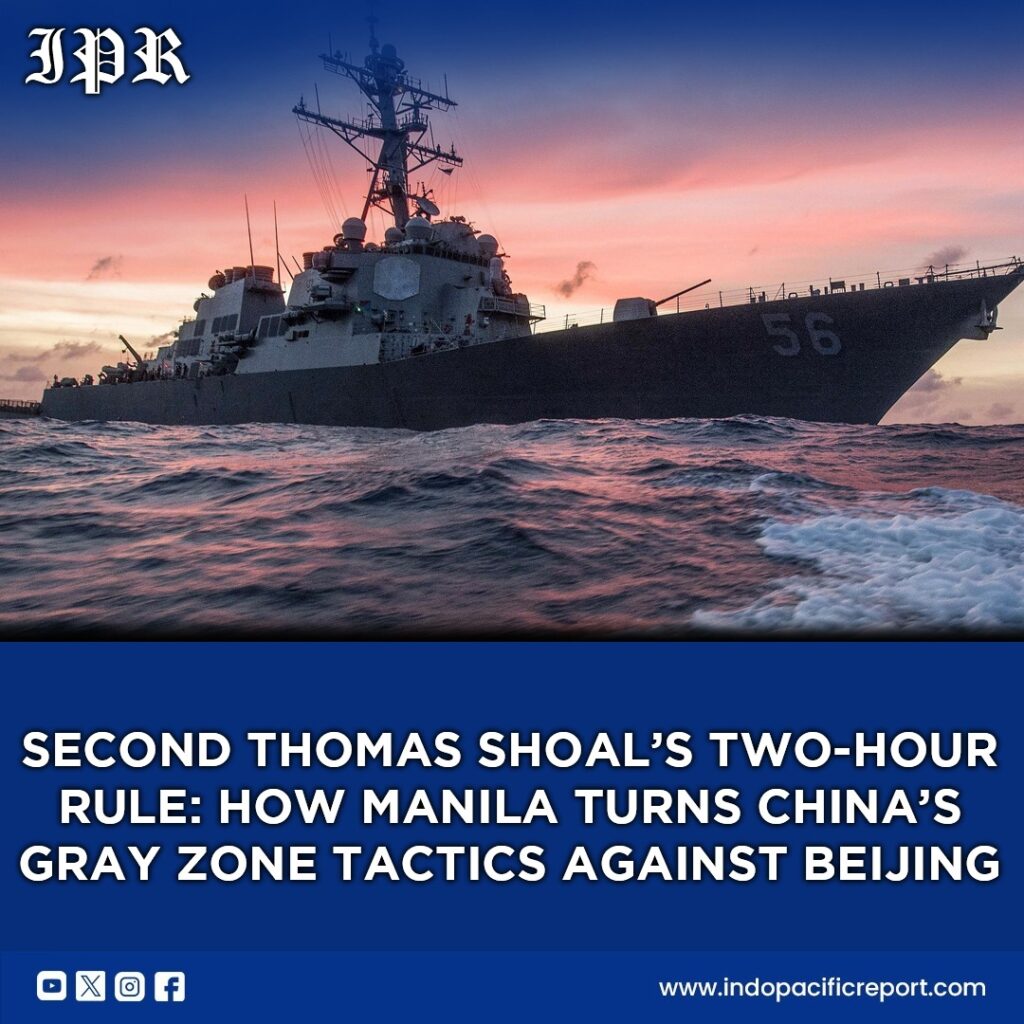
The recent Philippine operational approach at Second Thomas Shoal illustrates a profound evolution in maritime deterrence: the “two-hour rule.” Unlike traditional responses to Chinese gray zone coercion—larger ships, stronger signals, or one-off diplomatic protests—this approach prioritizes timely, verifiable evidence over physical confrontation. The principle is simple: any act of coercion, harassment, or intimidation becomes a strategic liability if documented, validated, and disseminated within two hours. The goal is not to engage kinetic power against Beijing, but to collapse ambiguity, denying China the operational and narrative space that fuels its maritime gray zone strategy.
Viewed through the lens of great-power competition, the two-hour rule is an information-centric adaptation to a modern Chinese strategy. Gray zone tactics are effective precisely because they exploit delays, uncertainty, and fragmented observation. By capturing real-time video, GNSS data, and precise timestamps—and ensuring their rapid distribution—Manila flips the paradigm: instead of China shaping perception, it becomes the actor under scrutiny. The Philippines, with U.S. support, is essentially compressing its OODA (Observe–Orient–Decide–Act) loop, forcing Beijing into a reactive posture where harassment no longer delivers coercive advantage.
From a regional security architecture perspective, this method highlights a layered, alliance-enabled approach to sovereignty enforcement. Philippine-led operations retain legitimacy and leadership, while U.S. forces provide standoff intelligence, surveillance, reconnaissance, and secure communications support. This dual posture allows Manila to operate within its EEZ, reinforce legal claims, and maintain the initiative without triggering direct military confrontation. The U.S.-Philippine Maritime Cooperative Task Force established in 2025 institutionalizes this pattern, linking evidence collection, ISR assets, and diplomatic release protocols in a repeatable, low-escalation framework.
In terms of alliance dynamics, the two-hour rule exemplifies a support-oriented partnership. Allies such as the United States, Japan, Australia, and the United Kingdom amplify Manila’s evidence releases, ensuring credibility and reach without having to place large platforms directly in contested waters. This division of labor strengthens collective deterrence: the Philippines leads on the front line, while allies bolster technical, legal, and informational weight. This model avoids the historical pitfall of escalation-by-presence that often drew criticism or risked inadvertent clashes.
From a maritime strategy and economic security lens, the approach reshapes how territorial claims are defended in resource-rich, contested waters. Rather than relying solely on presence to secure fishing rights or access to EEZ resources, Manila leverages visibility, speed, and narrative control. The rapid documentation of harassment—laser dazzlers, water cannons, ramming—acts as a cost-imposition mechanism on Beijing, transforming every gray zone incident into a diplomatic setback with reputational and coalition consequences. Over time, the expectation of rapid exposure changes behavior, incentivizing restraint while preserving maritime access.
The implications for the Indo-Pacific balance of power are significant. Gray zone strategies have long allowed China to assert control over contested maritime zones without provoking full-scale conflict. The two-hour rule inverts this advantage, demonstrating that timely evidence can be weaponized as effectively as physical force in the domain of coercive diplomacy. As Manila operationalizes this model, regional partners and potential claimants—Vietnam, Malaysia, and Taiwan—gain a blueprint for defending sovereignty using information operations, ISR-enabled partnerships, and disciplined public messaging rather than costly deployments of combat vessels.
Forward-looking assessment: The two-hour rule is not merely a tactical innovation; it represents a new doctrine of informational deterrence. By prioritizing speed, verifiability, and narrative control, Manila and its allies are defining a sustainable method for managing gray zone competition without triggering kinetic escalation. Over the next decade, this approach could reshape norms in contested waters, making coercive maneuvers politically and diplomatically expensive for China while strengthening Philippine operational autonomy and regional alliance coherence. In the Indo-Pacific, control of information—faster than control of sea lanes—may become the most potent tool for managing the rise of gray zone conflict.