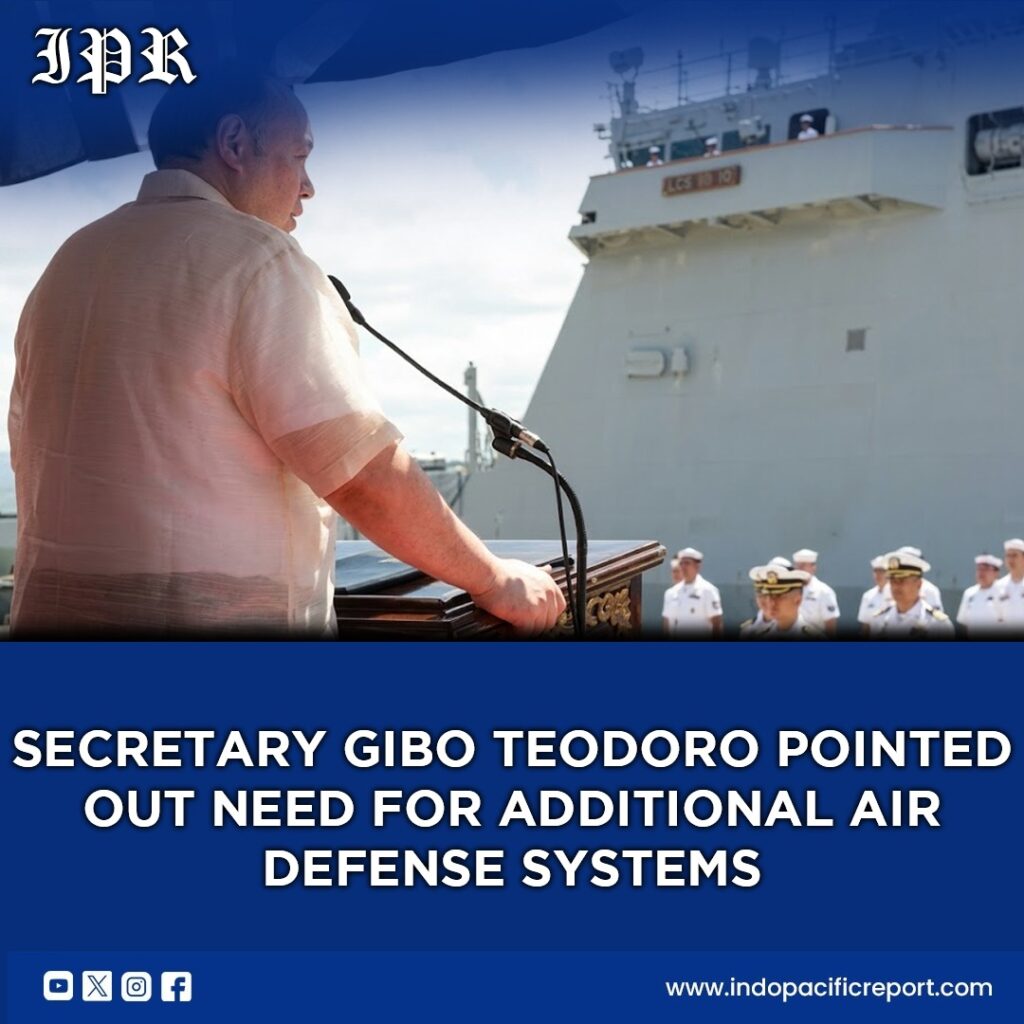
Defense Secretary Gilberto Teodoro Jr. highlighted the urgent need for more air and missile defense systems to strengthen the Philippines’ ability to intercept potential missile threats. The new acquisitions are intended to complement the SPYDER Medium-Range Ground-Based Air Defense System (GBADS) already operated by the Philippine Air Force, as part of the country’s broader military modernization program.
From a great-power competition perspective, the Philippines faces increasing missile capabilities in the region, including advances from China and North Korea. Strengthening air defense is not only about protecting population centers and military installations—it is a deterrent signal to potential aggressors, demonstrating that Manila is investing in credible, layered defensive capabilities.
In terms of regional security architecture, enhanced air defenses integrate with allied intelligence and early warning systems, potentially including U.S. radar networks and ASEAN cooperative frameworks. These systems could improve detection, tracking, and interception of missile threats, reducing vulnerability and increasing resilience against both conventional and asymmetric attacks.
From an alliance dynamics standpoint, the acquisition of additional systems strengthens the Philippines’ credibility as a partner in multilateral defense arrangements. It allows Manila to contribute more effectively to joint air and missile defense exercises with allies like the United States, Japan, and Australia, while reinforcing the U.S.-Philippines Mutual Defense Treaty in a more tangible, capability-driven manner.
Considering maritime and economic strategy, modern air defense extends protection to critical ports, maritime infrastructure, and strategic chokepoints. Given the Philippines’ geostrategic location along the South China Sea, these systems safeguard both territorial integrity and trade routes, ensuring that vital economic lifelines are defended against emerging missile threats.
Implications for Indo-Pacific balance of power: By expanding its air defense, the Philippines is moving toward credible regional deterrence, balancing its role between major powers while reducing the asymmetry in missile capabilities. This approach also signals to neighbors and competitors alike that Manila is investing in defensive depth rather than relying solely on external security guarantees.
Forward-looking assessment: As missile technology continues to proliferate in the Indo-Pacific, the Philippines’ enhanced air defense network will become a critical element in regional deterrence, operational readiness, and alliance interoperability. These systems also allow Manila to engage in joint planning, exercises, and threat response coordination, increasing strategic flexibility.
Audience Question: Will investing in advanced air defense systems truly deter missile threats, or does it risk escalating regional arms competition?