Philippines Secures Iran Transit Deal for Oil Shipments: What It Really Means for Asia
As the Strait of Hormuz remained blocked and fuel stocks dwindled to 45 days, the Philippines made a quiet but historic call to Tehran — and the geopolitical map of the Indo-Pacific shifted.
Published: April 4, 2026 | By IndoPacific Report Editorial Team
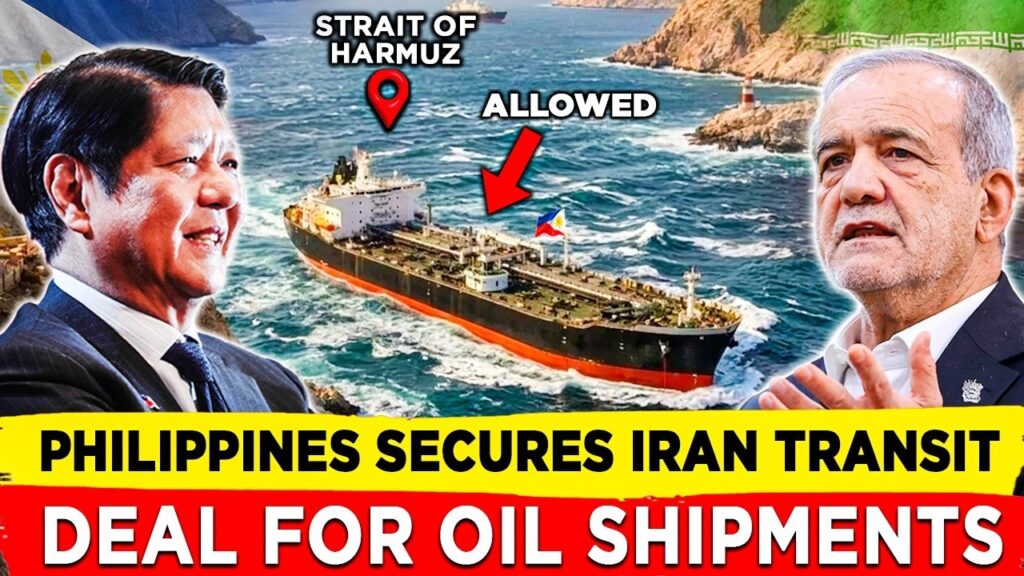
On April 2, 2026, the Philippines quietly made one of the most consequential diplomatic phone calls in its modern history. Philippine Foreign Secretary Theresa Lazaro reached out to Iranian Foreign Minister Seyed Abbas Araghchi — and asked Tehran to recognize the Philippines as a non-hostile state.
Tehran said yes.
That single exchange secured toll-free, safe passage for Philippine-flagged oil tankers through the Strait of Hormuz. It also sent a message that every government from Tokyo to Jakarta is still processing: when survival is on the line, even Washington’s closest allies in Asia will chart their own course.
“The sea does not care about alliances. It only cares about passage.” — IndoPacific Report
Why the Strait of Hormuz Closure Was a Crisis — Not Just a Disruption
To understand what Manila just did, you first need to understand what happened on February 28, 2026.
Following joint US-Israeli military strikes on Iran — which included the death of Supreme Leader Ali Khamenei — Iran’s Islamic Revolutionary Guard Corps (IRGC) effectively halted shipping traffic through the Strait of Hormuz. The closure was swift, severe, and global in impact.
The numbers were staggering. Brent crude surged past $100 per barrel on March 8 for the first time in four years, peaking at $126 per barrel. Maritime analysts described it as the largest disruption to the global energy supply since the 1970s oil crisis. And it was not just oil — up to 30% of internationally traded fertilizers transit this 34-kilometer chokepoint, threatening food supply chains across Asia.
The Philippines’ 45-Day Countdown
For the Philippines, the crisis was existential. The country imports 98% of its crude oil from the Middle East, and when the strait closed, Energy Secretary Sharon Garin delivered a stark warning: the Philippines had roughly 45 days of fuel supplies remaining.
On March 24, 2026, President Ferdinand Marcos Jr. formally declared a national energy emergency — a first in the country’s history — to address the cascading impact on transportation, employment, and the broader economy.
https://indopacificreport.com/iran-war-what-has-the-u-s-lost-in-30-days/
45 days. That is not a policy challenge. That is a survival countdown.
Iran’s Permitted Nations List — and What It Reveals About Power in Asia
Iran did not simply close the Strait. It reinvented itself as a gatekeeper — and in doing so, began redrawing the diplomatic map of the Indo-Pacific.
On March 26, 2026, Iranian Foreign Minister Araghchi announced that ships from China, Russia, India, Iraq, and Pakistan would be permitted to transit. Malaysia, Thailand, and Bangladesh were subsequently added. According to maritime tracking platform Kpler, commodities shipping through the Strait fell by 95% between March 1 and March 26.
Study that list carefully. It is not an ideological roster. It is a list of nations Tehran judged to be neutral, non-threatening, or strategically useful. It drew a hard line across Asia: those who benefit from American security guarantees — and those who can actually move oil.
The Philippines looked at that list, understood what was at stake, and made a decision.
The Philippines-Iran Deal: What Was Agreed and Why It Matters
Under President Marcos’s direct directive, Philippine officials engaged Tehran in diplomatic talks that resulted in a formal agreement. Foreign Secretary Lazaro’s discussions with Minister Araghchi produced the following outcome:
Philippine-flagged ships secured safe, toll-free passage through the Strait of Hormuz.
Tehran’s assurances covered both oil and fertilizer deliveries — critical for food security.
The deal may also expedite the repatriation of over 20,000 Filipino seafarers stranded in the region.
The Human Cost: 20,000 Seafarers Forgotten by the Headlines
The Philippines is the world’s largest exporter of maritime labor. Its sailors crew tankers, container ships, and bulk carriers across every major sea lane on earth. When the Strait of Hormuz closed, more than 20,000 Filipino seafarers were stranded — caught in a conflict they had no hand in starting, in waters they had no power to reopen.
When Secretary Lazaro picked up the phone and called Tehran, she was not just negotiating oil prices. She was trying to bring those men and women home. For President Marcos, this was not abstract foreign policy — it was a domestic political crisis with a human face.
The Uncomfortable Question: What Can the US Alliance Actually Guarantee?
The Philippines is not alone in making this calculation. Japan and South Korea — America’s other two primary treaty allies in Asia — were also separately approaching Tehran for safe passage guarantees in the weeks before Manila’s deal. Three of the US’s most critical allies in Asia, within weeks of each other, were each negotiating independently with Iran because Washington’s military campaign to reopen the Strait had yet to restore normal shipping.
This exposes a structural contradiction at the heart of the US security architecture in Asia: Washington asks its allies to accept political and military risk on its behalf, but cannot always deliver the economic security that makes those risks bearable. The US-Philippines Mutual Defense Treaty was designed to deter military aggression. It was never designed to guarantee fuel delivery through a waterway where the US itself is a belligerent.
American alliances guarantee certain things — and not others. Manila has now learned the difference firsthand.
Officials in Manila have been careful in their language, describing the Iran outreach as “a pragmatic, independent foreign policy to protect Filipino lives.” But that framing is itself a diplomatic signal. It tells Washington that the alliance has limits — and that Manila knows exactly where they are.
What This Means for the Indo-Pacific Going Forward
The Philippines’ deal with Iran will not end its alliance with the United States. American bases remain. Joint patrols in the South China Sea continue. The existential challenge from Beijing’s territorial claims remains the defining strategic concern of Manila’s long-term foreign policy — and on that front, Washington’s deterrence remains indispensable.
But something has shifted that will not easily shift back.
Every government in Southeast Asia watched Manila pick up that phone. Every foreign minister from Kuala Lumpur to Jakarta noted that the first country to declare a national energy emergency was a US treaty ally — and that it solved its problem not through Washington, but around it.
The lesson being absorbed across the Indo-Pacific is not that America is weak. It is something more nuanced and more durable: that the value of any security alliance is defined not by its promises, but by what it can actually deliver in a crisis.
Asia runs on oil. It runs on fertilizer. It runs on sea lanes that connect it to the Persian Gulf. Any alliance that cannot guarantee the safety of those supply chains will find its partners conducting their own quiet diplomacy — however inconvenient that may be.

Conclusion: Geography Had the Final Word
History will record that on April 2, 2026, the Philippines — a nation that stood with the United States through Leyte Gulf, the Cold War, and the South China Sea confrontations with Beijing — called the Islamic Republic of Iran and asked not to be treated as an enemy.
That is not a failure of Philippine loyalty. It is a precise measurement of where American power actually ends — and where Philippine survival begins.
The Strait of Hormuz is 34 kilometers wide. The strategic distance it has opened between Washington and its Asian allies may prove far harder to close.
Stay Informed — Follow IndoPacific Report
For in-depth analysis of geopolitics, energy security, and strategic affairs across the Indo-Pacific, follow us on all platforms:
IndoPacific Report — Website — Your source for independent analysis on Indo-Pacific affairs.
IndoPacific Report on Facebook — Daily updates, breaking news, and commentary.
IndoPacific Report on YouTube — Video essays, expert interviews, and strategic briefings.
https://youtu.be/Ec8JXipiCNI?si=a9PAU_WjeQ0KzkmV