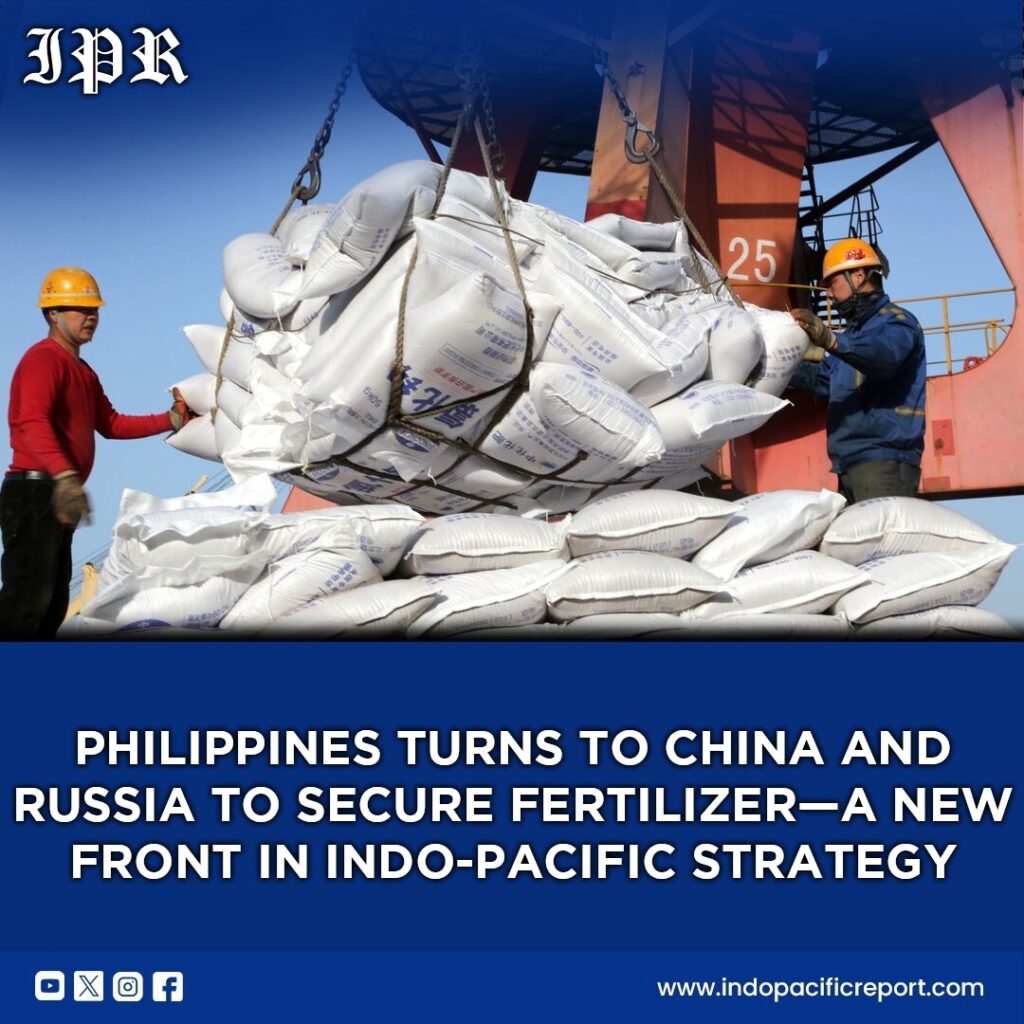
The Philippines’ recent diplomatic outreach to China and Russia for fertilizer supplies highlights a growing intersection of agriculture, economic security, and geopolitics in the Indo-Pacific. Agriculture Secretary Francisco Tiu Laurel Jr. confirmed discussions with Beijing, where Chinese officials assured Manila that exports would continue despite global supply shocks. With domestic stocks expected to last through May, the Philippines is acting proactively to hedge against disruptions caused by the ongoing Middle East conflict, which has kept global fertilizer prices elevated.
From a great-power competition lens, these negotiations underscore China and Russia’s expanding influence in Southeast Asia through economic leverage. Fertilizer, while a civilian commodity, has strategic implications: it underpins food security, rural stability, and domestic political legitimacy. By controlling or guaranteeing supply, Beijing and Moscow can project soft power while increasing Manila’s dependence on their export policies, subtly shifting the balance of influence in the region.
In terms of regional security architecture, the Philippines’ move illustrates that supply chains and economic resilience are now critical components of national security. Traditionally, military alliances like the US-Philippines Mutual Defense Treaty dominated discourse, but strategic vulnerabilities now extend to food, energy, and industrial inputs. Manila’s outreach is effectively part of a broader security calculus, seeking diversification to avoid single points of failure in essential commodities.
Looking at alliance dynamics, these efforts could recalibrate Manila’s relationship with Washington. While the US remains a security guarantor, it has limited control over global fertilizer markets. The Philippines’ engagement with Beijing and Moscow signals a pragmatic, multi-vector approach: balancing defense reliance on the US with economic hedging against regional and global shocks. Such dual-track diplomacy may become a model for other Southeast Asian states navigating between great powers.
From a maritime and economic strategy perspective, fertilizer supply chains rely on secure maritime transport routes, particularly through the South China Sea and key transshipment hubs. Any disruption in these sea lanes, whether due to conflict or coercion, directly threatens Manila’s agricultural output. Ensuring steady imports from China and Russia not only secures domestic food production but also reduces vulnerability to broader maritime pressure, reinforcing the interconnectedness of economic and maritime security in the Indo-Pacific.
The implications for Indo-Pacific balance of power are subtle but significant. By securing supplies from multiple major powers, the Philippines strengthens its resilience against coercion, reducing the likelihood that economic pressure could be leveraged in political or territorial disputes. Simultaneously, China and Russia gain strategic leverage, using critical goods as instruments of influence. This interplay demonstrates how non-military assets—like fertilizers—can act as soft-power levers in a region defined by contested maritime claims, alliance networks, and great-power rivalry.
Forward-looking assessment: Manila’s actions suggest a shift toward broader strategic hedging in Southeast Asia, where economic, food, and energy security increasingly intersect with geopolitical calculations. The Philippines’ efforts to secure essential fertilizer supplies signal a new type of strategic diplomacy, where economic resilience underpins national security. Over time, similar approaches may become the norm across the region, requiring both regional powers and external actors to account for non-military levers in Indo-Pacific power competition.
Debate Question: Should Southeast Asian countries rely on China and Russia for critical supplies, or prioritize self-sufficiency and alternative partners to avoid strategic dependence?