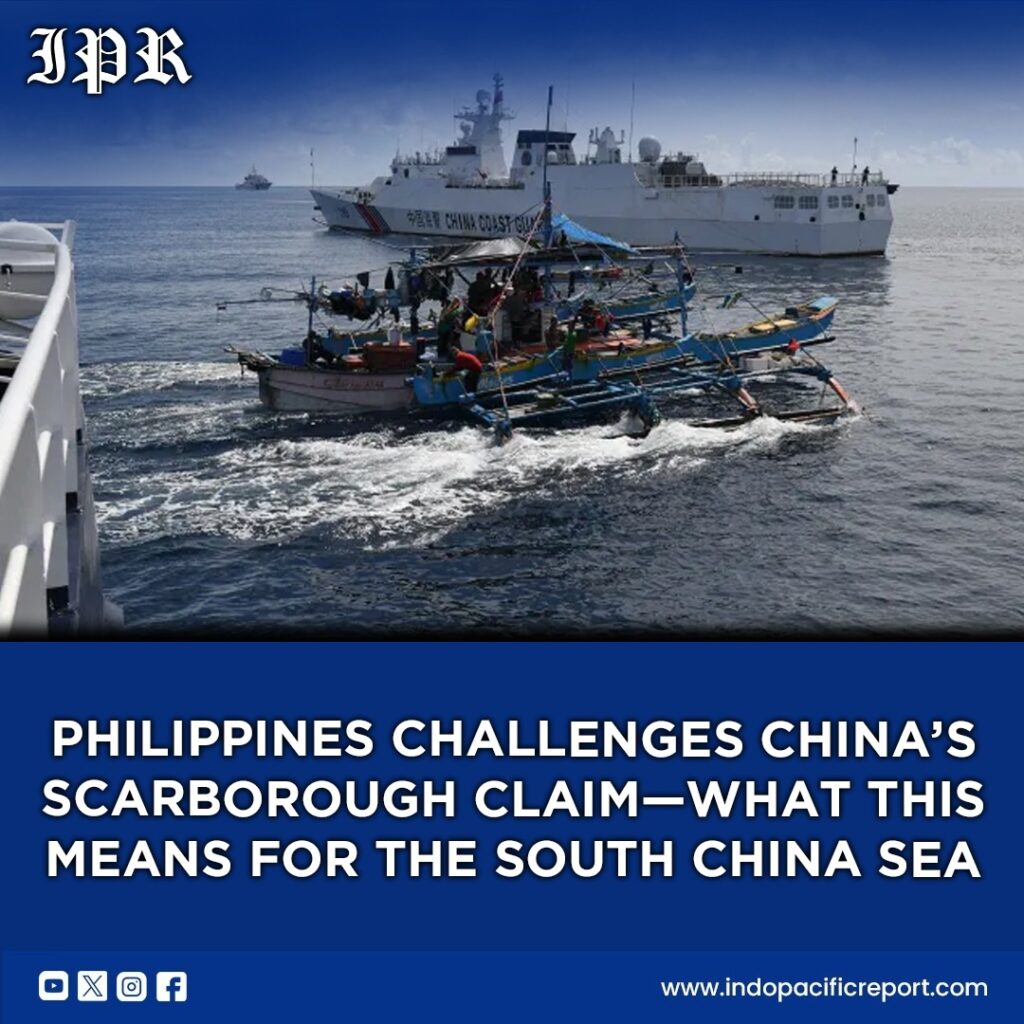
The Philippines has formally rejected a 1990 diplomatic letter recently circulated by China that suggests Scarborough Shoal lies outside Philippine sovereignty. Manila questions the authenticity of the letter and emphasizes that territorial claims are determined by national law and international law, not by social media posts or unilateral statements. By reaffirming its control over Scarborough and the Spratly Islands, the Philippines signals it will maintain active, legal, and physical presence in the disputed waters.
From a great-power competition perspective, China’s attempt to use historical documents is a classic example of strategic narrative shaping. Beijing is leveraging selective archival evidence to create doubt over Manila’s claims, hoping to weaken Philippine domestic and international support. For regional observers and U.S. allies, this shows how China combines legal ambiguity, historical claims, and media narratives to press its maritime ambitions without triggering direct military conflict.
This episode also highlights gaps in the regional security architecture. Southeast Asian states face a challenge when legal rulings and physical control diverge. Scarborough lies 222 km off the Philippine coast, within Manila’s EEZ, yet has been under Chinese control since 2012. The Philippines’ insistence on rules-based claims backed by history and law is a strategic attempt to assert authority while maintaining legitimacy in the eyes of ASEAN neighbors and the international community.
The situation underscores the importance of alliance dynamics. By publicly rejecting Beijing’s claim, the Philippines reinforces its credibility as a partner in the U.S.-led regional security framework. Strong diplomatic and operational support from Washington strengthens Manila’s deterrence posture, signaling to China and other claimants that the Philippines has backing in disputes over strategic maritime zones.
The stakes are also economic and maritime. Scarborough is near major shipping lanes and rich fishing grounds. Control over this area affects not only the Philippines but the broader Indo-Pacific trade network. Manila’s approach—legal argumentation, active presence, and alliance coordination—helps protect freedom of navigation, fishing rights, and maritime resource security, which are critical for regional stability and economic resilience.
Looking ahead, the Scarborough dispute shows that in the Indo-Pacific, narrative, law, and presence matter as much as military strength. Manila’s legal and diplomatic efforts reinforce its territorial claims, but the Philippines must maintain active patrols and regional support to deter coercion. How Manila handles Scarborough will shape ASEAN cohesion, U.S.-Philippine cooperation, and the broader balance of power in the South China Sea.
Audience Question:
If Manila continues to reject China’s claims, should ASEAN countries coordinate patrols to enforce international law, or rely primarily on U.S. military backing?