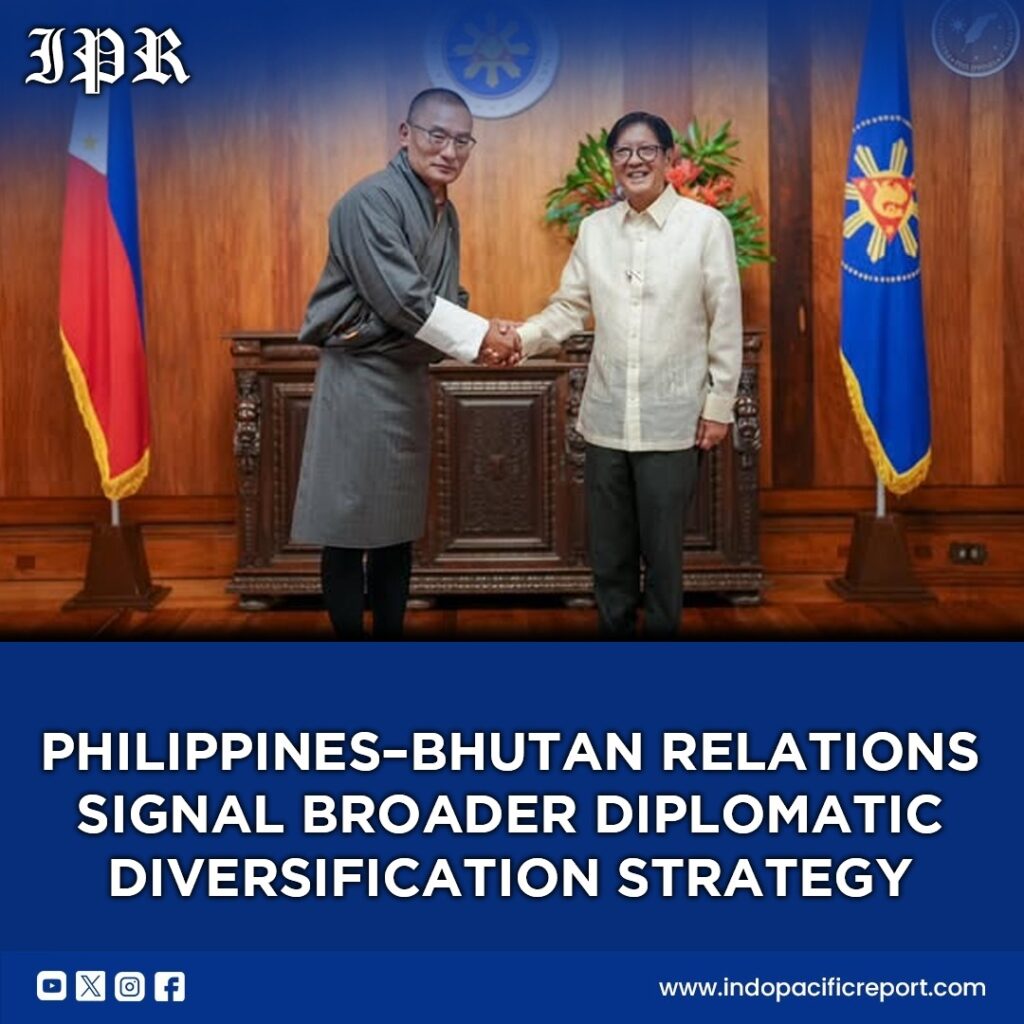
The courtesy call of Bhutan’s Prime Minister Tshering Tobgay on President Ferdinand “Bongbong” Marcos Jr. at Malacañang on March 19, 2026 may look like a routine diplomatic event. But in geopolitical terms, it reflects a quiet but important trend: the Philippines is slowly widening its diplomatic network beyond its immediate security and maritime focus. This visit is the first by a Bhutanese leader since the two countries formally established diplomatic relations on October 6, 2025. Even small diplomatic moves like this matter in a region shaped by great-power rivalry and shifting alignments.
From a great-power competition perspective, this engagement is less about Bhutan’s material power and more about geography and positioning. Bhutan sits in a sensitive Himalayan space between India and China, two major Asian powers with long-standing strategic competition. While Bhutan is not part of Indo-Pacific maritime disputes, its foreign policy environment is influenced by this larger rivalry. For the Philippines, engaging Bhutan is not about military alignment. It is about diplomatic expansion. Manila is building relationships beyond its immediate security partners to avoid over-dependence and to increase its diplomatic flexibility in a highly competitive regional order.
At the level of regional security architecture, this development shows that Indo-Pacific geopolitics is not only about navies and sea lanes. The system is broader and includes continental Asia, small states, and cross-regional diplomatic ties. Much of the current security debate focuses on maritime flashpoints like the South China Sea. But behind that visible layer is a quieter process of diplomatic network-building across Asia. The Philippines–Bhutan engagement is part of this wider pattern. It reflects how states are expanding their diplomatic reach into areas that are not directly linked to military competition but still contribute to overall strategic connectivity.
In terms of alliance dynamics, this relationship does not change formal security structures. The Philippines remains firmly anchored in its alliance with the United States and continues to deepen operational cooperation with partners like Japan and Australia. However, engagements with smaller and less strategically aligned states like Bhutan add another layer to Manila’s foreign policy. This is often called “multi-vector diplomacy.” It allows the Philippines to maintain strong security alliances while also building relationships outside formal alliance blocs. This reduces diplomatic isolation and increases flexibility in an increasingly polarized Indo-Pacific.
From an economic and strategic perspective, the Philippines–Bhutan relationship is still at an early stage, but it carries long-term potential. Bhutan focuses on sustainable development, hydropower, and niche economic sectors, while the Philippines has a large, labor-driven economy with growing regional ambitions. At this stage, cooperation is symbolic, but over time it could expand into areas like education, tourism, and development partnerships. In a region where economic resilience is increasingly tied to strategic stability, even small bilateral ties contribute to broader diplomatic diversification.
At the level of Indo-Pacific balance of power, this engagement reflects a deeper structural trend. The region is no longer defined only by military alliances and maritime competition. It is also shaped by a growing web of small and medium diplomatic relationships that create flexible influence networks. The Philippines is not shifting its core alliances, but it is building additional diplomatic pathways. This helps it operate in a complex environment where competition and cooperation coexist at different levels of intensity.
Looking ahead, the key question is how far this diplomatic diversification strategy can go. Can small relationships like Philippines–Bhutan meaningfully strengthen strategic resilience, or are they mostly symbolic additions to a system still dominated by major power rivalry?
Do small diplomatic partnerships like this actually strengthen a country’s strategic position, or are they mostly symbolic in a great-power-driven Indo-Pacific?