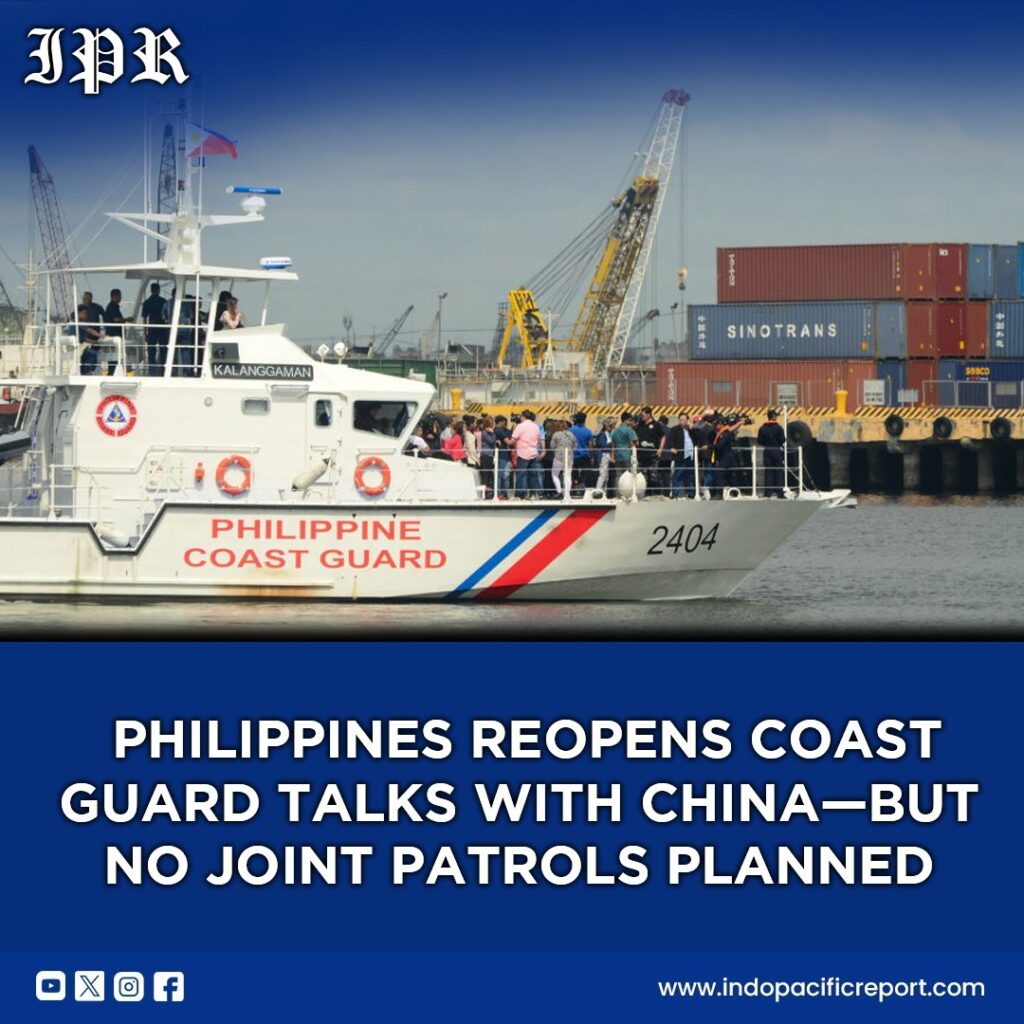
The Philippines’ recent clarification that proposed updates to its 2016 coast guard memorandum of understanding (MOU) with China do not include joint patrols or sensitive operational coordination highlights a careful balancing act in the South China Sea. While Manila seeks to maintain open communication channels with Beijing, it remains committed to defending its maritime claims and upholding international law. The discussions aim to revive the Joint Coast Guard Committee as a formal platform for dialogue—focused on incident management and miscalculation prevention, not collaborative enforcement or co-patrols.
From a great-power competition perspective, the move illustrates Manila’s effort to manage rising tensions between the U.S. and China in the Indo-Pacific. By maintaining a limited, non-operational engagement with Beijing, the Philippines signals that it can interact diplomatically without compromising its sovereignty or strategic partnerships. The approach reduces the risk of incidents escalating while simultaneously sending a subtle message to regional observers: Manila is pragmatic, not passive.
The development also reflects broader regional security architecture dynamics. ASEAN and bilateral mechanisms remain the primary channels for crisis management, yet their effectiveness relies on the willingness of stronger powers to adhere to agreed frameworks. By focusing on a joint committee rather than operational patrols, the Philippines is leveraging institutional communication to prevent escalation while avoiding unilateral concessions. This underscores how smaller states navigate asymmetric power relationships: engagement without entanglement.
Alliance dynamics play a complementary role. Manila continues to rely on its security partnerships with the United States and Japan to provide credible deterrence against coercion. By explicitly excluding joint patrols with China, the Philippines reinforces the value of its alliances while retaining diplomatic flexibility. The strategy signals that Manila’s engagement with Beijing is tactical, not strategic, and that operational security remains anchored in partnerships with established powers.
From a maritime strategy and economic perspective, this measured approach reduces risk to vital sea lanes and fisheries in the West Philippine Sea. Open communication channels between coast guards can help prevent miscalculations or accidents near disputed features, protecting both commercial activity and local livelihoods. Manila’s approach demonstrates that operational restraint and dialogue can coexist with assertive sovereignty enforcement—a critical lesson for maritime risk management in contested waters.
The implications for the Indo-Pacific balance of power are subtle but important. While no immediate shift in territorial control occurs, Manila’s approach reinforces the concept that smaller states can manage escalation through careful diplomacy. It also highlights the limits of Chinese influence: engagement does not equate to operational dominance. For the U.S. and regional partners, the Philippines’ strategy provides a model for maintaining open channels with rivals without weakening alliances or legal claims.
Looking forward, Manila’s handling of the coast guard MOU illustrates a nuanced model of maritime statecraft. Engagement and vigilance are complementary: communication channels can prevent crises, but sovereignty and operational readiness remain intact. The strategy demonstrates how middle powers in the Indo-Pacific can navigate rising tensions, preserve autonomy, and avoid miscalculations in a high-stakes maritime environment.
Can Manila’s limited engagement with China prevent accidents in the West Philippine Sea, or does it risk giving Beijing a diplomatic advantage?