Thousands of Filipinos came to streets on Sunday in what has become one of the country’s largest protests in recent years, rallying against a massive corruption scandal that has rocked the government. The controversy centers on more than ₱545 billion in public funds earmarked for flood-control projects—many of which were allegedly substandard or never built at all.
At Manila’s Rizal Park and along the city’s main highway, protesters waved flags and held banners reading “No more, too much, jail them,” demanding accountability from both lawmakers and contractors accused of pocketing kickbacks. Police deployed nearly 8,000 officers to maintain order, while foreign embassies, including those of the US and Australia, warned their citizens to avoid the demonstrations.
The scandal gained momentum in July when President Ferdinand Marcos Jr. acknowledged the “horrible” scale of the corruption in his annual address, promising an independent investigation led by a former Supreme Court justice. Outrage reached new heights this month when construction magnates Sarah and Pacifico Discaya testified on live television that they had been forced to pay kickbacks of up to 25% of contract values. The couple displayed dozens of imported luxury cars—including a British vehicle worth ₱42 million —a move that only deepened public anger.
The accusations implicated 17 members of the House of Representatives, two senators, and several public works officials. Although all have denied wrongdoing, the fallout has been swift. Senate President Francis Escudero and House Speaker Martin Romualdez resigned, while engineers tied to the scheme have been dismissed and had their assets frozen.
Church leaders and civic groups urged calm. Cardinal Pablo Virgilio David, head of the Catholic Bishops Conference, reminded demonstrators that “our purpose is not to destabilise, but to strengthen our democracy.” Protest organizers dubbed the rally the “Trillion Peso March”, deliberately holding it on 21 September, the anniversary of martial law declared by Marcos Jr.’s father in 1972. They stressed that the movement seeks transparency and reform—not the president’s resignation.
The scandal has also rattled institutions. The UN Human Rights Office warned that the misuse of disaster-protection funds could worsen poverty and inequality in one of Asia’s most climate-vulnerable nations. Meanwhile, the central bank tightened rules on large cash withdrawals to stem money laundering after regulators flagged suspicious transactions linked to the case.
For ordinary citizens, however, the outrage is deeply personal. Althea Trinidad, a university student who joined the march, captured the mood: “I feel bad that we wallow in poverty while they rake in a fortune from our taxes. We lose our homes, our lives, and our future while they drive luxury cars.”
Thousands of Filipinos have taken to the streets in the “Trillion Peso March,” one of the largest protests in years, triggered by revelations that more than ₱545 billion in public funds for flood-control projects were siphoned off or misused. The scandal implicated lawmakers, contractors, and senior officials, forcing resignations of Senate President Francis Escudero and House Speaker Martin Romualdez. With nearly ₱118.5 billion ($2.1 billion) lost between 2023–2025, the scale of graft has rattled the economy, politics, and society at large. But beyond the outrage lies a critical question: does this turmoil weaken the Philippines’ military readiness in the West Philippine Sea?
Domestic Corruption as a Strategic Weakness
Corruption scandals in the Philippines have always raised alarm, but the latest revelations cut much deeper because they show how systemic graft directly weakens the country’s ability to defend itself. Finance Secretary Ralph Recto admitted that up to 70% of government funds for flood-control projects vanish through corruption—amounting to ₱42.3 to ₱118.5 billion between 2023 and 2025. These aren’t small leaks; they represent billions of pesos that could instead be used to buy fighter jets, build naval bases, or strengthen coastal defenses against Chinese aggression. As Recto bluntly put it, “There are ghost projects and poor-quality projects, and the people end up losing because government funds, which come from citizens’ taxes, are being wasted.”
This financial drain comes at a time when the Armed Forces of the Philippines (AFP) is scrambling to modernize. In the 2025 budget, the AFP modernization program was allotted ₱35 billion in guaranteed funding—but another ₱40 billion was classified as “unprogrammed,” meaning it will only be released if the government finds excess revenues. Lawmakers have already raised concerns that this uncertainty makes it nearly impossible for defense planners to execute projects on schedule. Even though the proposed 2026 defense budget rises to ₱430.87 billion—a 14% increase—competition with social services, infrastructure, and disaster recovery ensures that defense funding remains fragile.
Meanwhile, the AFP is moving forward with key acquisitions, such as the delivery of BrahMos supersonic missiles from India under a ₱19.8 billion deal signed in 2022. These systems, with a range of around 290 kilometers, are considered crucial for deterring Chinese incursions in the West Philippine Sea. Defense Secretary Gilberto Teodoro has emphasized that proper deployment and integration of these systems require stable funding and political commitment, not just one-off purchases.
The larger implication is clear: when tens of billions vanish into corruption, the Philippines isn’t just losing money—it’s losing time, credibility, and deterrence. The AFP can’t modernize effectively if its budget is riddled with uncertainty, and even advanced weapons like the BrahMos risk becoming underutilized without reliable logistics and long-term planning. In short, corruption doesn’t just weaken domestic governance; it directly erodes Manila’s ability to stand firm against Beijing in the South China Sea.
Why Now? The Collision of Protest and Geopolitics
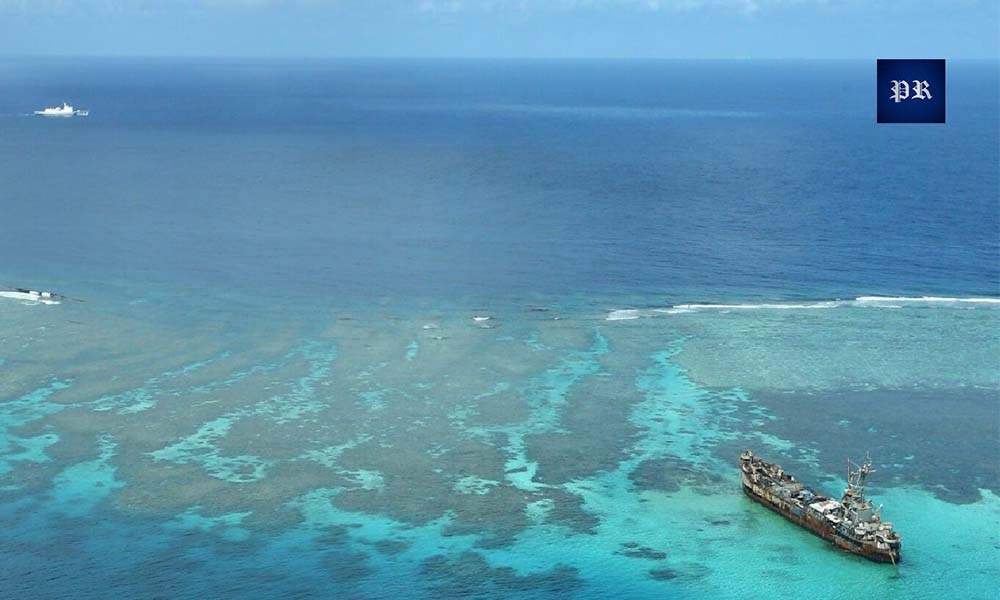
The timing of the “Trillion Peso March” marks a sharp collision between a massive domestic corruption scandal and mounting pressure from China in the West Philippine Sea. In the weeks leading up to the protest, maritime tensions hit new heights. On September 16, 2025, a Filipino fisheries vessel, the BRP Datu Gumbay Piang, was pummeled by high-powered water cannons from two Chinese coast guard ships near Scarborough Shoal, leaving it badly damaged and injuring a crew member. The Philippine Coast Guard condemned the act as “illegal, coercive, aggressive, and deceptive,” while Manila revealed it had already filed 21 diplomatic protests against Beijing in just the first quarter of 2025.
China, meanwhile, has been making symbolic moves to cement its claims. Days before the collision, Beijing announced that it was designating part of Scarborough Shoal as a “national nature reserve”—a declaration that drew immediate condemnation from Manila and its allies, including the US, UK, and Australia. To heighten the pressure, China also issued radio notices warning of upcoming “live-fire exercises” in the shoal’s vicinity, sparking fear and uncertainty among Filipino fishermen. In response, the Philippines has pushed forward with increased patrols and joint exercises with partners like the US and India, with defense officials stressing that the armed forces remain non-partisan and cannot afford distractions “at such a critical time for national security.”
Against this backdrop of external pressure, the Philippines has been shaken by one of its largest-ever corruption scandals. Over ₱545 billion in funds meant for flood-control projects were either siphoned off or wasted on substandard works, a figure confirmed by President Marcos Jr. himself in his State of the Nation Address. The fallout has already forced high-profile resignations, including Senate President Francis Escudero and House Speaker Martin Romualdez. The sheer scale of the scandal has inflamed public anger, fueling the massive protests in Manila.
President Marcos Jr. has tried to strike a careful tone. He acknowledged the public’s outrage, even saying, “If I wasn’t president, I might be out in the streets with them.” By encouraging protesters to “demand accountability” while urging them to remain peaceful, Marcos has lent some legitimacy to the demonstrations—but his remarks also expose the political fragility of his administration.
Public sentiment shows just how combustible the mix of corruption and external pressure has become. A recent political stability index by Asia News Network rated the Philippines at “medium risk,” noting that countries facing corruption, civic unrest, and external threats often find these pressures reinforcing one another. The symbolism of the protest’s timing—September 21, the anniversary of Marcos Sr.’s martial law declaration—was not lost on demonstrators. Chants and banners tied the “theft” of public funds directly to everyday suffering, with one slogan capturing the anger: “Their luxury, our misery.
1 Philippine Navy Vessel Against 22 Chinese Ships at Scarborough Shoal
The Repercussions: Military Focus Under Strain
The fallout from the Philippines’ ₱545 billion corruption scandal is rippling through politics, the economy, and national security, raising concerns that domestic instability could weaken Manila’s hand against Chinese aggression in the West Philippine Sea.
Politically, the scandal has already claimed major figures. On September 19, 2025, Senate President Francis Escudero and House Speaker Martin Romualdez—President Marcos Jr.’s cousin—resigned from their posts. Romualdez’s departure was widely interpreted as an attempt to shield the presidency and ease public anger. Analysts warn that the crisis risks spiraling into a constitutional standoff. Political scientist Richard Heydarian observed that the scandal handed rival dynasties an “opportunity to undermine the Administration,” while Marcos himself admitted, “If I weren’t president, I might be out in the streets with them.” His candid acknowledgment gives legitimacy to protesters but also underscores the pressure on his leadership.
The economic impact has been immediate. Investor jitters dragged the Philippine Stock Exchange Index down 2.17% on September 16, 2025, with analysts citing “political noise” from the scandal. The peso also slipped, closing at ₱57.06 per dollar on September 18, its weakest level in weeks. Regulators reported that nearly $800 million fled the country in a single week, forcing the central bank to tighten rules on large cash withdrawals amid fears of money laundering. Finance Secretary Ralph Recto revealed that between 2023 and 2025, as much as ₱42.3 billion to ₱118.5 billion—roughly $2 billion—vanished from flood-control budgets due to corruption. Critics now worry that these losses will squeeze government resources and delay ambitious defense modernization plans, even as the country faces the twin challenges of natural disasters and maritime insecurity.
Operationally, the timing could not be worse. Beijing has ramped up its “gray-zone” tactics, including the September 16 water cannon attack on the BRP Datu Gumbay Piang near Scarborough Shoal and its unilateral declaration of the shoal as a “national nature reserve.” Security analysts argue that China is betting on a politically distracted Manila being unable to respond decisively. The Armed Forces of the Philippines, however, has pushed back against attempts to drag it into politics. In a joint statement, defense and military chiefs reaffirmed that the AFP remains “non-partisan and professional” and warned that any effort to divert the military’s focus at such a critical time is “futile.”
Allies are also watching closely. The United States, Japan, and other partners have stopped short of criticizing Manila’s domestic troubles, but their statements stress the need for stability. A recent US-Japan-Philippines trilateral declaration highlighted “deepening” strategic coordination, signaling that Washington and Tokyo are counting on Manila to remain a reliable partner. Behind the scenes, concern is growing. A senior Japanese diplomat, speaking privately, noted that “the rule of law” must be upheld if the Philippines is to be a “truly strategic and enduring” ally. Such remarks reflect quiet unease that unrest in Manila could undermine implementation of key agreements, such as the Enhanced Defense Cooperation Agreement (EDCA) with the US.
Taken together, the scandal has exposed how deeply corruption, political instability, and external threats intersect in the Philippines. Unless the government swiftly restores trust, domestic unrest could sap the country’s credibility abroad and leave it dangerously vulnerable in the West Philippine Sea.
Philippines on HIGH ALERT as 3 Chinese Warships Enter Disputed Waters
Conclusion: A Divided Nation Facing an External Test
The Philippines today is caught between internal disunity and external pressure. The Trillion Peso March reflects a society demanding accountability, but the timing is critical: while Filipinos march in Manila, Chinese vessels tighten their grip in the West Philippine Sea. The danger is not that protests themselves topple the government, but that they sap focus, legitimacy, and resources from national defense when unity is most needed. Unless reforms quickly restore confidence in leadership and spending, political unrest may prove China’s most effective weapon—not missiles or warships, but the Philippines’ own internal weakness.