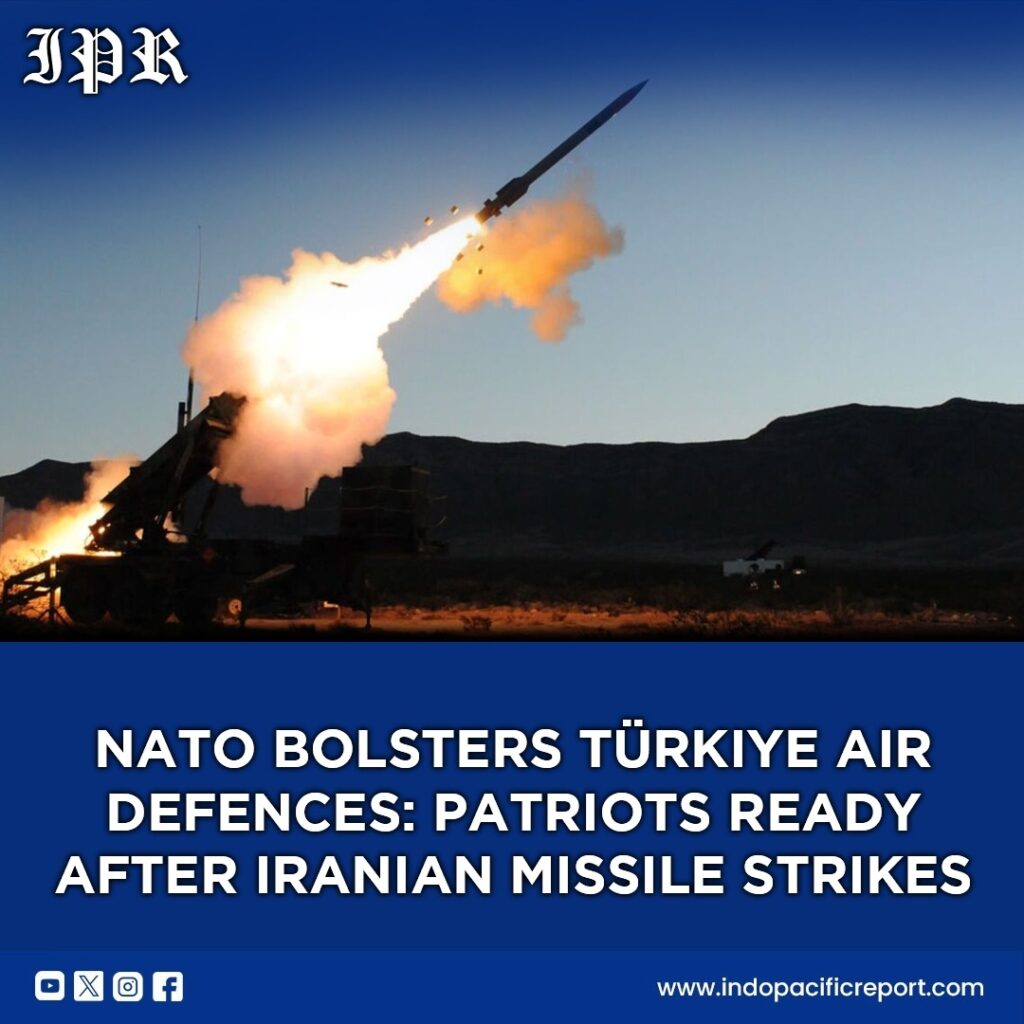
NATO has deployed a new Patriot missile battery at Incirlik Air Base in southern Türkiye, following the interception of a third ballistic missile launched from Iran in Turkish airspace. This latest deployment complements the existing Spanish Patriot system and comes amid heightened regional tensions stemming from the ongoing Middle East conflict. While details on the operating nation for the new PAC-3 system remain undisclosed, the move signals NATO’s commitment to forward-deployed missile defence and the protection of critical assets in Turkey, including early-warning radar sites like Kurecik Air Base.
From a great-power competition perspective, the deployment highlights NATO’s operational posture in a region where Iranian missile capabilities are increasingly sophisticated. By positioning high-end air defence systems close to potential launch zones, NATO demonstrates both deterrence and rapid reaction capacity. For Tehran, these deployments impose operational constraints on missile trajectories and risk assessments, complicating its regional escalation calculus. The action also reinforces NATO’s credibility vis-à-vis Russia and China, who are closely monitoring alliance responses to ballistic missile threats outside Europe.
Within the framework of regional security architecture, Türkiye continues to act as a critical buffer state. Its geographic proximity to the Middle East makes it both vulnerable to spillover from conflicts and essential to NATO’s extended deterrence strategy. The addition of a second Patriot battery creates overlapping coverage with Malatya’s earlier deployment, ensuring layered defence for both Turkish population centers and key military infrastructure. The operational integration of PAC-2 and PAC-3 systems enables simultaneous coverage against low-flying cruise missiles, tactical ballistic missiles, and manned aircraft, demonstrating NATO’s multi-tiered air defence strategy.
The move also reflects alliance dynamics. Türkiye, often balancing between NATO obligations and regional ties, now benefits from a reinforced protective umbrella, which may influence Ankara’s diplomatic calculations vis-à-vis Iran and other Middle Eastern actors. The deployment reinforces NATO interoperability, with multinational crews likely operating the system and coordinating with existing Spanish and US assets. Such integration strengthens collective defence norms while showcasing alliance cohesion at a time when internal divisions have occasionally challenged NATO decision-making.
From a maritime and economic strategy lens, Türkiye’s protection of its southern airspace safeguards vital energy and trade corridors linking the Eastern Mediterranean, the Black Sea, and global markets. Missile threats targeting critical infrastructure or ports could disrupt maritime transit, energy flows, and NATO logistics chains. By deploying layered air defences, NATO not only shields Türkiye’s civilian population but also secures strategic chokepoints with broader implications for regional trade and energy security.
In terms of the Indo-Pacific balance of power, while geographically distant, NATO’s demonstration of rapid missile defence deployment offers strategic lessons for Asia-Pacific states. Regional powers like Japan, South Korea, and Taiwan observe the utility of forward-deployed, mobile air defence systems in deterring missile attacks. The Turkish example reinforces the importance of networked missile defence, interoperability, and forward presence in contested airspace—a model increasingly relevant in the Indo-Pacific given tensions in the Taiwan Strait, the South China Sea, and along the Korean Peninsula.
Forward-looking assessment: NATO’s deployment of a new Patriot battery in Türkiye signals a commitment to dynamic deterrence, collective defence, and rapid crisis response in a volatile region. It strengthens Türkiye’s role as a regional stabilizer, complicates adversary operational planning, and highlights the strategic value of mobile air-defence assets in contested theaters. As missile threats continue to evolve, NATO and regional partners will likely expand layered, interoperable air defence architectures to mitigate risks to both civilian populations and critical infrastructure.
Audience Question: Can forward-deployed missile defence systems truly deter state actors like Iran, or do they merely shift escalation risks elsewhere?
#NATO #TurkeyDefense #PatriotMissile #IranThreat #MissileDefense #RegionalSecurity #IndoPacificLessons #GreatPowerCompetition