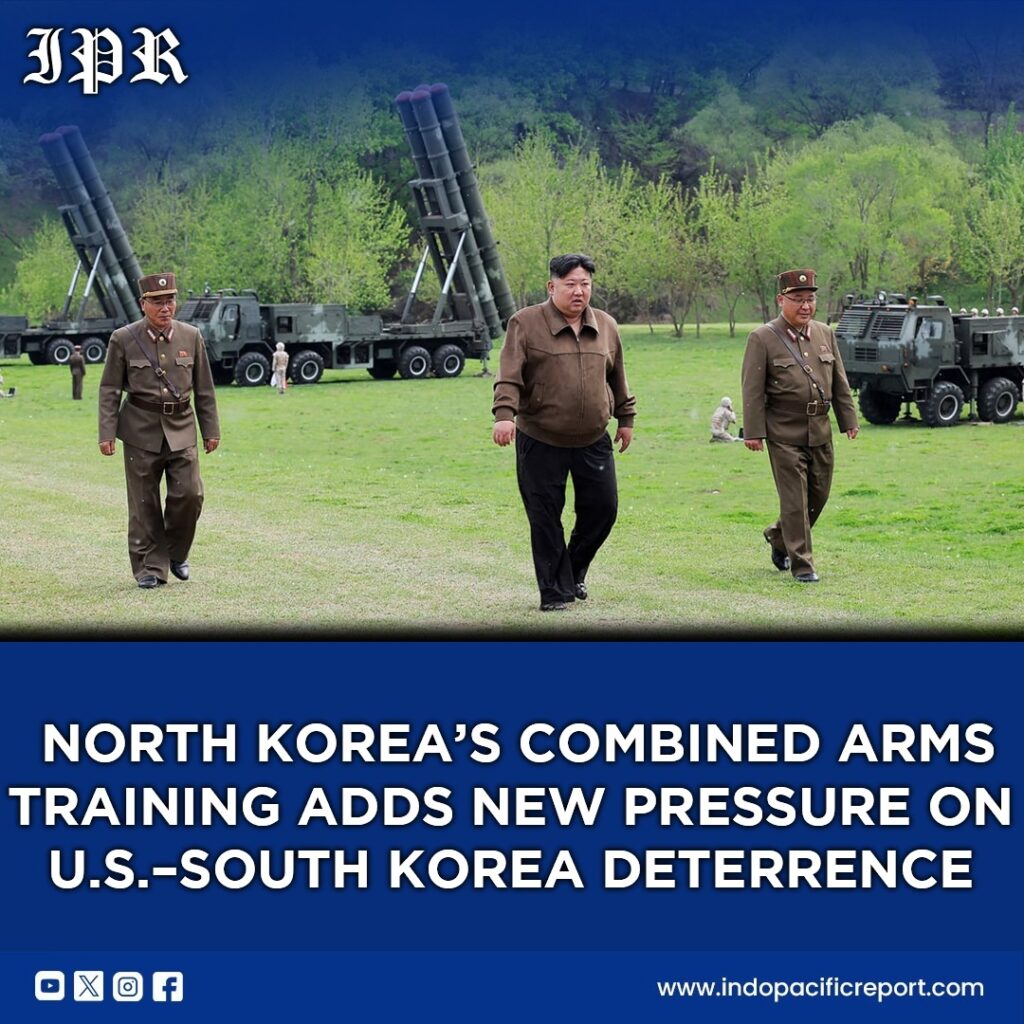
North Korea’s recent combined arms exercise, personally overseen by Kim Jong Un at a Pyongyang training base, is another signal that the Peninsula is entering a phase of intensified military normalization. The drill, which involved coordinated infantry and battle tank maneuvers, was conducted under the Capital City Defence Corps of the Korean People’s Army. It was also observed by Kim’s daughter, Kim Ju-ae, reinforcing the political messaging element of succession and regime continuity. While framed as a routine tactical exercise, the timing and optics carry broader strategic meaning in the Indo-Pacific security environment.
From the perspective of great-power competition, this exercise reflects how North Korea is adapting to a more distracted international system. The United States is simultaneously managing crises in Europe, the Middle East, and the Indo-Pacific. This diffusion of attention creates strategic space for Pyongyang to refine its conventional warfighting capabilities while continuing its nuclear modernization. The combined arms drill is important because it shows not only missile development but also improved coordination between armored and infantry units. This suggests a gradual shift from symbolic deterrence to more structured battlefield readiness. For China and Russia, North Korea’s growing military activity remains a useful strategic buffer against U.S. pressure in Northeast Asia.
In terms of regional security architecture, the Korean Peninsula remains a classic high-tension military frontier. North Korea is steadily improving its ability to conduct integrated land warfare operations, which complicates South Korea’s defense planning. The Republic of Korea military has long focused on countering artillery and missile threats from the North, but exercises like this indicate that Pyongyang is also investing in conventional combined arms proficiency. This blurs the traditional distinction between nuclear deterrence and conventional imbalance. The result is a more complex threat environment, where escalation could occur through multiple military channels, not just missile launches.
Alliance dynamics are also affected, particularly between South Korea and the United States. The presence of U.S. forces on the Peninsula—approximately 28,500 troops—remains the backbone of deterrence. However, North Korea’s sustained exercise tempo is designed to test the credibility of this alliance under conditions of strategic overload. By expanding conventional readiness, Pyongyang increases the pressure on both Seoul and Washington to maintain high readiness levels across multiple domains. The inclusion of Kim Jong Un’s daughter in the inspection adds an internal political dimension: it signals regime stability and long-term continuity, reinforcing deterrence by reducing perceptions of internal fragility.
From a maritime and economic security standpoint, the implications are indirect but still important. While the exercise itself is land-based, the Korean Peninsula is deeply embedded in the broader Indo-Pacific maritime system. Any escalation on land would immediately affect sea lanes in the Yellow Sea, the East China Sea, and surrounding shipping corridors. South Korea and Japan rely heavily on stable maritime routes for energy imports and trade flows. A more confident and militarily active North Korea increases baseline regional risk, which in turn affects insurance costs, naval deployments, and contingency planning across the Indo-Pacific maritime domain.
In the wider Indo-Pacific balance of power, North Korea functions as a persistent strategic disruptor. Its military modernization does not need to match that of South Korea or the United States; it only needs to complicate their planning and stretch their attention. Combined arms drills like this one suggest Pyongyang is moving toward a more balanced force structure, integrating armor, infantry, artillery, and missile systems into a unified operational concept. This increases deterrence complexity and reduces the predictability of escalation pathways. It also indirectly strengthens China’s strategic position by forcing the U.S. and its allies to allocate more resources to Northeast Asia, thereby limiting flexibility in other theaters such as the Taiwan Strait.
In conclusion, Kim Jong Un’s oversight of a combined arms drill is not an isolated military event. It is part of a broader strategic pattern: steady conventional modernization, nuclear deterrence reinforcement, and political signaling of regime continuity. North Korea is positioning itself as a long-term, multi-domain military actor rather than a single-dimensional missile state. For the Indo-Pacific, this means a more layered and less predictable security environment, where deterrence must account for both nuclear escalation and conventional conflict scenarios simultaneously. The key question going forward is not whether North Korea can win a war, but how effectively it can raise the cost of any strategic calculation on the Peninsula.
Hashtags:
#NorthKorea #KimJongUn #KoreanPeninsula #IndoPacificSecurity #USSouthKoreaAlliance #MilitaryBalance #GreatPowerCompetition #DeterrenceDynamics