Japan’s Upgraded Type 12 Missile Strengthens Indo-Pacific Deterrence
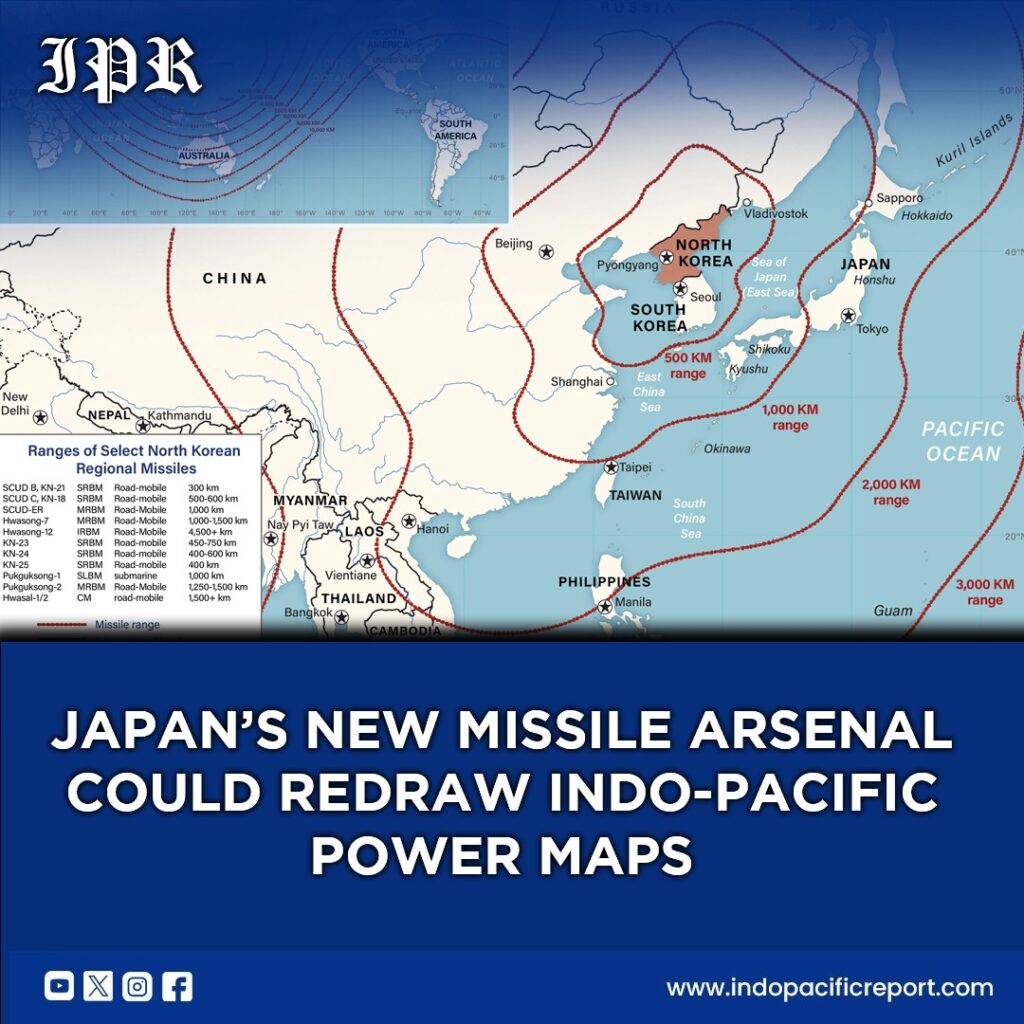
Japan’s New Missile Arsenal Could Redraw Indo-Pacific Power Maps Japan’s deployment of the Upgraded Type 12 ground-launched anti-ship missile marks a pivotal shift in its defensive posture and signals a more assertive approach to maritime deterrence in the Indo-Pacific. Stationed at Camp Kengun in Kumamoto Prefecture, the first units of the Upgraded Type 12 are operational with the 5th Surface-to-Ship Missile Regiment, with full capability expected by the end of March. This missile, with a reported range approaching 1,000 kilometers, dramatically extends Japan’s ability to threaten hostile vessels well beyond its immediate coastline, potentially reaching Chinese naval assets across the East China Sea. Mounted on mobile 8×8 tactical trucks, the system’s mobility further complicates any adversary’s targeting calculus, reinforcing Japan’s “Island Defence” concept. Viewed through the lens of great-power competition, this deployment represents Tokyo’s strategic response to China’s growing maritime assertiveness. Beijing’s expansion in the East and South China Seas, coupled with its rapid naval modernization, has forced regional powers to reconsider the calculus of deterrence. By extending strike capabilities from Kyushu to Okinawa, Japan can now project credible risk across vital sea lanes and disputed maritime zones.
Catholic Church to Open a Mission on a South China Sea Island Claimed by the Philippines and China
The Upgraded Type 12, with its low radar signature, precision guidance, and midcourse correction capability, underscores Japan’s emphasis on survivable, long-range anti-access/area-denial (A2/AD) tools—a clear signal to Beijing that aggressive naval maneuvers could be met with immediate and precise counterstrike. The broader regional security architecture will feel the ripple effects of these deployments. Japan’s missile modernization complements the ongoing development of the Hyper Velocity Guided Projectile (HVGP) and future New Surface-to-Ship Missile systems by ATLA. These programs, leveraging hypersonic glide technologies and precision targeting, enhance Tokyo’s ability to control access to its remote islands and maritime approaches. When combined with expanded reconnaissance satellites and amphibious rapid-response forces, Japan is moving toward a layered, integrated defense posture that blends traditional deterrence with modern, networked strike capabilities. For U.S. allies and partners, this reinforces interoperability opportunities while simultaneously complicating strategic calculations for adversaries. Alliance dynamics are particularly salient. The U.S.-Japan security relationship is strengthened by Japan’s growing independent strike capacity, offering Washington greater flexibility in distributing responsibilities across the Indo-Pacific. Tokyo’s mobile missile units allow for rapid repositioning and reduce dependence on fixed bases, which are often vulnerable in conventional war scenarios. By fielding credible, long-range strike assets, Japan not only enhances its deterrence posture but also signals to regional partners, such as Australia and South Korea, that it is prepared to share the burden of defending critical maritime commons. This can encourage more coherent, multilateral responses to potential flashpoints in the East China Sea and beyond. From a maritime and economic strategy perspective, these missile deployments have far-reaching implications. Japan sits astride critical chokepoints for global trade, including the East China Sea and the Taiwan Strait. Extending the reach of precision anti-ship systems to these areas enables Tokyo to threaten disruption of hostile naval operations while safeguarding freedom of navigation. This capability indirectly bolsters the security of global trade routes, reinforcing the strategic value of Japan’s island defense concept not just for national security, but for regional economic stability. Finally, the Indo-Pacific balance of power is shifting incrementally but perceptibly. Japan’s investments in long-range, survivable strike systems tilt the region toward a more robust deterrent posture against coercive strategies by revisionist powers. While these capabilities are defensive in principle, they introduce new layers of complexity into regional calculations, particularly for China. The potential for rapid, precise counterstrikes may induce caution in Beijing’s maritime maneuvers, but also risks prompting arms competition or pre-emptive countermeasures.
Philippines not in position to support U.S. efforts to secure the Strait of Hormuz
The challenge for Tokyo will be to balance credible deterrence with regional stability, leveraging technology, mobility, and alliances to shape a strategic environment that discourages aggression without escalating tensions unnecessarily. Looking forward, Japan’s missile modernization signals a long-term strategic commitment to fortifying its remote islands, securing maritime approaches, and projecting credible deterrence throughout the Indo-Pacific. For policymakers, these developments highlight the importance of integrated defense planning, resilient alliances, and calibrated signaling in an era of intensifying great-power competition. Tokyo is clearly preparing to defend not only its territory but also the broader maritime commons upon which regional stability and global trade depend.