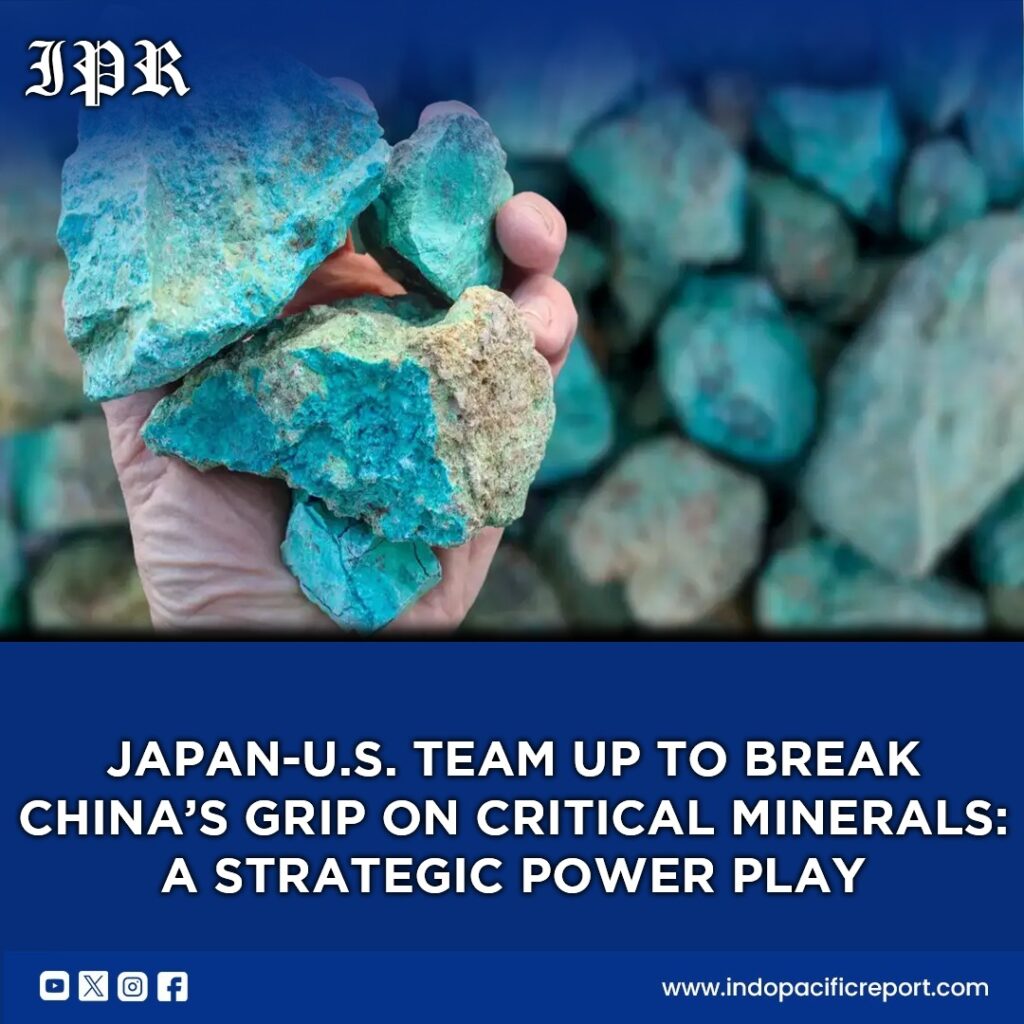
Japan and the United States are set to formalize cooperation on securing supply chains for critical minerals, including rare earths, at a bilateral summit in Washington next week. This initiative follows prior agreements and reflects a shared concern over dependence on China for minerals essential to high-tech industries, defense manufacturing, and emerging technologies. Tokyo is also exploring mining rare earths near Minamitorishima, a remote Pacific island, highlighting Japan’s willingness to leverage domestic and regional resources for strategic autonomy.
From a great-power competition perspective, this move underscores the intensifying resource rivalry in the Indo-Pacific. Rare earths and strategic minerals are not merely commercial commodities—they are central to advanced defense systems, semiconductors, and green technologies. By coordinating with the U.S., Japan aims to reduce Beijing’s leverage over critical supply chains, signaling a shift from passive reliance to proactive resource diplomacy.
In terms of regional security architecture, the mineral initiative complements broader economic and strategic alliances. A U.S.-led supply chain bloc strengthens ties among democracies in the region, linking economic resilience to security collaboration. By securing access to critical minerals, Tokyo and Washington enhance their capacity to sustain technological superiority for both civilian and military applications—a key factor in deterrence and long-term security planning.
Alliance dynamics are also reshaping. Japan’s initiative signals a deeper integration with U.S. industrial and strategic priorities, moving beyond traditional military coordination into economic-security interdependence. This cooperation may encourage other like-minded regional partners, including Australia and India, to formalize joint resource strategies, potentially creating a bloc that can collectively counterbalance China’s near-monopoly over critical minerals.
From a maritime and economic strategy lens, Minamitorishima’s exploration is particularly significant. The island’s location in the Pacific provides Japan with strategic depth, allowing access to offshore deposits while reinforcing maritime presence. It demonstrates how resource security and maritime strategy intersect: controlling extraction points and supply lines bolsters both economic independence and regional influence, mitigating the risks of supply disruptions during crises.
Implications for the Indo-Pacific balance of power are profound. By diversifying mineral sources and creating a coordinated supply network with the U.S., Japan strengthens its technological resilience while subtly reinforcing U.S. influence in the broader Indo-Pacific. These moves reduce China’s ability to coerce neighboring states through resource leverage, creating a more multipolar economic-security environment where strategic autonomy and alliance cohesion define regional hierarchies.
Forward-looking assessment: Japan-U.S. cooperation on critical minerals is not just about economics—it is a strategic hedge in an era of intensifying great-power competition. Over the next decade, this initiative could influence industrial policy, defense readiness, and regional alliances. How other Indo-Pacific powers respond—whether by joining supply chains, pursuing domestic extraction, or seeking alternative partners—will shape the balance of influence and strategic resilience in the region.
Audience Question: Should Japan and the U.S. pursue aggressive mineral diversification even if it provokes China, or focus on dialogue and trade to reduce tensions in the Indo-Pacific?