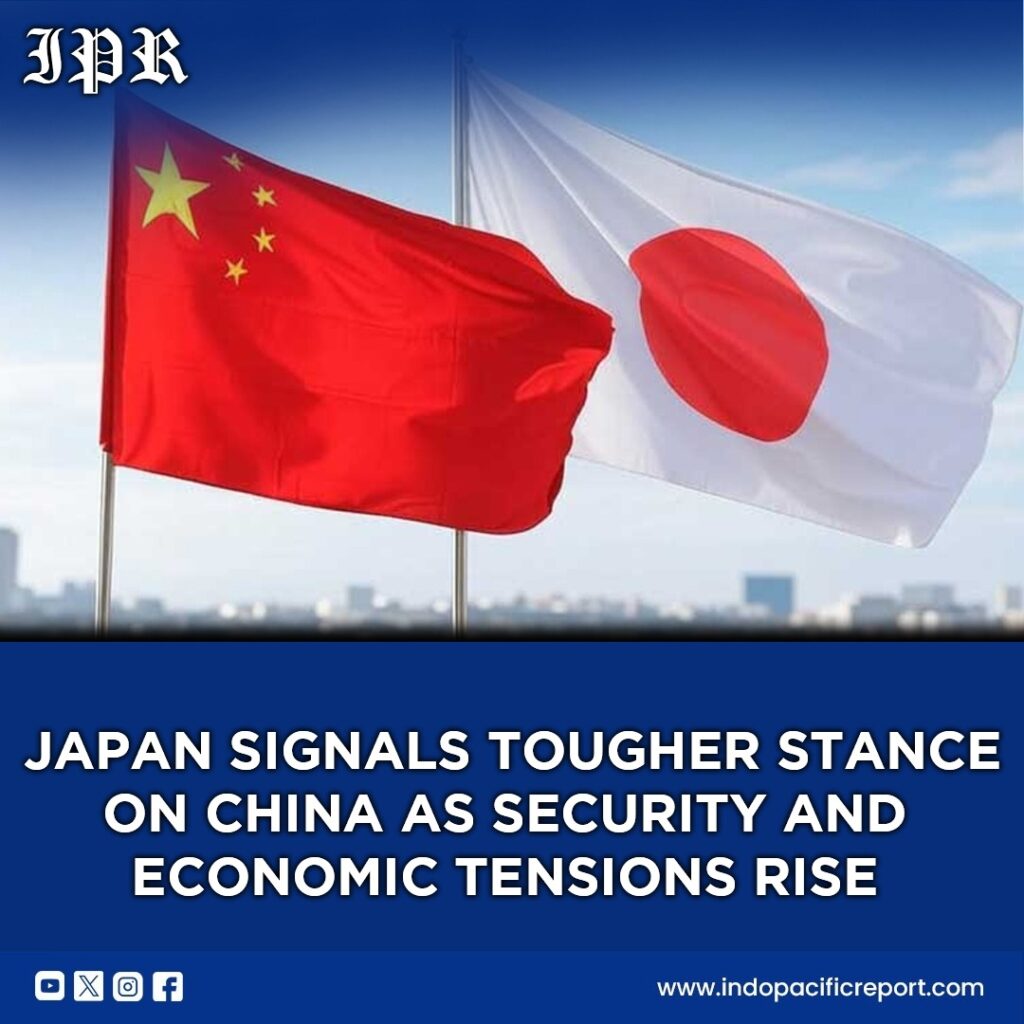
Japan is signaling a shift in its diplomatic posture toward China, downgrading the language in its 2026 Diplomatic Bluebook. The long-standing phrase describing Beijing as “one of its most important partners” will be replaced with the more neutral “important neighbour,” while still noting the relationship remains “strategic” and “mutually beneficial.” This change, expected under Prime Minister Sanae Takaichi, reflects a steady deterioration in bilateral ties driven by economic friction, security tensions, and regional uncertainty.
Over the past year, multiple disputes have accelerated this recalibration. China imposed export controls on rare earths and critical minerals, key inputs for Japan’s electronics and advanced manufacturing sectors. Meanwhile, military incidents—including radar lock-ons and aggressive maneuvers near Taiwan—have reinforced Tokyo’s perception of China as a coercive regional actor. Japan’s signaling that it may deploy forces if a Taiwan conflict threatens its territory further heightened tensions, prompting Chinese economic countermeasures such as seafood import restrictions and mineral export limitations.
From an economic-security lens, the Bluebook shift underscores Tokyo’s concern over supply chain vulnerabilities. Japan is pursuing diversification efforts in coordination with the United States, reducing dependence on Chinese-controlled resources. This approach illustrates a broader trend among major Indo-Pacific economies: balancing engagement with China against the imperative of strategic resilience. By framing trade, technology, and critical minerals as part of national security, Japan is recalibrating its policies to anticipate escalating great-power competition.
Strategically, Japan’s updated language reflects a security-driven foreign policy. By explicitly linking Chinese behavior to concerns about Russia and North Korea, Tokyo signals alignment with broader Western deterrence frameworks. The downgrading of cooperative language is more than symbolic: it communicates a repositioning in regional power dynamics, signaling that Japan no longer sees China primarily as a partner, but increasingly as a competitor whose influence must be managed through both economic and military means.
Yet the Bluebook retains terms like “strategic” and “mutually beneficial,” suggesting Tokyo is not abandoning engagement. Japan appears to be pursuing a dual-track approach: deterring Chinese coercion while maintaining avenues for diplomacy and trade where possible. This reflects a sophisticated understanding of modern statecraft in the Indo-Pacific, where gradual recalibration of ties, rather than abrupt confrontation, can preserve maneuverability and strategic flexibility.
The implications for the region are significant. Tokyo’s shift could accelerate economic decoupling in sensitive sectors, influence alliance dynamics with the United States and European partners, and signal to neighboring states that Japan is willing to adopt a harder stance on security while safeguarding essential economic links. In an era of intertwined economic and military competition, this language change may foreshadow more robust defense initiatives, expanded intelligence-sharing, and closer alignment with like-minded partners across the Indo-Pacific.
Does Japan’s subtle downgrade of China signal a new era of regional rivalry, or is it a calculated step to balance deterrence with continued economic engagement?