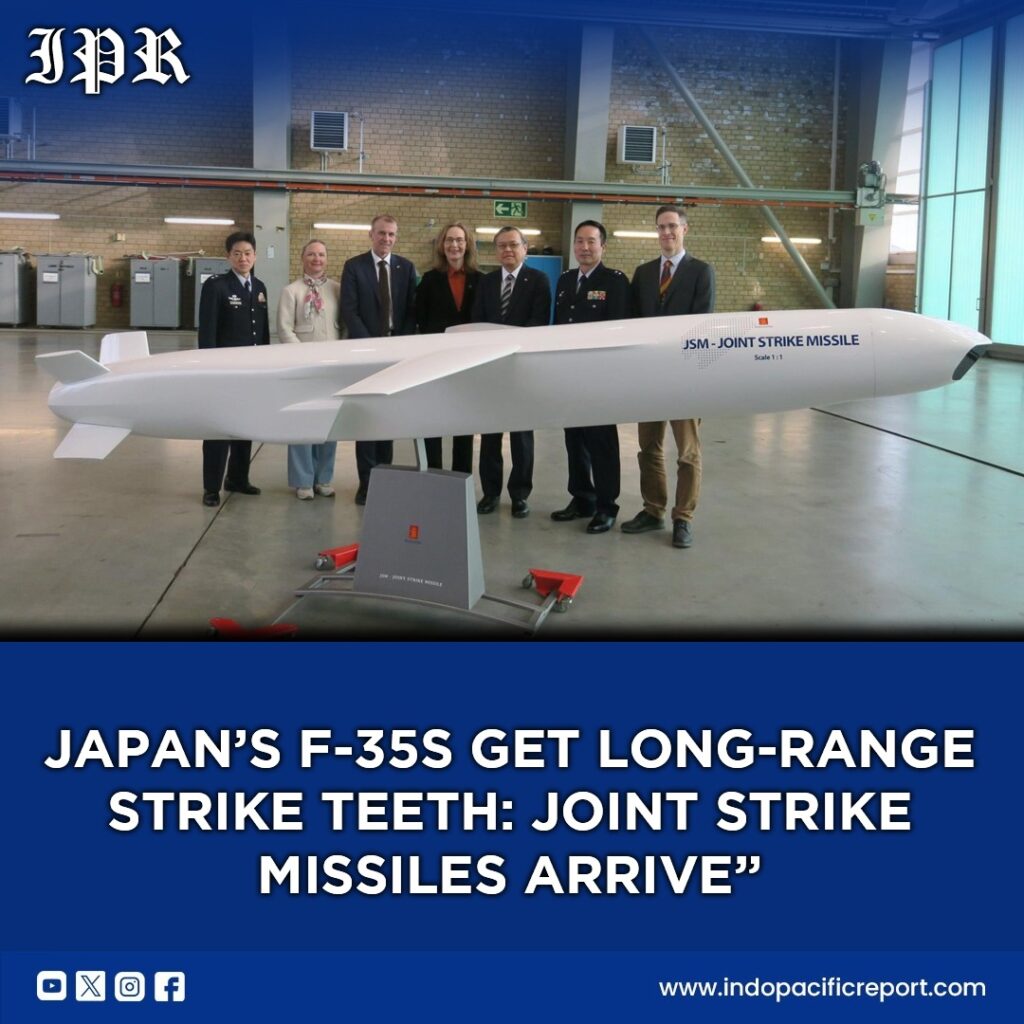
Japan has officially taken delivery of its first batch of Joint Strike Missiles (JSM), marking a major enhancement of its long-range precision-strike capability. Developed by Kongsberg Defence & Aerospace, the JSM integrates seamlessly with the F-35A Lightning II, fitting within its internal weapons bay while capable of striking targets at ranges up to 563 kilometers. These missiles, designed for anti-surface warfare and naval fire support, bring Japan a new level of standoff capability, combining GPS-guided midcourse navigation with a passive, jam-resistant infrared seeker for terminal accuracy.
From a great-power competition perspective, this acquisition highlights Japan’s commitment to counterbalance China’s rapid military modernization. The JSM provides Tokyo with the ability to target high-value maritime assets, including Chinese surface combatants and missile batteries, at ranges beyond the first island chain. By equipping its F-35A fleet with these missiles, Japan closes a gap in credible, long-range precision-strike that complements its existing missile defense and naval deterrence posture.
The delivery also reflects the evolution of regional security architecture. Japan’s adoption of advanced Norwegian missile technology demonstrates the diversification of defense partnerships beyond traditional US-centric procurement. This strengthens interoperability with Western allies and creates a layered deterrent in the East China Sea and broader Indo-Pacific maritime domain. As regional tensions in the Taiwan Strait and East China Sea intensify, these capabilities signal Japan’s readiness to project power defensively and contribute to a rules-based order.
Alliance dynamics between Japan, Norway, and the United States are further deepened by this transfer. The missile’s adoption in multiple Western air forces, including the US, Norway, Germany, and Australia, allows Japan to standardize training, joint exercises, and operational procedures across allied air platforms. Joint training, such as that with the Royal Norwegian Navy and the Japan Maritime Self-Defense Force in 2025, lays the groundwork for combined deterrence operations, improving strategic cohesion across the Western alliance in Asia.
From a maritime and economic strategy standpoint, the JSM strengthens Japan’s ability to protect critical sea lines of communication, including shipping lanes for energy imports and exports. By extending standoff strike range, the missile provides Tokyo with the means to defend key choke points and deter coercive maneuvers near disputed islands or vital ports. This capability indirectly supports economic stability by ensuring continuity of trade and reinforcing the credibility of maritime deterrence in contested waters.
Considering the balance of power in the Indo-Pacific, the integration of JSMs into Japan’s F-35A fleet increases the strategic cost for any potential adversary seeking to coerce Tokyo or disrupt regional security. These missiles enhance deterrence without requiring permanent forward deployments or provocative posturing, allowing Japan to maintain a defensive yet credible long-range strike posture. Over time, the capability may encourage regional partners to pursue similar standoff systems, reinforcing a networked deterrence architecture across the Indo-Pacific.
Forward-looking assessment: Japan’s JSM deployment signals a pragmatic approach to asymmetric deterrence in a region defined by maritime competition. While it does not alter the overall strategic balance, it raises the operational threshold for potential aggression and underscores the growing trend of allied collaboration in missile technology and precision strike. As Tokyo continues to integrate high-end capabilities with broader alliance frameworks, it positions itself as a key enabler of both national defense and collective stability in the Indo-Pacific.
Audience Question: Will Japan’s enhanced standoff strike capabilities deter aggression in the East China Sea, or risk escalating an arms race in the region?