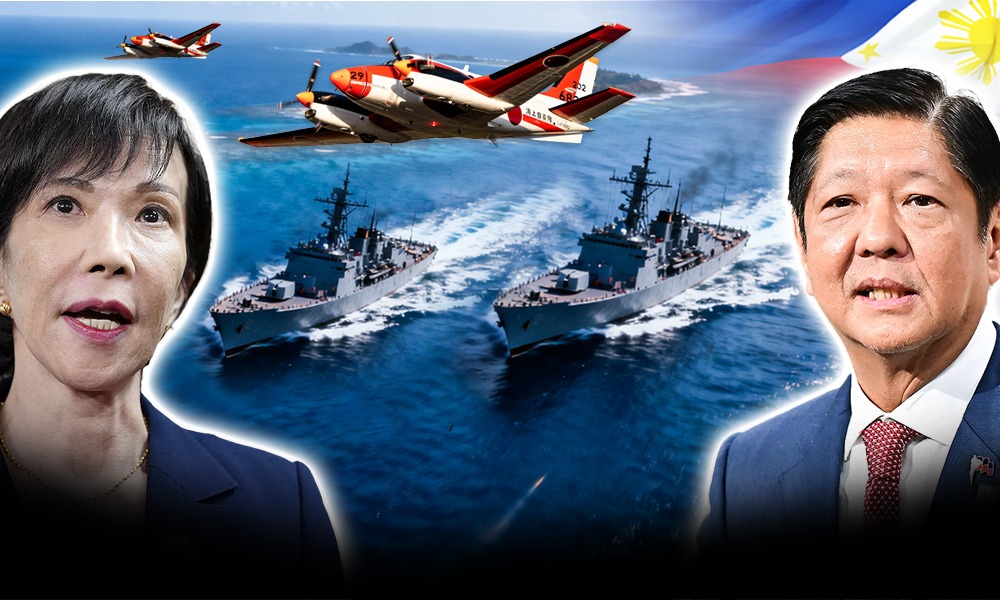
The Japan–Philippines security axis is accelerating faster than any other defense partnership in the Indo-Pacific, and the latest development marks another leap forward. On November 26, 2025, Philippine Navy Chief Vice Adm. Jose Ma. Ambrosio Ezpeleta confirmed that Manila is now seeking five additional retired TC-90 maritime patrol aircraft from Japan’s Maritime Self-Defense Force, a move that comes on the heels of ongoing talks about Japan’s possible transfer of retired Abukuma-class destroyer escorts. These are not minor requests. They are building blocks of a strategic transformation that is redefining how Manila monitors, defends, and asserts presence across its vast maritime territory. For Japan, this deepening cooperation reflects its expanding security role across the first island chain; for the Philippines, it is a critical step in closing long-standing surveillance gaps at sea. As Vice Adm. Ezpeleta put it clearly, “We still have a lot of gaps in our maritime domain awareness, so we want to determine if we can incorporate these additional aircraft into our fleet.” Beneath that simple statement lies a much bigger story, one of two democracies aligning their capabilities, doctrines, and strategic futures at a moment when maritime tensions are rising and the need for credible, coordinated defense has never been more urgent.
WHY THE PHILIPPINES NEEDS MORE TC-90s — THE SURVEILLANCE GAP
The Philippines is urgently seeking more TC-90 aircraft because it faces a surveillance challenge unlike anything most nations confront. With a 2.26-million-square-kilometer Exclusive Economic Zone, one of the largest in Asia, the country is responsible for monitoring waters so vast that even major navies struggle to patrol such distances. Yet Manila can currently keep watch over only about 30 percent of this maritime expanse, leaving enormous blind spots that Chinese coast guard vessels, maritime militia, and research ships routinely exploit. This is where the TC-90 becomes critically important. Originally used by Japan’s Maritime Self-Defense Force for pilot training and maritime reconnaissance, the twin-turboprop aircraft has proven ideal for the Philippines’ needs: slow enough to observe fishing vessels up close, fast enough to cover long stretches of coastline, and versatile enough to track militia swarms, shadow suspicious ships, and conduct route surveillance over hotspots like Scarborough Shoal, the Batanes islands, and Palawan’s contested waters. But the significance of the TC-90 goes beyond its technical performance, it carries strategic and historical weight. When Japan first transferred five TC-90s to the Philippines in 2017 and 2018, it marked Tokyo’s first-ever transfer of military aircraft abroad, made possible only after Japan relaxed its strict defense export rules in 2014. That transfer broke decades-old barriers and signaled Japan’s willingness to take on a more proactive role in regional security. As Japan’s Ministry of Defense said at the time, “The TC-90 transfer symbolizes Japan’s commitment to supporting regional maritime security.” Eight years later, the symbolism has matured into a hard strategy: the Philippines needs more eyes in the sky, and Japan is emerging as the partner most willing and most capable of filling that gap.
JAPAN’S TRANSFERS — PART OF A GROWING SECURITY PARTNERSHIP
Japan’s growing list of defense transfers to the Philippines is no longer just a series of isolated donations, it has evolved into a structured, long-term security partnership that is accelerating faster than any Manila–Tokyo cooperation in modern history. Tokyo has already delivered advanced air-surveillance radar systems and is now preparing to send new coastal monitoring radars under its Official Security Assistance (OSA) framework, part of Japan’s expanding portfolio of military aid to like-minded Indo-Pacific states. Even surveillance drones, maritime intelligence equipment, and additional pilot training programs are now part of ongoing discussions. What makes these transfers strategically transformative is how they align with the Philippines’ rapid establishment of new forward operating bases across its northern frontier, including the emerging hub in Mahatao, Batanes, a mere 200 kilometers from Taiwan. As these outposts begin to take shape, Japan’s radars, patrol aircraft, and future unmanned systems will help Manila monitor the Luzon Strait, the North Philippine Sea, and the increasingly contested West Philippine Sea with far greater accuracy and persistence than ever before. This is not simply capacity-building; it is the creation of a shared surveillance architecture stretching across the first island chain. And Japan is not limiting its support to hardware alone. Tokyo has opened its doors to Philippine sailors and aviators undergoing anti-submarine warfare training, an area where Japan’s expertise is world-class and essential for detecting growing Chinese submarine activity near Philippine waters. As Vice Adm. Ezpeleta acknowledged, “Japan is helping us with intelligence sharing and anti-submarine expertise. We need this to build a modern navy.” The message behind these transfers is unmistakable: Japan is no longer just helping the Philippines watch its seas, it is helping Manila prepare to defend them.
Japan Is Strengthening the Philippine Navy to Deter China in the South China Sea
THE ABUKUMA-CLASS TRANSFER — A MAJOR NAVAL MODERNIZATION OPPORTUNITY
The possible transfer of Japan’s Abukuma-class destroyer escorts represents one of the most significant naval modernization opportunities the Philippines has faced in years, not simply because of the ships themselves, but because of what they symbolize in Manila–Tokyo security relations. Built between 1989 and 1993, the six Abukuma-class vessels that the Philippine Navy inspected are proven multi-role workhorses, designed with a strong emphasis on anti-submarine warfare, coastal patrol operations, and escort missions, exactly the kind of gap-filling capabilities the Philippines urgently needs as Chinese submarines, coast guard cutters, and maritime militia push deeper into contested waters. Vice Adm. Ezpeleta’s request for “at least three vessels” reflects a pragmatic doctrine rather than ambition: one ship deployed on operational patrols, one in scheduled maintenance, and one dedicated to crew training and systems integration. This rotation ensures that the Navy maintains real, uninterrupted maritime presence without overtaxing new assets, a critical lesson learned from previous fleets that wore out faster than they could be replaced. But the true complexity lies not in the ships’ condition, but in the legal and political debate unfolding in Tokyo. Japan’s current arms export restrictions limit the transfer of lethal weaponry, a legacy of its post-war pacifist constitution. Yet the ruling Liberal Democratic Party has been openly pushing to relax these rules, arguing that Japan must support partners facing coercion and contribute more meaningfully to regional stability. If the Abukuma transfer moves forward, it would mark one of Japan’s largest-ever military equipment exports and a historic expansion of defense cooperation with the Philippines, a signal that Tokyo is stepping firmly into its role as a proactive security actor. For Manila, receiving these ships would not only strengthen its naval posture, but also deepen integration with Japan’s fleet, doctrine, and maritime strategy. For Tokyo, it would represent a turning point in its willingness to empower partner nations facing the same strategic pressures it confronts from Beijing. The Abukuma-class vessels are more than hulls and hardware, they are a test case for how far the Japan–Philippines strategic partnership is prepared to go.
WHY MANILA WANTS THESE ASSETS — DOCTRINE & STRATEGIC NEED
The Philippines is pursuing more TC-90s and potentially Abukuma-class ships because these platforms directly support the country’s most urgent doctrinal and strategic requirements as it shifts from internal insurgency operations to full external defense. At the core of this transition is maritime domain awareness, the ability to actually see, track, and understand what is happening across the vastness of the West Philippine Sea and along the northern approaches facing Taiwan. TC-90 aircraft are essential in closing these surveillance gaps. They fill the space between drones, coastal radars, and satellite feeds, creating a continuous watch that exposes the movements of Chinese militia swarms, coast guard cutters, survey vessels, and submarines before they can position themselves for coercive actions. At the same time, the potential acquisition of Abukuma-class destroyer escorts speaks to an even deeper doctrinal need: anti-submarine warfare. As China increases its submarine deployments in the South China Sea including quiet diesel-electric boats capable of hiding in deep trenches off Palawan and Luzon, the Philippines urgently requires ships equipped with sonar, torpedoes, and trained crews capable of detecting and tracking undersea threats. These vessels would provide Manila with a baseline ASW capability it currently does not possess. Together, the TC-90s and Abukumas serve a broader transformation already underway within the Armed Forces of the Philippines: a pivot toward regional deterrence that aligns Manila with the archipelagic defense strategies of the United States and Japan. By strengthening maritime surveillance, expanding ASW capacity, and integrating into allied networks, the Philippines is not just acquiring equipment, it is building the doctrinal foundation of a modern external defense force prepared for the strategic realities of the Indo-Pacific.
Is the Philippines Ready for the Cyber Battlefield?
THE RAA — THE GAME-CHANGING FRAMEWORK BEHIND THIS COOPERATION
The engine driving this entire wave of Japan–Philippines defense cooperation is the Reciprocal Access Agreement, a pact that quietly but decisively rewires how the two countries operate together. Now fully in force, the RAA removes the bureaucratic barriers that once slowed joint training, ship movements, overflight permissions, and equipment transfers, replacing them with a framework similar in spirit to the U.S.–Japan Status of Forces Agreement. With the RAA, Japanese Maritime Self-Defense Force vessels can conduct more frequent port calls, Japanese troops can rotate for exercises with minimal paperwork, and both nations can stage joint operations with a level of logistical ease that would have been unthinkable only a few years ago. This isn’t just about convenience, it is about interoperability becoming the norm rather than the exception. It allows MSDF aircraft and Philippine crews to train together on maritime patrol missions, enables destroyers and Philippine Navy vessels to rehearse anti-submarine drills, and opens the door for more complex deployments across Batanes, Luzon, and Palawan. As Vice Adm. Ezpeleta put it, “Now that the RAA is in place, we expect more regular exercises and more port calls from the MSDF.” But the deeper significance is geopolitical. The RAA effectively anchors the Philippines inside the Japan–U.S.–Philippines security triangle, one of the Indo-Pacific’s most important and rapidly consolidating defense alignments. With the RAA in force, Tokyo and Manila are no longer occasional partners; they are operationally linked, strategically synchronized, and positioned to act together across the first island chain at a time when maritime tensions are rising and collective deterrence has never mattered more.
When Will the Philippines Become a Trillion-Dollar Economy?
REGIONAL CONTEXT — THE CHINA FACTOR
The deepening Japan–Philippines partnership cannot be understood without recognizing the accelerating tension in the West Philippine Sea, where China’s coercion has reached levels that neither Manila nor Tokyo can afford to ignore. Water cannon strikes powerful enough to injure sailors, dangerous intercepts near Ayungin Shoal, and the relentless presence of China’s maritime militia swarms have turned Philippine patrols into high-risk missions where every approach, every maneuver, and every mile traversed must be filmed, logged, and prepared for escalation. Beneath the surface, the situation is just as troubling: Chinese submarines have stepped up their patrols through vital sea lanes and chokepoints, moving quietly through waters that connect the South China Sea to the Pacific, exactly the routes Japan depends on for energy, trade, and maritime security. This is why Tokyo is so deeply engaged. Japan sees the Philippines not just as a partner, but as the critical southern anchor of the First Island Chain, the geographic barrier that shapes China’s strategic reach and influences any potential Taiwan contingency. By strengthening Manila’s surveillance capabilities, Japan helps protect sea lanes that carry its oil from the Middle East, supports early warning systems that matter for Taiwan’s defense, and reinforces the principle that freedom of navigation must be defended, not merely declared. At the heart of this alignment is a simple truth: Japan and the Philippines are frontline states facing the same pattern of Chinese assertiveness. Their challenges are intertwined, their vulnerabilities overlap, and their security is now inseparable. In this context, every TC-90 aircraft added, every radar installed, every port call made under the RAA becomes part of a shared strategic shield, a regional response to a regional threat.
IMPLICATIONS FOR THE PHILIPPINE NAVY
The Philippines’ pursuit of more TC-90s and the potential acquisition of Abukuma-class ships directly reshape the Navy’s future posture, creating what defense planners increasingly describe as a “Triangle of Defense” a geographic and operational framework that finally gives Manila layered coverage across its most vulnerable maritime frontiers. In the north, bases in Batanes armed with Japanese radars and reinforced by U.S. surveillance platforms provide early warning across the Luzon Strait, a chokepoint critical not only for Philippine security but for Taiwan contingency scenarios. To the west, TC-90 patrol planes, fixed coastal radars, and the newly deployed BrahMos missile batteries form the backbone of deterrence in the West Philippine Sea, giving the Philippines the eyes, the tracking data, and the strike capability needed to monitor and, if necessary, challenge hostile movements near Scarborough Shoal and Second Thomas Shoal. In the south, maritime patrol expansion and upgraded ports strengthen the Navy’s ability to respond to grey-zone activity, smuggling routes, and potential incursions into the Sulu and Celebes Seas. The synergy of these assets becomes even clearer when viewed through the lens of modernization. The TC-90s, with their long flight endurance and wide-area coverage, dramatically enhance the reconnaissance and targeting picture for systems like BrahMos, giving mobile missile batteries the real-time intelligence they need to track surface targets across hundreds of kilometers. Meanwhile, the Abukuma-class destroyer escorts would provide badly needed anti-submarine and escort capabilities, allowing the Navy to protect its patrol ships, safeguard undersea cables, and accompany logistical convoys during crises. All of this supports a broader evolution unfolding within the service: the Philippine Navy is no longer merely a coastal constabulary force, it is beginning to function as a true maritime defense institution with layered surveillance, strike readiness, and multi-domain coordination. As Vice Adm. Ezpeleta put it plainly, “We’re trying to build a modern navy, we need expertise from Japan and the U.S.” That statement captures the transition now underway. These acquisitions are not about prestige hardware; they are about transforming the Navy into a force that can detect earlier, respond faster, and operate confidently in a region where maritime threats are becoming more complex, more coordinated, and more strategically consequential by the year.
CONCLUSION — A NEW SECURITY ARCHITECTURE IN THE INDO-PACIFIC
The Philippines’ move to acquire more TC-90 patrol aircraft and potentially bring Abukuma-class ships into its fleet marks a historic acceleration in its military modernization, but more importantly, it signals the emergence of a new security architecture taking shape across the Indo-Pacific. What once felt like cautious cooperation has now matured into one of the region’s fastest-growing strategic partnerships, with Japan stepping forward as Manila’s closest security partner after the United States. The RAA has transformed the relationship from episodic cooperation into a living framework: intelligence sharing, joint patrols, anti-submarine training, and asset transfers are no longer symbolic gestures but the building blocks of a durable security alliance. For the Philippines, this means greater surveillance, stronger deterrence, and a Navy that can finally watch, respond, and defend across the vastness of its maritime territory. For the region, it represents something even larger, a shift toward a collaborative Indo-Pacific where frontline democracies reinforce one another, where deterrence is shared, and where security is built not on isolation but on partnership. In a time of rising maritime coercion, Japan and the Philippines are proving that cooperation is not just an option; it is the new strategic currency of a region determined to shape its own future.