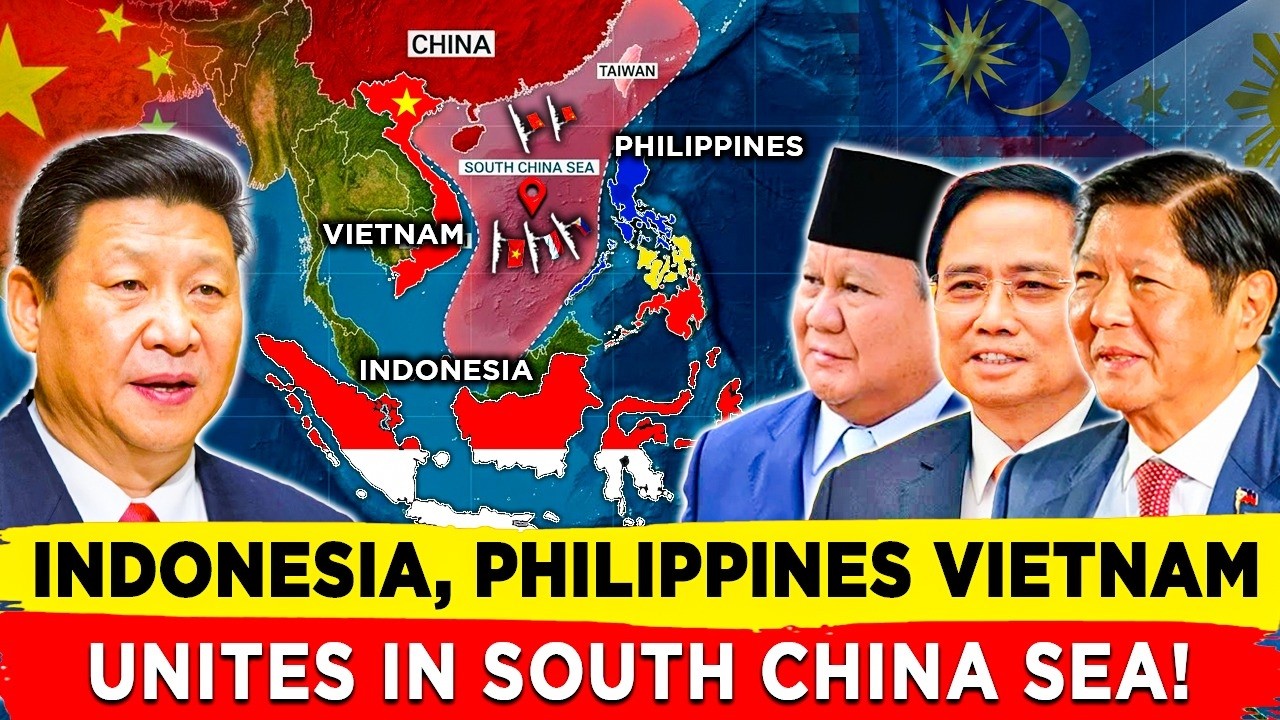
Indonesia, Philippines, and Vietnam Unite in the South China Sea
Let me start with a question that’s been sitting in the back of my mind lately. What happens when three smaller coastal nations quietly decide they’ve had enough and start standing closer together in one of the most contested seas on Earth? Not with a loud military alliance. Not with dramatic headlines. Just quiet coordination. More patrols. More communication. More shared awareness.
That’s exactly the kind of shift unfolding right now in the South China Sea and honestly, it’s the kind of story that doesn’t always explode into the news cycle, but it changes the strategic picture more than people realize.
In recent months, officials from Indonesia, the Philippines, and Vietnam have been strengthening coordination over maritime security, sharing patrol information, aligning coast guard activities, and quietly signaling that protecting their waters is no longer something they intend to do alone. It’s subtle. But it’s real.
A Philippine security official recently put it bluntly during a regional discussion: “The region cannot face maritime pressure in isolation anymore.” And when you look at the map, you begin to see why. Picture this for a second. A Vietnamese fishing vessel operating near the Spratly Islands suddenly finds itself shadowed by larger ships. Not long after, Philippine coast guard patrols increased in nearby waters. Meanwhile, Indonesian maritime authorities tighten surveillance around the Natuna Sea. Three different countries. Three different incidents. But increasingly, the response is starting to look coordinated. Not officially. Not loudly.
Just, connected. Analysts have started calling this quiet alignment a “Maritime Security Triangle.” It’s not a treaty. It’s not NATO-style defense cooperation. There are no joint command centers or mutual defense clauses. Instead, it’s something more organic and maybe more powerful.
Three nations realize that if they watch the sea alone, they remain vulnerable. But if they watch it together, the balance changes. For years, the strategic conversation around the South China Sea has revolved around the rivalry between China and the United States. Superpowers. Aircraft carriers. Global politics. But here’s the twist that people often miss. The real shift might not be happening between the giants. It might be happening between the neighbors.
And slowly, almost quietly, Indonesia, the Philippines, and Vietnam are beginning to show that regional states are no longer just reacting to great-power competition. They’re starting to shape it.https://indopacificreport.com/hegseths-daring-strategy-counter-china-southeast-asia/

The Strategic Importance of the South China Sea
To understand why tensions keep rising, you first have to understand just how important the South China Sea really is. At first glance, it looks like just another stretch of ocean on the map. Blue water, scattered islands, long shipping routes cutting across it. But the moment you start looking closer, the scale of its importance becomes almost overwhelming. This sea is not just water between countries, it is one of the busiest economic highways on Earth. Every year, an estimated $3.4 trillion worth of global trade moves through these waters. Massive cargo ships carrying electronics, energy, food, and industrial goods cross it day and night. In fact, roughly one-third of all global maritime trade passes through this single maritime corridor, linking the factories of Asia with markets across the world.
Pentagon’s $975K Project at Oyster Bay Sends a Warning to China
That alone would make the region strategically valuable. But the story doesn’t stop there. Beneath the seabed lies another layer of competition. According to estimates by the U.S. Energy Information Administration, the South China Sea may contain around 11 billion barrels of oil and roughly 190 trillion cubic feet of natural gas. Those are not small numbers. For countries with growing populations and expanding economies, energy resources like these represent long-term security and economic survival. Control over maritime zones could mean access to resources that power industries, cities, and entire national economies for decades.

And then there is the human side of the sea. For millions of people across Southeast Asia, these waters are not just geopolitics, they are daily life. The South China Sea is one of the richest fishing areas in the world, supplying roughly 12 percent of the global fish catch. Entire coastal communities depend on it. Fishing boats leave ports in Vietnam, the Philippines, and Indonesia before sunrise, the same way their fathers and grandfathers did for generations. For them, the sea is not a strategic map, it’s their livelihood.https://youtu.be/lsiZCcD5Hlo?si=qQyeAL1Eo_CIn3rl
Geographically, the region sits at a critical crossroads between the Pacific Ocean and the Indian Ocean. Tankers carrying oil from the Middle East pass through these waters on their way to East Asian economies. Container ships linking Europe, Asia, and North America follow the same maritime lanes. In many ways, the South China Sea functions like a central artery of the global economic system. If something disrupts this route, supply chains across the world would feel the shock almost immediately. And this is where the tension begins to make sense.
Will China Agree to the Philippines proposed Code of Conduct for the SCS
Because when a single body of water holds so much trade, energy, food, and strategic access, it naturally becomes one of the most contested spaces on the planet. Over the past decade, competing territorial claims, expanding coast guard patrols, and increasing military presence have transformed the South China Sea into one of the most heavily militarized maritime regions in the world. So when analysts talk about rising tensions here, they’re not exaggerating. They’re simply recognizing that this stretch of ocean, quiet on the surface, but packed with global significance, has become one of the defining geopolitical flashpoints of the 21st century.
China’s Expanding Presence and Regional Concerns
If you talk to fishermen or coast guard officers around the South China Sea, one phrase keeps coming up again and again: things have changed a lot in the past decade. And most of that change traces back to the growing maritime footprint of China.https://www.youtube.com/watch?v=vU07RKK6mM4
At the center of the issue is China’s sweeping claim over almost 90 percent of the South China Sea, represented by what’s known as the Nine-Dash Line. On Chinese maps, this curved line stretches deep into waters that other countries consider their own. The problem is that it overlaps with the maritime zones of several Southeast Asian states, including Vietnam, the Philippines, Malaysia, Brunei, and even areas claimed by Indonesia near the Natuna Islands.
From Beijing’s perspective, these claims are rooted in historical usage and old maps. But for many of its neighbors, the line cuts directly through waters they consider part of their exclusive economic zones, creating one of the most complicated maritime disputes in modern geopolitics.
Indonesia Joins Philippines for Massive Naval Drill in the South China Sea
The tension isn’t just about maps or legal arguments. It’s also about what has physically appeared in the sea.= Over the past decade, China has dramatically expanded its presence through large-scale land reclamation in the Spratly Islands. What were once small reefs or submerged features have been transformed into fully built artificial islands. Satellite images show long airstrips, reinforced harbors, radar facilities, and military infrastructure rising out of what used to be open water. Some of these installations now host missile systems, aircraft-capable runways, and surveillance equipment that can monitor large portions of the surrounding sea.
Security analysts at the Center for Strategic and International Studies estimate that since 2013, China has created more than 3,200 acres of artificial land across disputed features in the South China Sea. That scale of construction has few precedents in modern maritime disputes.
Alongside these installations, the presence of Chinese maritime forces has also expanded. The China Coast Guard, now the largest coast guard in the world, regularly patrols disputed waters, often accompanied by what analysts describe as a maritime militia, fleets of civilian fishing vessels that operate in coordination with state authorities. To many Southeast Asian countries, this layered presence, coast guard ships, naval forces, and militia vessels, creates constant pressure in contested areas.
The legal dimension of the dispute reached a turning point in 2016, when the Permanent Court of Arbitration issued a landmark ruling in a case brought by the Philippines. The tribunal concluded that China’s Nine-Dash Line claims had no legal basis under international law and determined that several contested features were not legally islands capable of generating their own exclusive economic zones.https://www.youtube.com/watch?v=gjl9DdC4Pjc
For the Philippines, the ruling was seen as a major diplomatic victory. Former Philippine Foreign Secretary Albert del Rosario described the decision as “a victory for international law and for all states that depend on the oceans.” China, however, rejected the ruling outright and has continued to assert its claims and maintain its presence across the disputed waters.
Why F-16 Viper Could Make China Think Twice About the West Philippine Sea
And that’s really where the regional anxiety comes from. For countries around the South China Sea, the concern isn’t just about one legal dispute or one incident at sea. It’s the sense that the balance in these waters, military, political, and strategic, has been shifting steadily, year by year.
The Emergence of a Maritime Security Triangle
Something interesting has been happening lately around the South China Sea, and it’s the kind of shift that doesn’t make loud headlines but quietly changes the strategic atmosphere.
Instead of responding alone to rising pressure at sea, countries like Indonesia, Vietnam, and the Philippines have started moving a little closer together. Not dramatically. Not with big declarations or treaty signings. Just steady coordination. More conversations between coast guards. More information sharing. More awareness about what’s happening across their waters.https://www.youtube.com/watch?v=W5SLEfeZ_1M
Security analysts have started describing this quiet alignment as a “Maritime Security Triangle.” It’s not an official alliance, and no one is pretending it is. But the idea behind it is simple: three coastal states facing similar challenges at sea are beginning to realize that working in parallel is far more effective than acting in isolation.
Think of it less like a military bloc and more like a neighborhood watch, but at the scale of the ocean.
Philippines Air Force Joins Multi-Nation War Games in Australia to Counter China
Each of these countries has its own reasons for strengthening cooperation. Indonesia has become increasingly alert about protecting waters near the Natuna Islands, where foreign fishing vessels and coast guard ships occasionally appear. Vietnam has long faced maritime standoffs around disputed islands and fishing grounds. The Philippines, meanwhile, has seen a steady rise in confrontations between its coast guard and Chinese vessels near contested reefs.
Individually, each country patrols its own waters. But when they begin sharing surveillance information, coordinating patrol patterns, and aligning diplomatic positions, something bigger starts to form. A network. A pattern of cooperation. The goal isn’t confrontation. At least not openly. Instead, the focus is on strengthening maritime sovereignty, improving surveillance across vast stretches of sea, and building enough presence to discourage coercion. In strategic language, it’s about deterrence, but a quieter kind, built on coordination rather than direct military escalation.https://www.youtube.com/watch?v=yIpC-8wr1ZA
There’s also a deeper principle behind this emerging alignment. All three countries repeatedly emphasize the importance of maintaining a rules-based regional order, where maritime disputes are managed through international law rather than raw power.
And that’s why this triangle matters. Because it signals something subtle but important: Southeast Asian states are not simply reacting to great-power rivalry anymore. They’re starting to shape their own security environment, step by step, patrol by patrol, conversation by conversation. No formal alliance. No dramatic announcement. Just three nations slowly realizing that in a contested sea, cooperation can be its own form of strength.
Indonesia: The Strategic Balancer
When people talk about the power dynamics of the South China Sea, one country often moves a little differently from the rest, quietly, carefully, but very deliberately. That country is Indonesia. Indonesia isn’t usually the loudest voice in the dispute. In fact, Jakarta has long maintained that it is not a formal claimant in the South China Sea territorial battles. But geography has a funny way of pulling countries into strategic competition whether they want it or not.
At the northern edge of Indonesia’s maritime territory sit the Natuna Islands, a remote but strategically important chain of islands surrounded by rich fishing grounds and energy resources. On paper, these waters fall well within Indonesia’s Exclusive Economic Zone under international law. But here’s where things get complicated.
China’s sweeping Nine-Dash Line stretches down into parts of the same waters. That overlap has led to repeated encounters between Indonesian patrol vessels and foreign fishing fleets operating near Natuna. Over the years, Indonesian authorities have detained vessels, expelled others, and steadily increased their presence in the area.
Japan Deploys 1,000 Troops for Balikatan 2026 with U.S. & Philippines
Jakarta’s approach has been firm but measured. Rather than framing itself as part of a direct territorial dispute, Indonesia positions itself as a guardian of its sovereign maritime rights. Still, the response on the ground shows that the country takes the situation seriously.
In recent years, Indonesia has increased naval and coast guard patrols around the Natuna waters, expanded maritime surveillance capabilities, and strengthened military infrastructure on nearby islands. Radar systems, upgraded air facilities, and reinforced naval bases now support a more permanent security presence in the region.https://www.youtube.com/watch?v=p_SCuOF6GRQ
The message is simple, even if the tone remains calm: Indonesia intends to protect its waters. That stance was made crystal clear by Indonesian President Joko Widodo during a high-profile visit to the Natuna Islands. Standing on the deck of a naval vessel, he delivered a line that quickly circulated across Southeast Asian media: “There is no negotiation on our sovereignty.” It was a short sentence. But in diplomatic language, it carried weight.
Indonesia’s role in the broader regional picture is often described as that of a strategic balancer. The country avoids formal alliances and prefers an independent foreign policy. Yet at the same time, it is quietly strengthening maritime cooperation with neighbors like Vietnam and the Philippines. That balancing act, firm on sovereignty, cautious in diplomacy, and increasingly active at sea, places Indonesia right at the center of the emerging regional security equation.
The Philippines: Frontline of Maritime Confrontation
If the South China Sea were a map of pressure points, the Philippines would probably sit right at the center of it. Over the past few years, Manila has experienced some of the most visible and frequent confrontations at sea with vessels from China. These aren’t large naval battles. Most of the time they’re tense standoffs between coast guard ships, supply boats, and patrol vessels. But the scenes are dramatic enough, sirens, close maneuvers, ships blocking each other in narrow waters, that they regularly make headlines across Asia.
One location keeps appearing again and again in those reports: Second Thomas Shoal.

This remote reef in the Spratly Islands has become one of the most symbolic flashpoints of the entire dispute. Back in 1999, the Philippines deliberately grounded an aging naval vessel there, the BRP Sierra Madre, to maintain a military presence. Since then, a small group of Philippine marines has lived aboard the rusting ship, which now functions as an outpost in contested waters.https://www.youtube.com/watch?v=F5krgC4CYR0
Keeping that outpost supplied has become increasingly difficult. In recent years, Philippine resupply missions heading toward the Sierra Madre have repeatedly encountered Chinese coast guard ships attempting to block their path. Some of these encounters have turned tense very quickly. Chinese vessels have used water cannons, shadowed supply boats at close distance, and performed blocking maneuvers intended to prevent them from reaching the shoal.
Each incident adds another layer of tension to an already fragile situation. The Philippine government has responded with increasingly firm language. President Ferdinand Marcos Jr. has repeatedly emphasized that Manila will defend its maritime rights and territorial claims. In one statement that quickly spread across regional media, he declared:
“The Philippines will not surrender a single square inch of its territory.” At the same time, Manila has been strengthening its security partnerships beyond Southeast Asia. Cooperation with the United States, Japan, and Australia has expanded through joint exercises, coast guard coordination, and broader Indo-Pacific security initiatives. For the Philippines, the South China Sea is not just a strategic debate, it’s a daily operational reality.
Vietnam: A Determined Maritime Defender
Further north, Vietnam has its own long and complicated history in the South China Sea disputes. In fact, Vietnam’s maritime tensions with China stretch back decades, making it one of the most experienced actors in navigating this difficult strategic environment.
Two island groups sit at the center of Vietnam’s claims: the Paracel Islands and the Spratly Islands. Control over these scattered reefs, shoals, and islands has been contested for years, and clashes have occurred in the past, including naval confrontations in earlier decades.
Rather than escalating dramatically, Vietnam has taken a steady approach to strengthening its maritime position. Over time, Hanoi has expanded its coast guard fleet, modernized naval capabilities, and increased patrols across its claimed waters. Surveillance systems have also improved, allowing Vietnamese authorities to monitor activity more closely in sensitive maritime zones.
But Vietnam’s strategy isn’t built only on military readiness. Diplomacy remains a central pillar. Hanoi continues to engage regional partners and participate actively in multilateral discussions aimed at managing tensions and preserving stability in the South China Sea. It’s a balancing act, defending national interests firmly while avoiding escalation that could destabilize the broader region.
Areas of Trilateral Cooperation
As these pressures continue to grow, cooperation between Indonesia, Vietnam, and the Philippines has slowly started to take shape. One of the most practical areas of cooperation lies in maritime security coordination. These countries are exploring ways to improve joint naval patrols, share maritime surveillance information, and coordinate responses to illegal fishing or foreign incursions. A concept known as Maritime Domain Awareness, essentially the ability to see and understand what is happening across vast ocean spaces has become increasingly important.
Defense and security ties are also expanding. Military dialogues, joint training programs, and cooperation between coast guards are gradually improving operational familiarity among the three countries. The goal is not to build a formal alliance but to ensure that when challenges arise at sea, each country is better prepared to respond.https://www.youtube.com/watch?v=F5krgC4CYR0
Diplomatic coordination plays another role. Within the Association of Southeast Asian Nations, these states frequently align their positions on maritime law and regional security. They consistently emphasize the importance of the United Nations Convention on the Law of the Sea as the legal framework guiding maritime disputes.
There is also a very practical motivation behind this cooperation: protecting livelihoods. The South China Sea sustains millions of people through fishing, offshore energy exploration, and maritime commerce. Ensuring that these resources remain accessible and secure is a shared concern across Southeast Asia.
Impact on Regional Geopolitics
As coordination deepens, it begins to influence the broader strategic landscape. When countries cooperate more closely on maritime security, it increases the potential cost of coercive actions in disputed waters. Even without forming a formal alliance, collective awareness and coordination can act as a form of deterrence. The emerging alignment may also encourage stronger cooperation within Southeast Asia itself. Other regional states watching these developments could feel more confident about defending their maritime rights and participating in broader security discussions. Beyond the region, major powers have also shown growing interest in supporting stability across the Indo-Pacific. Countries like the United States, Japan, Australia, and India have expanded maritime cooperation with Southeast Asian partners through exercises, training programs, and capacity-building initiatives.https://www.youtube.com/watch?v=iJ7w7zu3v4A
Challenges Facing the Maritime Security Triangle
Despite its promise, this emerging alignment is not without challenges. The most obvious risk is escalation with China, which remains the dominant naval and coast guard power in the region. Any coordinated maritime activities could potentially trigger diplomatic friction or operational incidents. There are also differences in how each country approaches its relationship with China. While they share concerns about maritime disputes, they also maintain deep economic ties with Beijing. In fact, China is the largest trading partner for all three states, making the strategic balancing act even more delicate. Institutional constraints also exist within the Association of Southeast Asian Nations, where consensus-based decision-making can sometimes slow collective action.
Future Prospects
Still, the trajectory of cooperation suggests that the Maritime Security Triangle could gradually evolve in the years ahead. Future developments might include more structured trilateral security mechanisms, expanded naval exercises, deeper intelligence sharing, and closer integration of surveillance networks across national maritime agencies. It’s also possible that other regional partners could join or support these efforts, broadening the framework into a larger network of maritime cooperation. For now, the arrangement remains informal but its strategic significance is becoming harder to ignore.
Conclusion
The growing coordination among Indonesia, the Philippines, and Vietnam represents a subtle yet important shift in Southeast Asia’s security landscape. Faced with mounting pressures in the South China Sea, these countries are gradually moving beyond isolated responses and toward coordinated maritime security and diplomatic engagement. It’s still early, and the framework remains informal. But the message is becoming clearer with every joint patrol, every shared radar picture, every diplomatic statement. The region’s coastal states are no longer just reacting to events in the South China Sea. Step by step, they are beginning to shape the balance themselves.https://youtu.be/p_SCuOF6GRQ?si=84zdciNN1EdsJLcA
