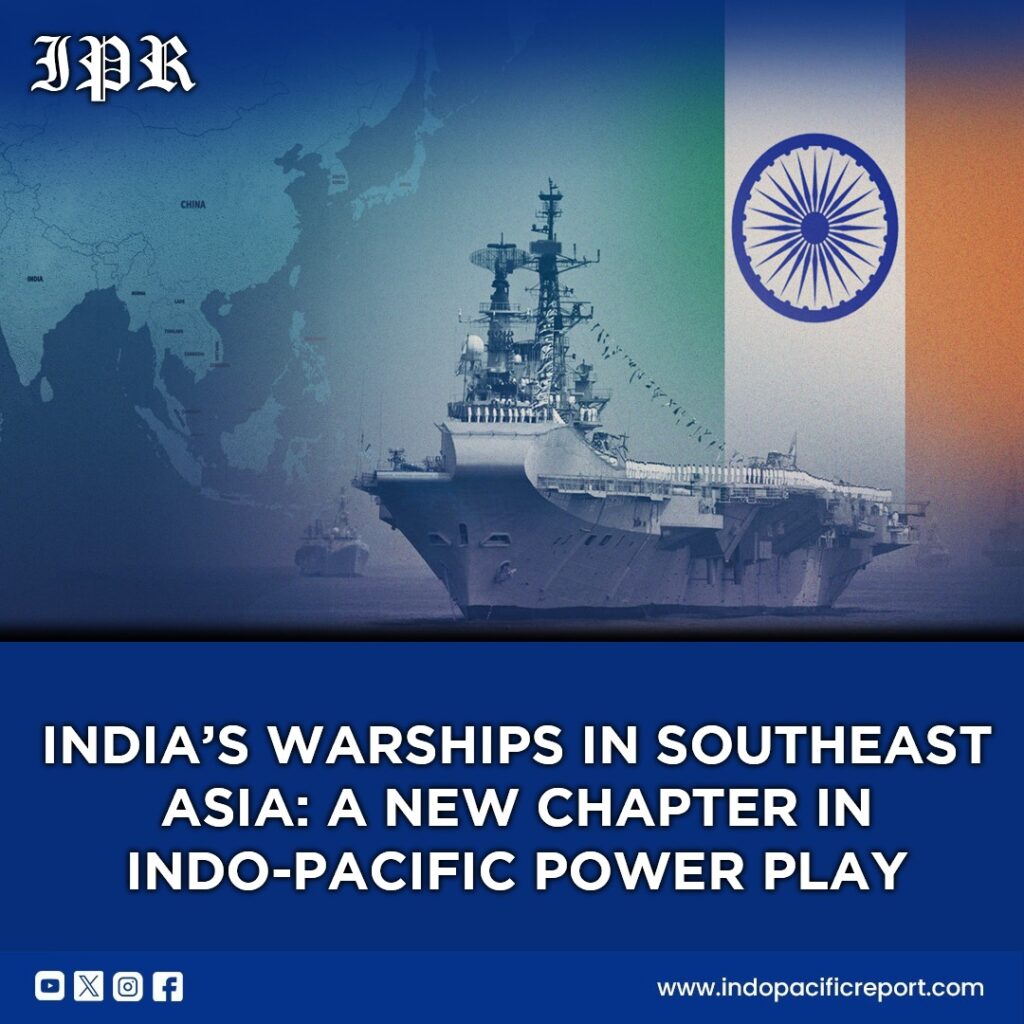
India has sent multiple warships to Southeast Asia, signaling a deeper military engagement with the region. Three vessels—including the guided-missile destroyer INS Delhi, anti-submarine corvette INS Kiltan, and fleet tanker INS Shakti—have arrived in the Philippines for joint exercises, while the stealth frigate INS Satpura participates in the 32nd edition of the “Simbex” exercise with Singapore. These operations involve complex drills, including air defense, cross-deck helicopter operations, precision targeting, and VBSS (visit, board, search, and seizure), building mutual trust and operational readiness.
From a great-power competition perspective, India is asserting itself as a strategic counterweight to China’s growing naval dominance in the South China Sea and the wider Indo-Pacific. Forward naval deployments allow India to project power, demonstrate deterrence, and signal to both allies and rivals that it is a credible maritime actor.
In terms of regional security architecture, these exercises strengthen interoperability between friendly navies and promote collective maritime stability. By combining operational drills with technology transfers—like the BrahMos supersonic cruise missile already supplied to the Philippines and potential sales of Akash air defense systems—India integrates its defense diplomacy with practical capacity-building for regional partners.
Regarding alliance dynamics, India’s engagement reinforces bilateral ties with the Philippines and Singapore while sending a subtle strategic signal to ASEAN nations. These partnerships are flexible, avoiding formal alliance commitments while creating security interdependencies that enhance India’s influence in Southeast Asia.
From a maritime and economic strategy lens, India’s deployments help secure key sea lines of communication (SLOCs) critical to trade, energy, and resource flows. By operating in contested waters and demonstrating advanced naval capabilities, India boosts surveillance, strengthens deterrence, and ensures freedom of navigation—particularly in areas sensitive to Chinese maritime assertions.
The Indo-Pacific balance of power is subtly shifting as India combines operational presence with defense exports. While China remains the dominant regional naval power, India’s proactive engagement allows it to shape perceptions, reinforce deterrence, and enhance regional multipolarity. For the Philippines and other ASEAN countries, this presence provides an additional layer of security without formal alliance entanglements.
Forward-looking assessment: India’s Southeast Asia deployments show a strategic mix of power projection, partnership-building, and defense diplomacy. By combining operational exercises with arms exports, India positions itself as a stabilizing force and credible counterweight in the Indo-Pacific.
Audience Question: Should Southeast Asian countries deepen defense cooperation with India to balance China, or could this increase regional tensions?
Geopolitically Relevant Hashtags:
#IndiaNavy #IndoPacificStrategy #ASEANSecurity #ChinaCounterbalance #MaritimePower #DefenseDiplomacy #BrahMos #RegionalStability