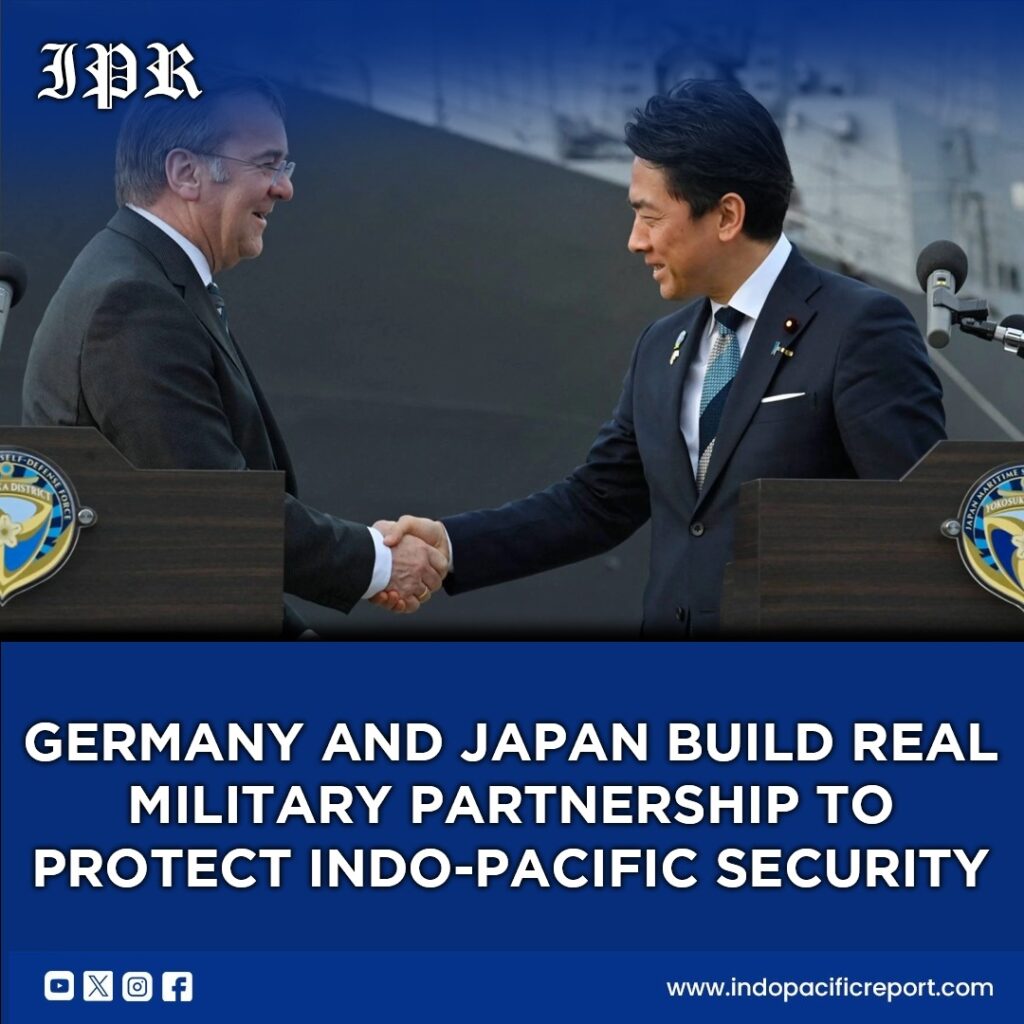
Germany is moving beyond symbolic diplomacy toward a practical security partnership with Japan. On March 22, 2026, German Defense Minister Boris Pistorius and Japanese Defense Minister Shinjiro Koizumi agreed to establish regular military consultations spanning peacetime planning to crisis response. Pistorius also proposed a Reciprocal Access Agreement (RAA) to streamline joint exercises, force deployments, and port visits between the Bundeswehr and Japan’s Self-Defense Forces.
This initiative marks a major strategic shift. Berlin has historically treated the Indo-Pacific as distant theater, but the move signals that European powers are now actively integrating into Asian security architectures. Tokyo, for its part, has long sought European partners to broaden its deterrence posture against regional threats. Together, Germany and Japan are signaling that Indo-Pacific stability is no longer Asia’s responsibility alone—it is a shared concern for democratic powers globally.
The proposed RAA builds on an existing legal framework that includes a 2021 information-security agreement, the 2+2 dialogue, and the 2024 Acquisition and Cross-Servicing Agreement (ACSA). While the ACSA ensures reciprocal supply exchanges, an RAA would reduce legal and operational barriers for visiting forces, enhancing interoperability and rapid response capabilities. These frameworks underscore a broader trend: Europe is operationalizing its Indo-Pacific presence rather than relying solely on symbolic visits or statements.
Already, practical deployments show progress. German naval vessels visited Japan in 2024, Japanese F-15s were deployed to Germany in 2025, and Pistorius’ visit this week included defense industry representatives. These moves emphasize strategic consultation, joint operational planning, and industrial cooperation, moving beyond diplomacy toward a partnership with real-world operational impact.
In the context of great-power competition, this development demonstrates Europe’s desire to hedge against China’s growing assertiveness while also reinforcing U.S.-led security architectures in the region. By establishing a permanent coordination mechanism, Germany and Japan signal that they are ready to respond collectively to threats to regional stability, blending Euro-Atlantic and Indo-Pacific security interests.
Strategic takeaway: The Berlin-Tokyo partnership is a clear example of the globalizing of Indo-Pacific security. European powers are no longer distant observers—they are becoming active operational partners in the defense of critical sea lanes, freedom of navigation, and regional deterrence. This partnership also raises broader questions about how Europe balances transatlantic commitments with direct involvement in Asia.
Audience question: Will European operational engagement in the Indo-Pacific strengthen regional deterrence, or could it provoke unintended escalation with China?