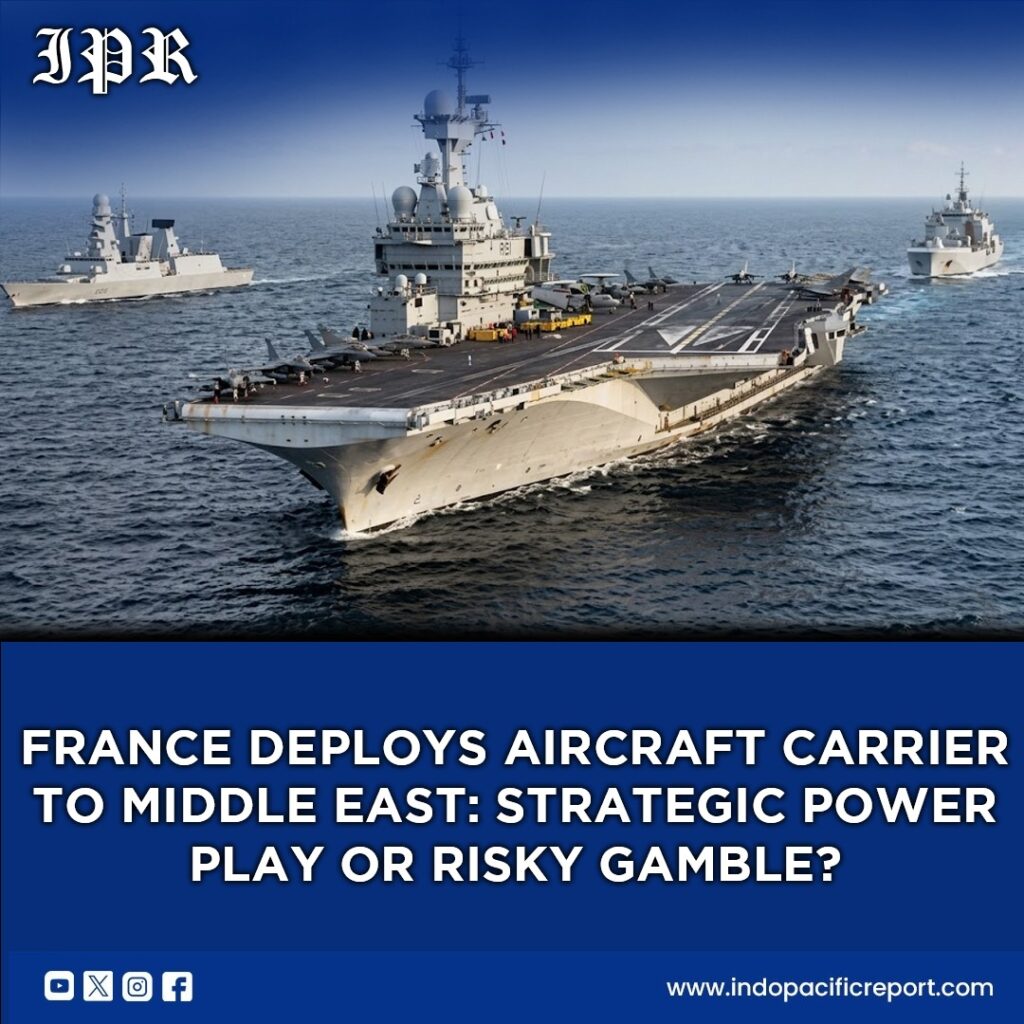
France has ramped up its military presence in the Middle East, sending the nuclear-powered aircraft carrier Charles de Gaulle, warships, helicopter carriers, and Rafale fighter jets to the eastern Mediterranean and nearby waters. President Emmanuel Macron described the move as “unprecedented” but defensive, aimed at protecting French citizens, supporting regional partners, and enabling rapid response in an increasingly volatile region.
More than 400,000 French nationals live across the Middle East, including in Israel and the UAE. The deployment allows France to quickly evacuate its citizens if the conflict escalates, while also signalling its readiness to respond to regional crises. French forces are reinforcing defence ties with Gulf allies such as Qatar, Kuwait, and the UAE, conducting joint air defence and intelligence coordination. Rafale jets have already intercepted drones targeting the UAE, demonstrating operational readiness and deterrence capability.
The military build-up comes alongside intensified diplomacy. Macron has urged de-escalation between Hezbollah and Israel in Lebanon, where renewed fighting has displaced civilians and caused casualties. France continues to support the Lebanese military, provide humanitarian aid, and participate in UN peacekeeping missions. Macron has also engaged directly with regional leaders, including Iranian President Masoud Pezeshkian, Israeli Prime Minister Benjamin Netanyahu, and U.S. President Donald Trump, attempting to create diplomatic channels to contain the crisis.
A key strategic concern for France is the Strait of Hormuz, a vital maritime chokepoint for global oil and gas shipments. Macron has proposed an international effort to secure the waterway, highlighting France’s interest in protecting global trade routes and demonstrating the link between military presence and economic security. This underscores the dual role of France’s forces: deterrence and safeguarding international commerce.
France’s deployment also reflects great-power signalling. By maintaining an independent military presence while coordinating with regional and global partners, Paris asserts its relevance as a security actor capable of influencing outcomes beyond Europe. This sends a clear message to other powers, including China and Iran, that France is prepared to protect its interests and allies in critical regions.
Forward-looking perspective: France’s naval surge is both defensive and strategic, combining rapid-response capability with diplomatic engagement. It strengthens alliances, reinforces maritime security, and positions Paris as a credible stabilizing force. However, the region remains volatile, and diplomatic solutions will likely take time. The move also demonstrates the growing interconnectedness of Middle East and Indo-Pacific security, showing how global powers project influence across multiple theaters.
Debate Question:
Is France’s military surge in the Middle East a stabilizing force, or could it draw Paris into a long-term regional conflict?