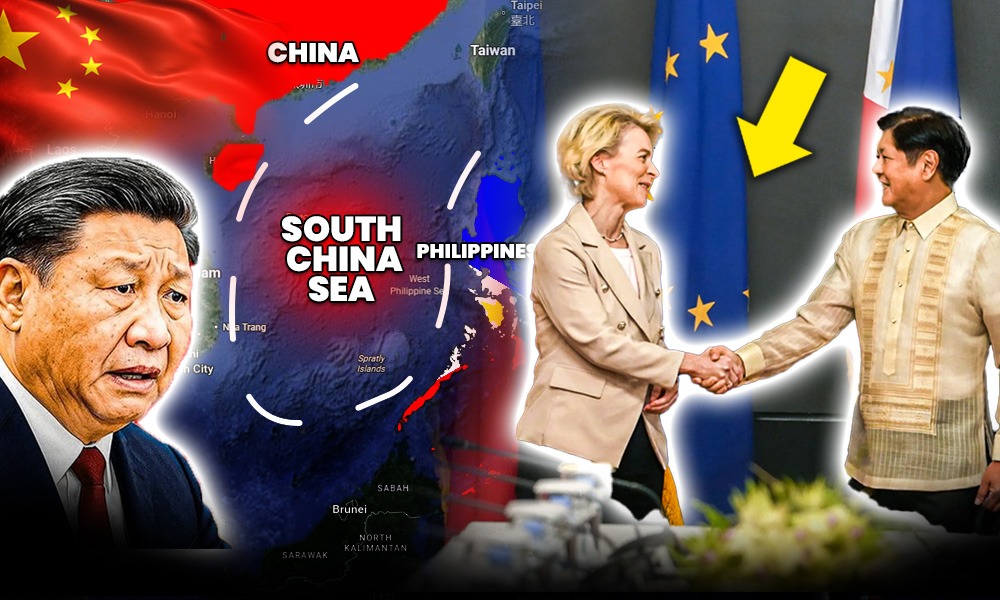
The South China Sea, a flashpoint of power and pride, where overlapping claims and rising tensions have turned calm waters into one of the world’s most dangerous hotspots. For years, China has leaned on its sweeping “nine-dash line” , a claim already struck down by the Hague Tribunal in 2016, yet still enforced on the waves with intimidation, harassment, and coercion. Against this backdrop, the Philippines under President Ferdinand Marcos Jr. has drawn a line in the water, standing firm in defense of its sovereign rights. And now, it isn’t standing alone.
The European Union has stepped forward, pledging support for the Philippines. This isn’t just about diplomacy or friendly words, it’s about principle. At the heart of Europe’s position is a commitment to a rules-based international order and the United Nations Convention on the Law of the Sea. By backing Manila, Brussels is saying loud and clear: the South China Sea isn’t just a regional dispute, it’s a global concern.
And what drives this new alignment? The nature of China’s threat itself. These are not open acts of war, but calculated “gray zone” tactics, water cannons fired at resupply boats, military-grade lasers blinding Filipino sailors, fishing grounds blocked by swarms of maritime militia. Every collision, every blockade, every harassment at sea is a warning shot and each one pushes the Philippines closer to its allies.
That’s where the EU’s support takes on real weight. In the short term, it’s a diplomatic boost, strengthening Manila’s voice on the global stage and proving it has friends beyond the Pacific. But in the long term, calculus is more complex. Can the EU do more than issue statements? Can it match its principles with power, or will China’s economic leverage divide Europe’s stance? Critics argue Brussels lacks the mandate and the will for direct intervention but supporters say its real weapon is legitimacy, law, and global solidarity.
And there’s precedent for that. Look back at past maritime disputes, the Swordfish Case with Chile, or the MOX Plant dispute between Ireland and the UK. In both, Europe didn’t send ships, it sent law, diplomacy, and international institutions. It reframed local conflicts as global issues, forcing resolution not through force, but through legitimacy. That same playbook is now being applied in the South China Sea, with Manila as the test case.
So here’s the bigger picture: the South China Sea is no longer just a regional flashpoint, it’s a global stage where principles of freedom, law, and sovereignty are on trial. The Philippines is no longer facing the gray zone alone. With allies from the U.S. to Japan, from Australia to Canada, and now the European Union stepping forward, Manila is backed by a growing chorus of voices. And every new voice added to that chorus makes it harder for Beijing to ignore.
The EU’s Diplomatic and Legal Support for the Philippines
The European Union’s pledge to stand with the Philippines is not a casual statement, it is anchored in principle, law, and a growing willingness to confront coercion head-on. At its core, Europe’s support rests on the foundation of the rules-based international order and the United Nations Convention on the Law of the Sea (UNCLOS), the global framework that defines maritime rights and responsibilities. For Brussels, defending UNCLOS isn’t just about Asia, it’s about protecting the very system that keeps global trade routes free, secure, and predictable. And nowhere is that commitment more visible today than in the South China Sea.
Over the past year, Manila and Brussels have deepened their relationship in unprecedented ways. High-level meetings have produced joint statements that no longer speak in vague terms about “unilateral actions,” but instead directly condemn what they call “illegal, coercive, aggressive, and dangerous actions” in the South China Sea. That sharper tone represents a shift in European diplomacy, from cautious neutrality to firm alignment with the Philippines. In effect, the EU is no longer just an observer, it is a vocal critic of China’s maritime behavior, placing its weight behind Manila’s position.
And words are now being matched by structure. The two sides have launched a formal Security and Defense Dialogue, a platform that institutionalizes their cooperation. This is more than symbolic. It means Europe and the Philippines now have a regular mechanism to coordinate on a broad range of security challenges: not only maritime disputes, but also cyberattacks, disinformation campaigns, and foreign interference. By embedding this dialogue into their relationship, the EU and the Philippines ensure that cooperation is not temporary or reactive, it becomes routine, strategic, and forward-looking. This is how alliances are built: not in one-off meetings, but in regular habits of collaboration that harden into trust.
Perhaps most importantly, the EU has been unambiguous in its legal support. Brussels has consistently upheld the 2016 arbitral ruling, which invalidated China’s sweeping “nine-dash line” claim. By doing so, the EU reframes the South China Sea issue. It is not, as Beijing argues, a bilateral dispute between the Philippines and China. It is a matter of international law, of compliance with UNCLOS, and of defending the principle that rules, not raw power, determine maritime rights. This legal position is crucial because it means Manila is not standing alone. When it invokes the Hague ruling, it does so with Europe behind it, giving its case more weight in global forums and reinforcing the idea that sovereignty and law cannot be erased by bullying.
Taken together, the joint statements, the creation of a Security and Defense Dialogue, and the EU’s unwavering legal stance all add up to something bigger: the Philippines is no longer just backed by regional partners like the U.S. and Japan, it now has Europe firmly in its corner. And by framing the dispute in the language of international law, Brussels ensures that the South China Sea is not treated as a remote regional quarrel, but as a test case for the future of global order. For Filipinos, this means their struggle is recognized not just as a local defense of fishing grounds, but as part of a worldwide fight for rules, rights, and respect.
The Nature of China’s Threat and Recent Incidents
China’s actions in the South China Sea are rarely open acts of war, but something far more insidious, what experts call “gray zone” tactics. These are carefully calibrated operations meant to assert control, intimidate rivals, and rewrite facts on the water, without crossing the line into full-scale conflict. And for the Philippines, these tactics are not abstract; they’re daily reality, and they’re the primary driver of this deepening cooperation with the European Union.
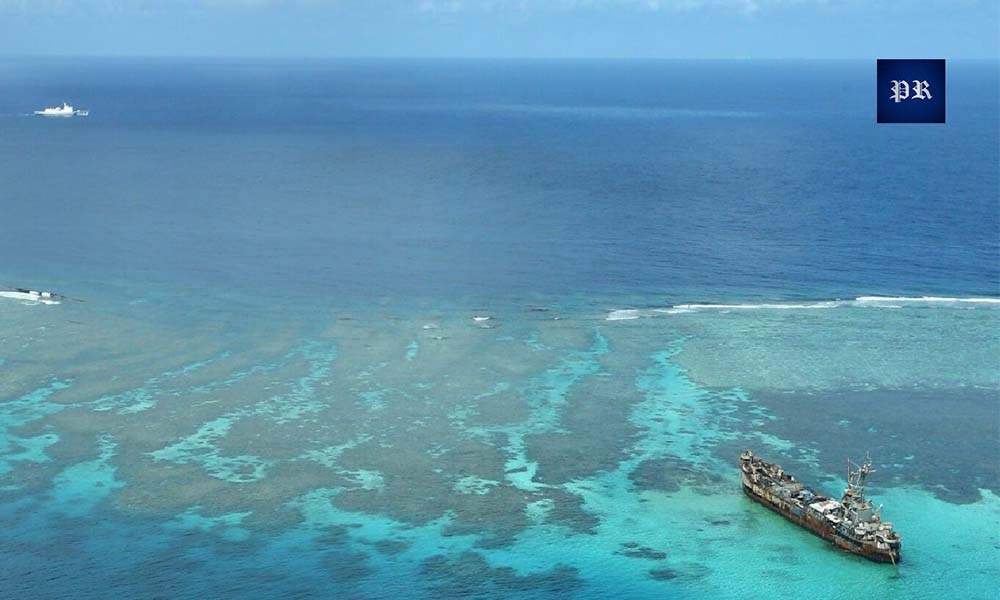
The numbers tell a story of escalation. In just the past year, confrontations between Chinese and Philippine vessels have sharply increased, especially around the Second Thomas Shoal, where a handful of Filipino marines cling to sovereignty aboard the rusting hulk of the BRP Sierra Madre. Chinese Coast Guard ships have repeatedly turned resupply runs into battlegrounds, blasting Philippine boats with high-pressure water cannons, blinding crews with military-grade lasers, and forcing dangerous evasive maneuvers in contested waters. More than once, these confrontations have ended in actual collisions, with both Beijing and Manila trading blame, but the footage speaks volumes: it is almost always the massive Chinese vessels menacing smaller Filipino craft. Meanwhile, China’s so-called maritime militia, swarms of civilian boats armed with state backing, has been documented blocking, ramming, and harassing ordinary Filipino fishermen, inside waters that legally fall within the Philippines’ exclusive economic zone. What should be peaceful seas have become a pressure cooker of intimidation.
Philippine leaders have been blunt in their response. Foreign Affairs Secretary Enrique Manalo recently thanked the European Union for its “clear and principled statements of support,” acknowledging how much international backing matters when facing a giant like China. The EU has echoed Manila’s warnings, calling these actions “illegal, coercive, aggressive, and dangerous.” But Beijing’s reply has been equally blunt: warning Europe to “stay out” of the dispute, insisting it has no right to interfere. That stark exchange captures the moment we’re in. For the Philippines, the threat is urgent and real. For the EU, supporting Manila is about defending the rule of law itself. And for China, the growing chorus of voices against its tactics is a challenge to its narrative of inevitability. The gray zone may not be a war, but it’s already shaping the balance of power in the South China Sea and every collision, every water cannon blast, every blockade brings the risk of something bigger.
The Strategic Calculus: What the EU’s Support Means Now and in the Future
The European Union’s support for the Philippines carries weight far beyond press releases; it has both immediate and long-term implications that will shape not only Manila’s fight for sovereignty, but the entire balance of power in the Indo-Pacific. In the short term, the impact is already visible. Diplomatically, the EU’s vocal backing provides Manila with a much-needed boost, strengthening the Philippines’ hand in international forums and reinforcing the sense that it is not isolated in this struggle against a far larger adversary. It’s not just moral support, it’s legitimacy, recognition, and solidarity from some of the world’s most influential economies and political blocs. For Filipinos, it is also a morale boost, proof that their plight resonates beyond Asia and is being defended on the global stage. But there’s another side: tension. Beijing has already bristled at Europe’s involvement, issuing warnings for the EU to “stay out” of the South China Sea dispute. That rhetoric is more than bluster, it signals that China could respond with sharper provocations, raising the risk of escalation.
In the long term, however, the calculus gets more complicated. Critics argue that for all its strong words, the EU’s support may still be more symbolic than substantive. Unlike the United States or Japan, Europe does not have forward-deployed naval fleets in the region capable of consistently challenging China’s presence. As one analyst put it, “The EU lacks means, mandate, and will for full-scale intervention.” That raises the core question: is the EU here to act as a military counterbalance to China or is its role more about diplomacy, international law, and shaping narratives? That debate will define the credibility of Europe’s presence in the Indo-Pacific.
Economics also complicates the picture. China remains a critical trading partner for many European states. That economic leverage gives Beijing the ability to pursue what experts call a “wedge strategy” using trade and investment ties to weaken or divide the EU’s unified stance on security. If some member states prioritize business over principles, Europe’s collective message could be diluted, and its impact in the South China Sea weakened.
Yet beyond these doubts, one fact is clear: Europe’s engagement in the South China Sea is part of a broader Indo-Pacific strategy. By standing with the Philippines today, the EU is setting a precedent that could extend to others tomorrow, Vietnam, Malaysia, and other nations facing similar gray-zone tactics from China. In this sense, Manila becomes the test case: if EU support here proves meaningful, it could open the door to deeper partnerships and a stronger European role in the region’s security architecture. For the Philippines, this isn’t just about having another ally, it’s about becoming the bridge that connects Asian struggles for sovereignty with global principles of law, freedom, and order.
U.S. Philippines Approve 500 Military Drills for 2026 | China Shocked!
Case Studies of International Maritime Disputes
When we ask what role the European Union can realistically play in the South China Sea, one truth stands out: Brussels is unlikely to send warships to clash head-on with China’s Coast Guard. But that doesn’t mean the EU is powerless. Far from it. Europe’s real weapons have always been diplomacy, law, and the ability to mobilize international legitimacy. And if we look back at past maritime disputes, we see clear precedents for the EU’s current approach in standing with the Philippines.
Consider the Swordfish Dispute between Chile and the EU. For years, the two sides clashed over fishing rights and access to ports for European vessels operating near Chilean waters. This wasn’t a minor spat, it was a long-running tension with economic and environmental stakes. Instead of escalating, the EU chose to lean on international law. It brought the case before the International Tribunal for the Law of the Sea (ITLOS), framing the dispute not as a bilateral quarrel, but as a test of global maritime rules. In the end, the case didn’t spiral into conflict. It was resolved through an amicable settlement, shaped by the legal pressure and diplomatic weight that the EU applied. That strategy is a direct echo of how Brussels now supports Manila: not with battleships, but with law, alliances, and the credibility of institutions.
The MOX Plant Case offers another telling example. This dispute was between Ireland and the United Kingdom over a nuclear reprocessing facility in Sellafield, which Ireland argued threatened the marine environment in the Irish Sea. At first glance, this wasn’t even about geopolitics, it was about safety. But what made it significant was the EU’s role in dispute settlement. Even though the EU wasn’t a direct litigant, it became deeply involved in the legal and institutional process, ensuring that environmental and maritime norms were upheld. This case demonstrated the EU’s unique role as a broker of law and order, able to influence outcomes by embedding disputes into the international legal system. Once again, no military fleet was deployed. The power lay in institutions, law, and persistence.
These examples matter because they reveal the EU’s playbook. When confronted with maritime disputes, Europe doesn’t rush to send carriers or submarines, it internationalizes the issue. It frames it in terms of international law, pulls in institutions like ITLOS or UNCLOS, and applies steady diplomatic pressure until resolution becomes the only option. And that is exactly the model we see today in the South China Sea. By launching a Security and Defense Dialogue with the Philippines, Brussels is doing more than making polite statements, it is institutionalizing cooperation, embedding Manila’s struggle into broader frameworks of law, cyber defense, and security. In effect, the EU is signaling: this isn’t just a spat between China and the Philippines, it’s a test of the international order itself.
The lesson from these case studies is simple: the EU may not deter Chinese ships with force, but it can deter them with legitimacy. Just as it did in the Swordfish Dispute and the MOX Plant case, Brussels is turning regional quarrels into global causes, raising the cost for Beijing to act outside the law. And that has global implications. The Philippines is no longer just a lone outpost fighting off harassment at sea, it’s becoming the frontline case through which the EU, and much of the world, draws a line in defense of law, order, and freedom of the seas.