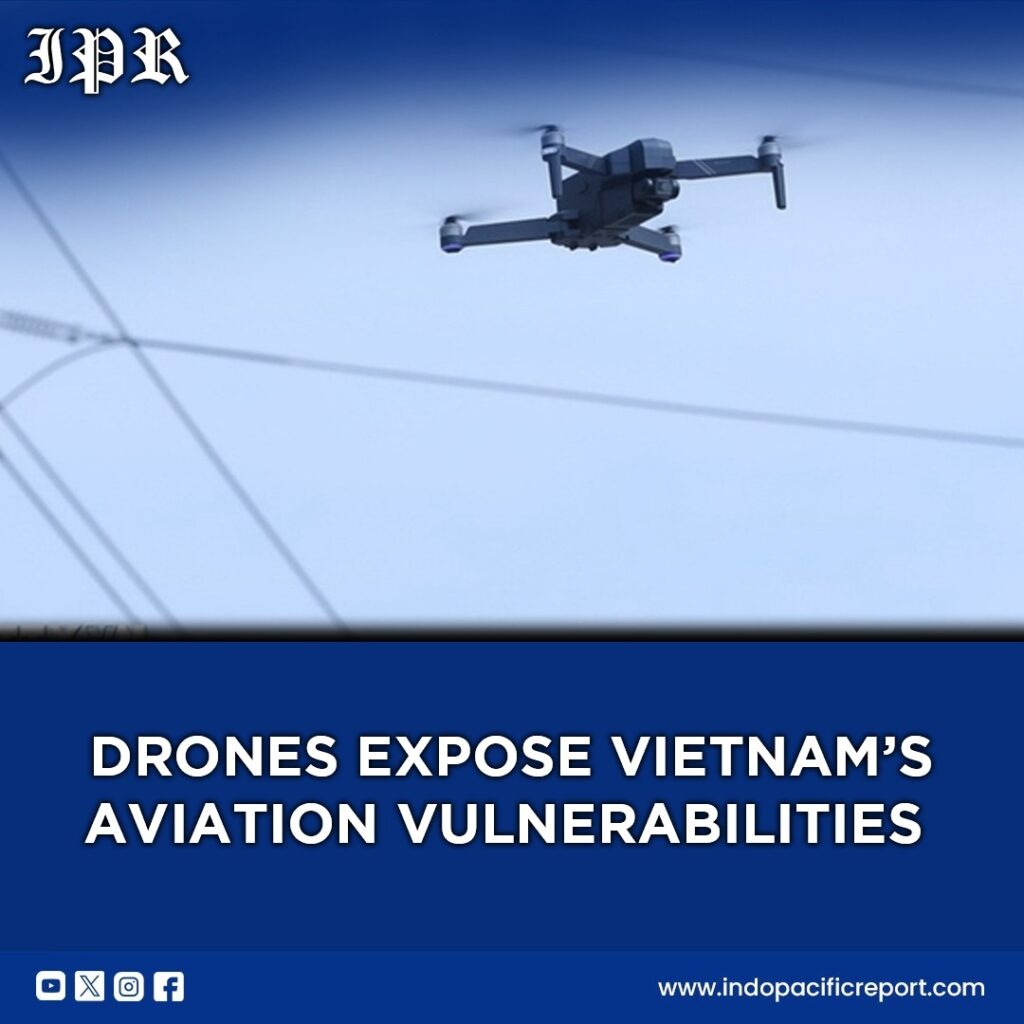
Illegal drone activity is creating serious challenges for Vietnam’s aviation sector. In late February 2026, unmanned aerial systems (UAS) operating near Danang and Cat Bi International Airports disrupted thousands of Vietnam Airlines passengers and caused financial losses of around USD 220,000. Flights were diverted or delayed, and emergency airspace procedures had to be activated. These incidents underscore how low-cost, commercially available technologies can suddenly affect critical infrastructure and national mobility.
From a strategic perspective, drone incursions reveal vulnerabilities in both civil and military airspace management. Airports are not just transport hubs; they are nodes of economic, logistical, and security importance. Repeated drone sightings highlight gaps in detection, rapid response, and inter-agency coordination. Vietnam is now calling for stricter regulations, tougher penalties, and improved civil-military integration to protect airspace. The broader lesson is that emerging technologies, even outside traditional military use, can influence national security.
In terms of regional security architecture, these disruptions reflect a challenge shared by many Indo-Pacific states: hybrid threats that blur civilian and military lines. Low-cost drones can be deployed by non-state actors, competitors, or criminal networks to disrupt transportation, logistics, or surveillance operations. For Vietnam, creating rapid response protocols and integrating military support with civilian authorities is crucial to maintain operational continuity. This also aligns with regional trends where middle powers are forced to innovate in asymmetric threat management.
Alliance dynamics may also be affected. Vietnam could look to partners such as the United States, Japan, and Australia for counter-UAS technologies, intelligence-sharing, and training programs. Such cooperation would not only strengthen domestic airspace security but also signal to regional actors that hybrid threats will be managed proactively. As the Indo-Pacific becomes more contested, these partnerships help maintain deterrence against potential coercion in both civil and military domains.
The economic impact of these drone disruptions is immediate and tangible. Beyond the USD 220,000 in losses for Vietnam Airlines, repeated incidents threaten tourism, trade, and investor confidence. Airspace disruptions can ripple into broader logistical and maritime supply chains. As unmanned systems become more prevalent, protecting critical infrastructure is not just a security imperative—it is an economic one.
Strategically, Vietnam’s experience demonstrates the growing importance of resilience against low-cost, asymmetric threats. Drones could be used not only as tools of mischief but also as instruments of hybrid warfare or economic coercion. Addressing this challenge will require a multi-layered strategy: improved detection, stricter regulations, emergency protocols, and stronger alliances. Countries in the Indo-Pacific that fail to adapt risk operational disruption and diminished deterrence credibility.
Looking forward, Vietnam must treat drone threats as part of its national security calculus. Strengthening civil-military integration, investing in detection and counter-UAS technologies, and formalizing coordination protocols with regional partners will be essential. For the Indo-Pacific, this incident is a warning: asymmetric, low-cost technologies can influence regional stability and require proactive, integrated responses.
Audience Question:
Are drones simply a nuisance, or a new tool of hybrid warfare in the Indo-Pacific?