Energy Showdown: How China’s CNOOC is Moving to Control Oil in Philippine Waters
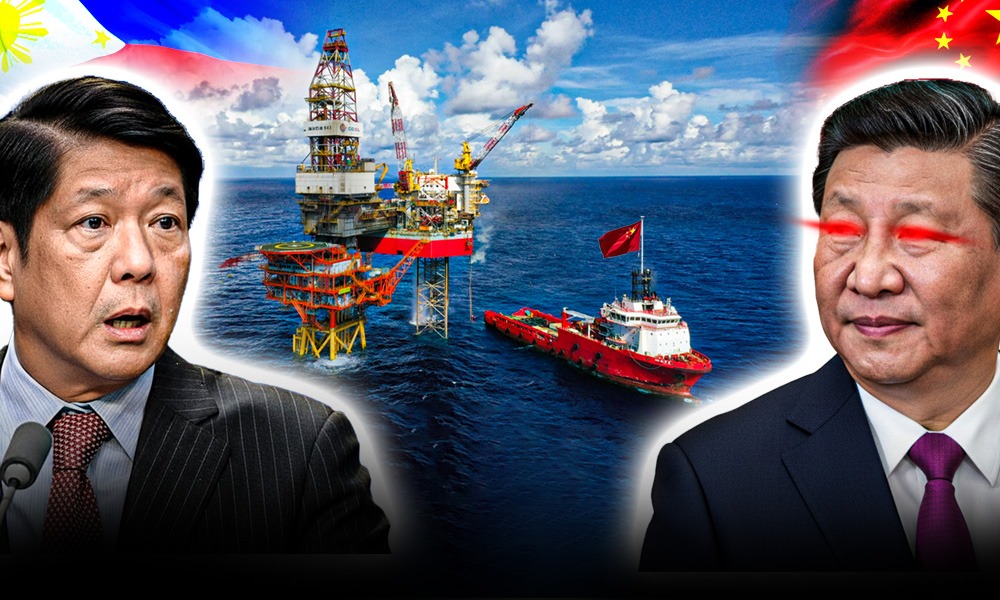
An energy security crisis is brewing for the Philippines. As the vital Malampaya gas field nears depletion, the Recto Bank (Reed Bank) emerges as the nation’s next energy hope—and the epicenter of a dangerous confrontation with China. The China National Offshore Oil Corporation (CNOOC), backed by state-owned power and escorted by Chinese Coast Guard and maritime militia vessels, is expanding its operations deep inside the Philippine Exclusive Economic Zone (EEZ). This strategic push blurs the line between commerce and coercion, leveraging a “carrot-and-stick” approach that offers joint development while systematically blocking Manila’s independent energy projects.
Beijing justifies its presence through the legally invalid “Nine-Dash Line” claim, a narrative of historic rights rejected by the landmark 2016 Permanent Court of Arbitration (PCA) ruling. The driving forces are clear: China’s massive energy needs, its military ambitions for power projection, and a sovereignty narrative it is determined to enforce. The South China Sea holds immense wealth, with estimates of billions of barrels of oil and trillions of cubic feet of natural gas. For the Philippines and other Southeast Asian nations, this presents a critical dilemma: the urgent need for energy security versus the high risk of Chinese economic and military retaliation.
The future of the region hangs in the balance. Control of these waters is about more than oil and gas; it is about power projection, A2/AD (Anti-Access/Area Denial) strategy, and dominance over global sea lanes. The fight for Recto Bank is the frontline test of whether the United Nations Convention on the Law of the Sea (UNCLOS) and the rules-based international order will prevail, or whether coercion and resource extraction will redraw the map of sovereignty in the Indo-Pacific.
CNOOC’s Strategic Advance into the Philippine EEZ
The most immediate flashpoint is Recto Bank, designated as Service Contract 72 (SC 72). Located just 80 nautical miles west of Palawan, this area lies unequivocally within the Philippines’ 200-nautical-mile EEZ under international law. Its hydrocarbon reserves are considered the nation’s best chance to replace the dwindling output of the Malampaya field. However, Manila’s lawful efforts to explore and develop SC 72 have been met with systematic obstruction.
At the heart of this dispute is CNOOC. While presented as a commercial entity, CNOOC functions as a direct instrument of Chinese state policy. Its survey and exploration ships are never alone; they operate under the constant protection of Chinese Coast Guard (CCG) cutters and maritime militia vessels. This corporate-state nexus allows Beijing to frame its incursions as legitimate business while projecting hard power, effectively turning a commercial energy issue into a sovereignty and security crisis.
Concrete incidents underscore this strategy:
- In August 2023, CCG vessels blocked and shadowed Philippine-chartered ships conducting seismic studies near Recto Bank, stalling critical exploration work.
- Simultaneously, resupply missions to the nearby Ayungin Shoal (Second Thomas Shoal) faced aggressive Chinese maneuvers, creating a climate of intimidation.
The message from Beijing is unambiguous: resource extraction in the Philippine EEZ will proceed only on terms dictated by China, with CNOOC as the commercial spearhead and the CCG as its armed enforcer.
Chinese Coast Guard Rams Philippine Vessel Near Pag-asa Island in South China Sea
The Drivers Behind China’s South China Sea Ambitions
Beijing’s strategy is propelled by a powerful mix of historical narrative, energy insecurity, and military ambition.
-
The “Nine-Dash Line” Doctrine: Despite its legal invalidation by the 2016 PCA ruling, China continues to assert its “indisputable historical sovereignty” over most of the South China Sea. This claim provides the ideological foundation for all its activities, allowing it to frame coast guard patrols and resource exploration as acts of sovereign defense rather than regional expansionism.
-
The Energy Security Imperative: As the world’s largest oil importer, China faces the “Malacca Dilemma”—a strategic vulnerability due to its reliance on oil shipments through the narrow Strait of Malacca. The South China Sea’s vast untapped reserves offer a crucial means to diversify its energy portfolio and reduce this dependency. CNOOC, which derived 43% of its 2022 crude output from domestic offshore operations, is central to this mission.
-
Military and Strategic Domination: China’s massive artificial island-building and militarization campaign at features like Fiery Cross Reef, Mischief Reef, and Subi Reef has created a network of fortified bases. These hubs support the People’s Liberation Army Navy (PLAN), CCG, and maritime militia, enabling Beijing to project power deep into the region and enforce an A2/AD bubble that complicates U.S. and allied naval operations.
Philippines Defense Chief Condemns Latest Chinese Escalation at Ayungin Shoal
The Stakes: Immense Resource Wealth and National Survival
The South China Sea is a resource nexus of global significance. According to the U.S. Energy Information Administration (EIA) and the Center for Strategic and International Studies (CSIS), the region holds an estimated 11 billion barrels of oil and 190 trillion cubic feet (TCF) of natural gas in proved and probable reserves.
For the Philippines, the resources at Recto Bank are existential. Estimates suggest the bank holds up to 3.4 TCF of gas and 440 million barrels of oil. This represents the only viable domestic replacement for the Malampaya field, which currently supplies about 20% of the country’s electricity but is projected to be depleted by 2027. Failure to develop Recto Bank would force a costly shift to imported Liquefied Natural Gas (LNG), potentially raising power costs by 50% and crippling the nation’s energy independence.
Beyond hydrocarbons, the South China Sea is a vital source of food security, accounting for 12% of the global fish catch, and a potential treasure trove of deep-sea minerals essential for the high-tech industry.
Regional Dilemmas: The Littoral States’ Precarious Balance
The Philippines is at a sharp crossroads, but it is not alone. Other Southeast Asian claimants face similar pressures:
- Vietnam: Has resisted Chinese pressure at Vanguard Bank but has also been forced to suspend exploration projects under intense diplomatic and economic coercion from Beijing.
- Malaysia: Prefers a quieter approach, pursuing joint ventures in less contested areas to avoid direct confrontation while still asserting its rights.
- Brunei: Generally prioritizes its economic relationship with China, keeping its territorial claims muted.
This dynamic reveals a common challenge: all littoral states must balance their sovereign rights under international law against the immense economic and military pressure exerted by Beijing.
China-Malaysia Vs. Japan-Philippines Drills Expose Deepening Rivalries in South China Sea
The “Joint Development Trap” and the Fight for the Future
China’s primary tool for stalling regional energy development is gray-zone coercion, notably its “White Hull Strategy.” By using coast guard and militia vessels instead of naval warships, Beijing maintains constant, intimidating presence while avoiding a military casus belli. This creates a low-level, high-tension environment where Chinese vessels outnumber and outmuscle their regional counterparts.
A second, equally effective tool is economic deterrence. International energy companies like Forum Energy, contracted by Manila for SC 72, have faced explicit threats from Beijing. The risk of losing access to the massive Chinese market or facing harassment at sea has led many foreign partners to withdraw, depriving the Philippines of the crucial investment and technology needed for deep-water drilling.
This leads to the “joint development trap.” Beijing often promotes joint ventures as a solution, but these typically require claimant states to set aside the 2016 PCA ruling and implicitly accept Chinese claims. Such deals offer short-term energy gains at the cost of long-term sovereign rights.
Philippines Defense Chief Condemns Latest Chinese Escalation at Ayungin Shoal
Conclusion: A Test of Law Versus Power
The standoff at Recto Bank is a microcosm of a larger global contest. The expansion of CNOOC’s operations in the Philippine EEZ is not a simple commercial dispute; it is the frontline of a strategy to transform an illegal claim into an enforced reality.
The world faces a clear choice: uphold the rules-based order anchored in UNCLOS and the 2016 PCA ruling, or allow a state-owned enterprise, backed by military and paramilitary force, to unilaterally redefine sovereignty through coercion. The fate of SC 72 will serve as the ultimate barometer of the international community’s resolve and will determine whether law or raw power will govern the critical waterways of the Indo-Pacific in the 21st century.