China’s Growing Flotilla: Satellite Images Reveal New Flashpoints in the West Philippine Sea
In December 2025, new satellite evidence from BBC Verify exposed a dramatic escalation in China’s naval posture across the Philippine Sea, revealing flotillas being resupplied at sea, far from home, and operating with the endurance of a true blue-water navy. What Philippine forces have been warning about for months is now visible from orbit: China has shifted from episodic patrols to sustained power projection, deploying destroyers, coast guard cutters, and militia units in a coordinated pattern that stretches from the Miyako Strait to Scarborough Shoal.
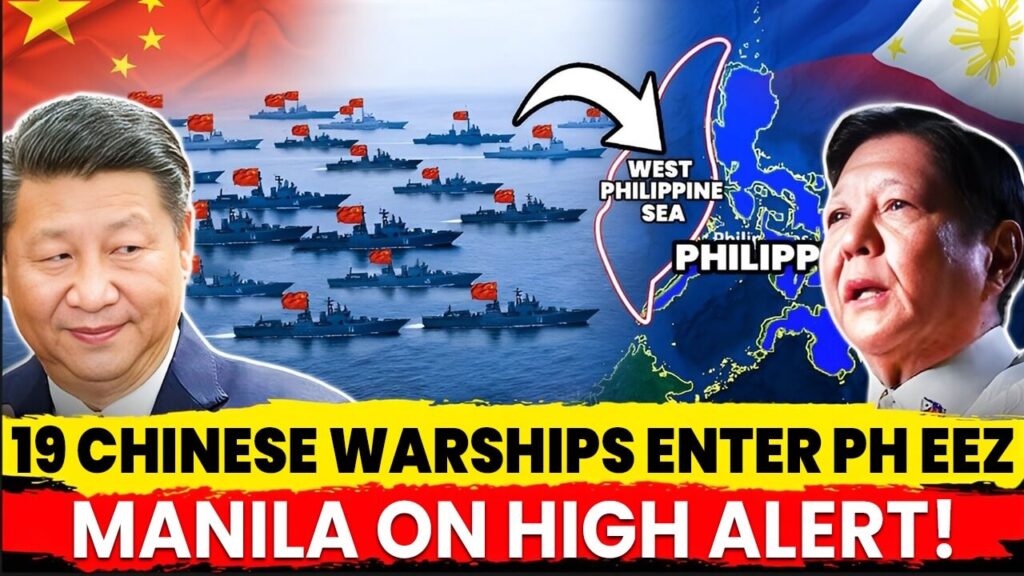
This sustained presence is not happening in isolation. The Philippines recorded 19 Chinese warships in November alone, part of a broader surge that mirrors the intensity of China’s pressure on Vietnam’s Vanguard Bank and Malaysia’s energy fields near Luconia Shoals but with far more aggressive tactics, including helicopter shadowing, water cannon blasts, and the placement of territorial buoys inside another nation’s EEZ.
Meanwhile, Japan, Australia, and even India are observing similar Chinese logistics activity in their own maritime regions. Japan intercepted a Chinese survey vessel near Okinotorishima in November; Australia monitored PLA Navy ships refueling near Christmas Island; and India tracked a Chinese research ship believed to be mapping routes toward the Malacca Strait. Together, these incidents reveal a regional pattern: China is rapidly expanding the reach of a navy that can now operate continuously, not just constantly.
For the Philippines, however, the stakes are higher and more immediate. The PCG has documented a 30–40% surge in Chinese vessels around Ayungin and Scarborough since mid-2025. These flotillas now include destroyers loitering for months, militia boats returning after long absences, and coast guard units that have escalated tactics to dangerous collisions, such as the August 2025 incident, where a Chinese destroyer struck a CCG cutter while chasing a Filipino resupply mission.
Countries like Japan and Vietnam respond with powerful navies of their own, equipped with Aegis destroyers and Kilo-class submarines. But the Philippines faces these incursions with a smaller fleet, relying instead on transparency flights, documentation, alliances, and modernization to counter China’s attempt to normalize its presence. As a senior Filipino official warned, “China is massing the pieces of a long game.”
And now, with fresh proof of extended resupply operations and sustained flotilla deployments, the picture is unmistakably clear: China is preparing for a semi-permanent posture in Philippine waters, a move that could redefine maritime security across the entire Indo-Pacific.
LATEST FLASHPOINT — PCG SPOTS MULTIPLE CHINESE SHIPS NEAR BAJO DE MASINLOC
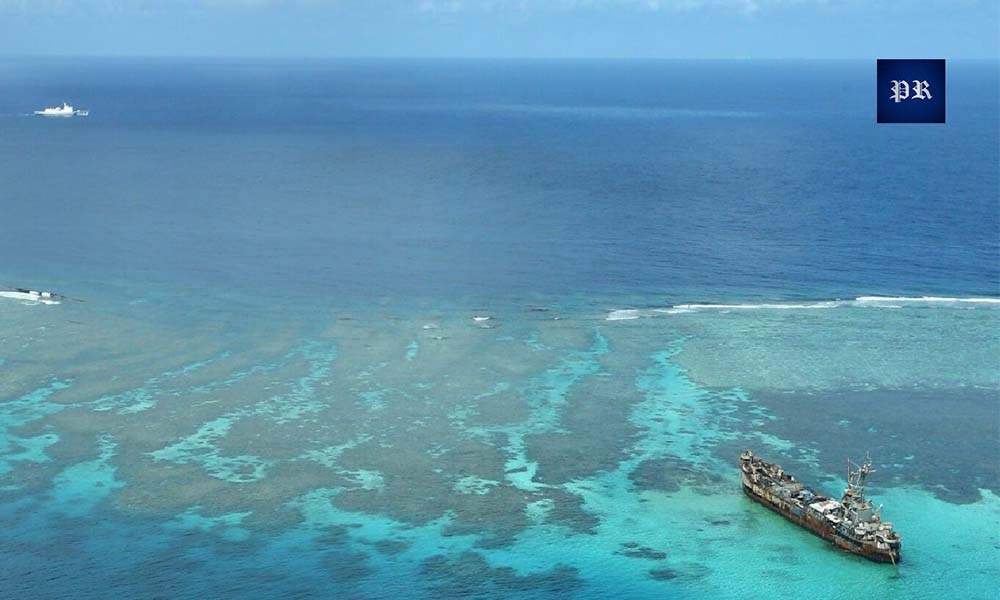
The escalation became even more visible on 3 December 2025, when a routine maritime domain awareness flight by the Philippine Coast Guard detected an unusually large and mixed group of Chinese vessels gathered around Bajo de Masinloc. According to reports from Manila Standard, the PCG crew observed a layered presence: People’s Liberation Army Navy warships, China Coast Guard cutters, maritime militia boats, and even anchored buoys, a familiar indicator of China’s pattern of occupation and area denial. This was not the typical rotation of a few vessels enforcing a blockade. It was a comprehensive formation, structured and deliberate, showing that China maintains a semi-permanent posture around one of the Philippines’ most strategically important maritime features.
The legal implications of this presence are profound. Bajo de Masinloc lies squarely within the Philippine Exclusive Economic Zone, as affirmed under Republic Act 12064 and reinforced by the United Nations Convention on the Law of the Sea (UNCLOS). More importantly, the 2016 Arbitral Award categorically ruled that China has no historic rights within the so-called nine-dash line and that any attempts to enforce control around the shoal violate international law. By massing a blended fleet of naval, coast guard, and militia vessels, China is defying these rulings and challenging the Philippines’ sovereign rights over its waters. In diplomatic terms, this is not a grey area. It is a direct legal contradiction to global maritime norms.
What makes the December 3 incident more alarming is that it fits a growing pattern of escalation rather than a one-off encounter. China’s presence near Scarborough Shoal has shifted from sporadic patrols to systematic, multi-layered coercion designed to normalize control. The combination of warships for deterrence, coast guard vessels for enforcement, militia boats for swarming tactics, and buoys for territorial marking reflects a strategy aimed at establishing de facto authority without firing a shot. As analysts have noted, this is how Beijing gradually transforms contested space into controlled space, through persistence, pressure, and the slow erosion of the status quo.
STATISTICS & DATA — THE SCALE OF THE SURGE
The scale of China’s maritime surge becomes unmistakable when viewed through the hard data collected by Philippine agencies over the past months. In November 2025, the Philippine Navy logged 19 Chinese warships operating across the West Philippine Sea, one of the highest monthly concentrations recorded in recent years, according to reports from the Philippine News Agency and Manila Times. This represents not just an uptick in numbers, but a dramatic expansion of the types of vessels deployed from missile destroyers to intelligence ships and even amphibious platforms. Such figures underline a shift from episodic activity to a continuous, multi-domain Chinese presence within Philippine waters.
The broader maritime picture is equally striking. The National Coast Watch Center reported that a total of 14,972 vessels were monitored across the Philippine maritime zones in November 2025 alone. Of these, 12,450 were foreign vessels, while only 2,522 were domestic, according to data cited by GMA Network. This imbalance, foreign ships outnumbering Philippine vessels almost 5 to 1, sharply illustrates the scale of foreign activity in waters where the Philippines maintains exclusive economic rights. Within this field of foreign presence, Chinese vessels consistently rank among the most active and persistent.
These numbers translate into real-world dangers at sea. In August 2025, a Chinese destroyer collided with a China Coast Guard cutter during an aggressive maneuver while both were chasing a Filipino supply vessel en route to Scarborough Shoal, an incident documented by The Guardian and described as one of the most reckless naval encounters in recent years. On 30 November 2025, the Philippine Coast Guard again reported a layered cluster of Chinese vessels near the shoal, including two PLA Navy destroyers, one replenishment ship, three China Coast Guard vessels, and two maritime militia boats, as reported by Manila Standard. These deployments reveal a formation built for simultaneous intimidation, surveillance, and tactical denial, a textbook gray-zone strategy.
What makes the situation even more concerning is how this on-the-water activity aligns with new satellite evidence. Imagery released in early December confirms that the ships detected by the PCG represent only one part of a much larger regional deployment, with additional Chinese flotillas conducting resupply operations beyond the Philippine EEZ. The vessels visible to Philippine patrols are simply the outward face of a deeper, more coordinated network of Chinese naval activity extending across the Philippine Sea and Western Pacific. In other words, the pressure the Philippines sees is only a fraction of the force China is now capable of projecting.
WHAT THE PCG FOUND ON DECEMBER 3 — A FOCUSED BREAKDOWN
The December 3 surveillance flight provided one of the clearest snapshots yet of China’s layered maritime posture around Bajo de Masinloc. During the routine patrol, the Philippine Coast Guard identified three China Coast Guard vessels, including one positioned at the northern entrance of the shoal, a location often used to restrict access to Filipino fishermen and patrol boats. Alongside them were three PLA Navy ships, consisting of two missile destroyers and a replenishment ship that Philippine officials noted had been loitering in the area for nearly two months. Their long-term presence signals more than intimidation; it reflects sustained operations backed by logistics. Adding to the complexity were two maritime militia boats, appearing for the first time in months, and two Chinese buoys placed both inside and outside the shoal, reinforcing China’s incremental territorial-marking strategy.
The heightened tensions were not limited to maritime activity. As the PCG aircraft conducted its patrol, it was challenged over the radio by PLA Navy ship 553, which issued warnings in an attempt to push Philippine forces away from their own EEZ. The PCG’s response was firm and grounded in international law. The flight crew reiterated the Philippines’ sovereign rights under Republic Act 12064, the United Nations Convention on the Law of the Sea (UNCLOS), and the 2016 Arbitral Award, which invalidated China’s expansive maritime claims. This assertive legal response has become a crucial component of PCG operations, ensuring that every encounter documents Manila’s lawful position.
The confrontation escalated further when China launched a helicopter in what appeared to be an intercept maneuver aimed at the PCG aircraft. Although the helicopter did not reach proximity, the move was unmistakably aggressive, reflecting China’s growing use of airborne intimidation tactics. The PCG disengaged before contact, prioritizing safety while still completing the surveillance mission, demonstrating both restraint and resolve.
Following the incident, the Philippine government issued a clear and unified message. PCG spokesperson Commodore Jay Tarriela emphasized the importance of maintaining vigilance in the West Philippine Sea, declaring, “We are standing for what is ours. That is a patriotic duty.” His statement captured the sentiment felt across the defense establishment, that the Philippines is now confronting a more assertive and coordinated Chinese presence, and every patrol is both a legal assertion and a national responsibility.
PATTERN OF ESCALATION — MORE THAN RANDOM INCIDENTS
What is unfolding in the West Philippine Sea is not a series of isolated maritime incidents, it is a repeatable, observable, and increasingly structured pattern of escalation. Data from Philstar shows that in November 2025 alone, Philippine authorities detected around 30 Chinese vessels, including warships, coast guard cutters, militia boats, and dual-use platforms operating within the country’s maritime zones. This level of activity surpasses normal patrol patterns and reflects a deliberate presence that is renewed month after month. Philippines & EU Strengthen Maritime Cooperation in Brussels Talks
At the core of this pattern is China’s well-documented grey-zone model, a strategy that relies on blending different types of forces to create constant pressure without crossing into open conflict. The mix typically includes PLA Navy ships for high-end deterrence, China Coast Guard vessels for enforcement and blockade operations, maritime militia boats for swarming and harassment, auxiliary ships for logistics, and even strategically placed buoys to signal territorial marking. This structure allows Beijing to assert control incrementally while maintaining plausible deniability and complicating any single-state response.
Independent verification from international sources reinforces this assessment. BBC satellite imagery, released in early December, showed Chinese naval groups conducting coordinated resupply operations, a capability that extends mission duration and allows flotillas to remain in contested waters for weeks at a time. Additionally, OSINT analysts have tracked ongoing expansion at a Chinese naval base linked to these deployments, providing the logistical backbone that supports China’s incursions into the West Philippine Sea and beyond. These developments confirm that what the Philippines sees on radar and patrol flights is only part of a much larger operational architecture.
The implications are serious and far-reaching. China’s sustained presence is an effort to normalize an illegal status quo, conditioning the region to accept Chinese activity as permanent and uncontested. This raises the risk of dangerous miscalculations, from collisions and ramming incidents to helicopter shadowing and the increasingly frequent use of high-powered water cannons. Beyond the geopolitical stakes, these actions directly harm Filipino fishermen, disrupt livelihoods, and erode the maritime order upheld by UNCLOS and the 2016 Arbitral Award. The pattern is clear: China is building a long-term position of dominance, one incremental deployment at a time.
LEGAL & SECURITY CONSEQUENCES
China’s escalating activities around Bajo de Masinloc and across the West Philippine Sea carry profound legal implications. Each intrusion, blockade, and deployment stands in direct violation of UNCLOS, which defines the Philippines’ sovereign rights over its Exclusive Economic Zone. These actions also contradict the 2016 Arbitral Award, which invalidated China’s nine-dash line and ruled that Beijing has no lawful basis to prevent Filipino vessels from accessing the area. Further compounding the issue, China’s conduct breaches the Philippine Maritime Zones Act, which codifies national jurisdiction over the region. Legally, the situation is unambiguous: China’s actions undermine both international maritime law and Philippine domestic law, setting a dangerous precedent for the region.
The consequences on the ground or rather, at sea, are felt most directly by Filipino fisherfolk. China’s blockades, aggressive maneuvers, and harassment have sharply reduced access to traditional fishing grounds that generations of Filipinos have relied on for their livelihood. In several documented cases, high-powered water cannons deployed by the China Coast Guard have not only driven fishermen away but have injured Filipino crew members and damaged their boats, depriving already vulnerable communities of income and safety. With these waters becoming increasingly militarized, small fishers now face uncertainty every time they set sail, navigating the risks of intimidation, interception, and forced displacement.
Strategically, China’s long-term deployments reveal a deeper and more concerning trajectory. The combination of persistent naval presence and newly demonstrated at-sea resupply capability points to a strategy designed for endurance, consolidation, and eventual normalization of Chinese control. Analysts warn that these patterns reflect preparations for a semi-permanent forward presence, allowing Chinese vessels to maintain pressure indefinitely without needing to return to port. Viewed together, these developments indicate not random assertiveness but a carefully executed occupation strategy, one that tests the limits of international law, regional stability, and Philippine sovereignty with each passing month.
THE PHILIPPINE RESPONSE — HOLDING THE LINE
In the face of China’s expanding presence, the Philippines has adopted a strategy rooted in transparency, consistency, and lawful assertion of maritime rights. Daily Philippine Coast Guard flights now serve as the country’s frontline in the information domain. These patrols expose Chinese activities that would otherwise remain hidden, ensuring that every blockade, buoy placement, and hostile maneuver is documented and brought into the public and diplomatic arena. By refusing to allow silent occupation, the PCG has transformed routine surveillance into a strategic tool, one that prevents China from operating uncontested in Philippine waters.
On the water, the Philippine Navy and Coast Guard have undertaken deliberate counter-maneuvers to challenge Chinese vessels directly. Ships like the BRP Cabra have repeatedly confronted China Coast Guard units, most notably vessel 21562, which has been heavily involved in blockades and shadowing operations around contested features. These encounters, often measured and carefully executed, demonstrate Manila’s resolve to maintain presence in its own EEZ despite China’s attempts to dominate the space through intimidation and swarming tactics.
Diplomatically, the Philippines is building a detailed legal and historical record of every incident. The Department of Foreign Affairs filed 47 diplomatic protests in 2025 alone, signaling a sustained effort to challenge China’s actions through formal channels. Each protest documents violations of UNCLOS, the Arbitral Award, and Philippine domestic law, reinforcing the country’s legal position and ensuring that China’s activities cannot be normalized without challenge. The diplomatic track is both symbolic and practical: it asserts legitimacy while creating a foundation for international support and future legal recourse.
Parallel to these immediate responses is the long-term effort to strengthen the country’s defense posture. The arrival of new offshore patrol vessels from South Korea, the soon-to-be-deployed BrahMos coastal defense missile system, and the proposed acquisition of Japan’s Chu-SAM air defense system collectively signal a shift toward a more capable and deterrence-oriented Armed Forces of the Philippines. The expansion of EDCA sites with the United States enhances joint interoperability and rapid response potential, while upgraded MDA radar networks improve maritime awareness across the archipelago. Together, these developments form the backbone of a modernization program designed not just to react to threats but to deter and shape strategic outcomes in the years ahead.
WHAT CHINA IS TRYING TO ACHIEVE — THE STRATEGIC LENS
China’s actions in the West Philippine Sea follow a clear strategic logic: the gradual normalization of an illegal presence. By repeatedly deploying warships, coast guard cutters, militia boats, and auxiliary vessels, Beijing aims to transform what should be temporary incursions into what it calls “routine operations.” Over time, the goal is to shift regional expectations so that China’s presence is not viewed as an intrusion, but as a permanent reality.
To achieve this, Beijing employs a mixed-force pressure strategy designed for plausible deniability. Warships provide the deterrent backdrop, coast guard vessels enforce blockades, militia units conduct harassment, and buoys or survey craft mark territory without the appearance of overt militarization. This layering allows China to operate beneath the threshold of open conflict while steadily expanding its footprint.

At the same time, these deployments serve a psychological purpose. The persistent presence of armed ships, helicopter shadowing, loudspeaker warnings, and water cannon attacks seeks to intimidate Filipino fishermen, pressure the Philippine Coast Guard into retreat, and project an image of unchallenged dominance to Southeast Asia. This is psychological warfare conducted in broad daylight, aimed at convincing local actors that resistance is dangerous and ultimately futile.
Behind all these tactics lies a long-term strategic ambition: to establish functional control over Scarborough Shoal and the waters surrounding it. By creating conditions where the Philippines is continuously on the defensive, China hopes to entrench a semi-permanent forward operating presence, one that places Beijing in command of one of the most valuable maritime choke points in the entire South China Sea.
CONCLUSION — A REGIONAL TURNING POINT
The emerging picture is unmistakable. The combination of new satellite evidence and on-the-ground sightings by the Philippine Coast Guard reveals that China is no longer operating in the West Philippine Sea as a dispersed collection of vessels, but as a large-scale, fully supported flotilla force with logistical endurance and coordinated purpose. November’s record-high count of 19 Chinese warships and the December confrontation near Scarborough Shoal confirm an escalation that is both sustained and strategic.
Why Indonesia Can’t Match the Philippines’ Transparency Initiative Against China?
This moment marks a critical turning point for the region. China’s posture suggests a move toward prolonged confrontation, one supported by resupply capability, forward deployments, and multi-layered coercion. Whether this strategy succeeds will depend heavily on the Philippines’ response: continued transparency patrols, legal assertion, strengthened alliances, and sustained defense modernization. Each flight, each protest, each new radar installation becomes part of a larger struggle to prevent China from shaping permanent “facts on the water.” And so the battle for the West Philippine Sea has entered a new phase, one defined not only by what happens at sea, but by what the world can now witness from space.
Final Line: The battle for the West Philippine Sea is no longer just at sea; it is now visible from space.