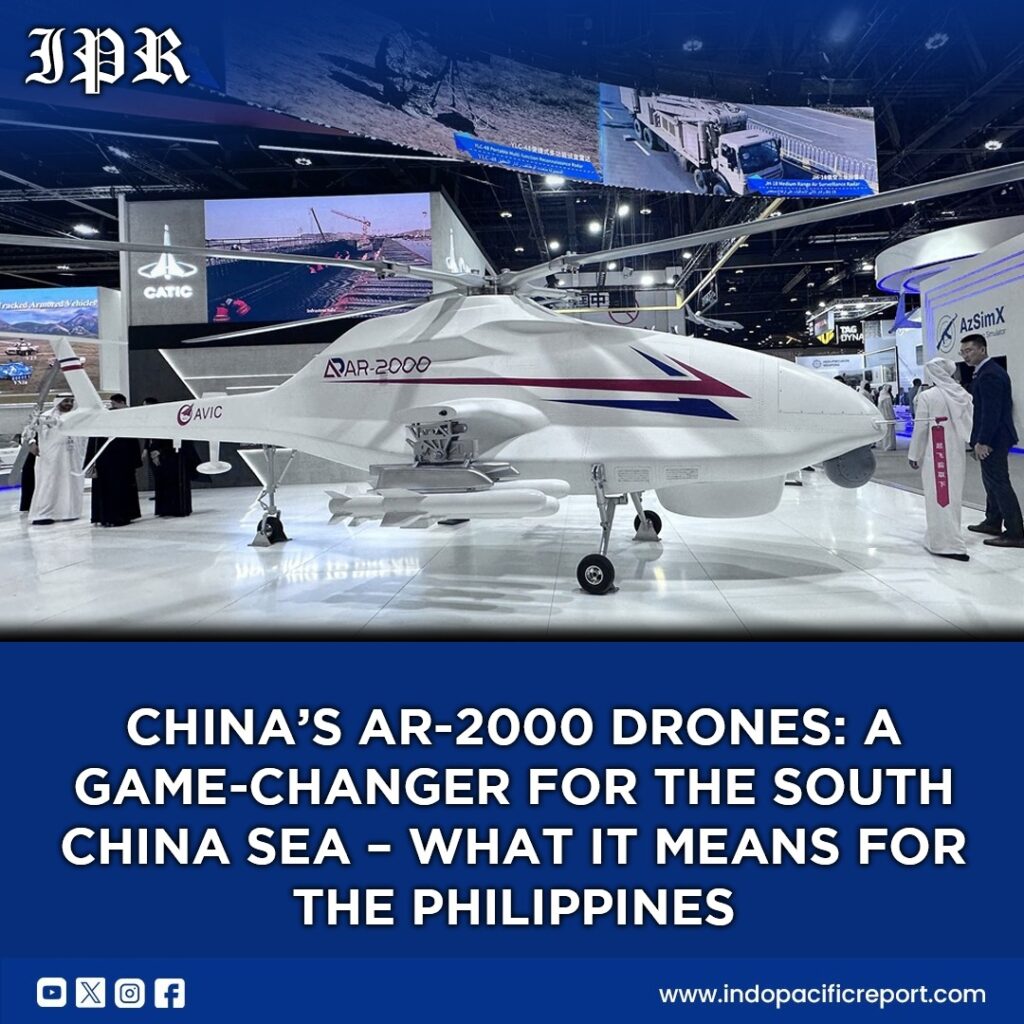
China’s deployment of the AR-2000 shipborne drone helicopter signals a subtle but significant shift in how Beijing projects maritime power in the Taiwan Strait and the South China Sea. The AR-2000, a lightweight autonomous helicopter capable of reconnaissance, strike, and anti-submarine missions, has been tested on the PLAN’s Type 075 amphibious assault ship. Its autonomous take-off and landing capabilities allow China to expand surveillance and operational reach from both large amphibious platforms and smaller island features, extending influence across contested waters while limiting exposure of crewed aircraft.
From a great-power competition lens, the AR-2000 enhances China’s asymmetric naval capabilities. By integrating drones into its amphibious assault and island defense operations, China increases its operational tempo and situational awareness, complicating U.S. and allied monitoring. The ability to project unmanned air assets from small islands or lightly built features reduces reliance on large infrastructure, which in turn strengthens Beijing’s capacity to assert control over contested maritime areas without overt escalation. For regional competitors like the Philippines, this development signals a more persistent and agile Chinese presence near their exclusive economic zone (EEZ).
Within the regional security architecture, the AR-2000 strengthens China’s surveillance and anti-access capabilities in the South China Sea. These drones can monitor foreign naval movements, provide ISR support for island garrisons, and act as early warning platforms against intruding vessels or aircraft. For Manila, this adds a layer of operational complexity: Philippine forces must now account for unmanned aerial surveillance as a constant presence, raising risks of miscalculation during routine patrols or joint exercises with allies. The drone’s potential use in island seizure or rapid-response operations could further shift the balance of maritime power toward Beijing.
Alliance dynamics are also affected. The Philippines relies on the U.S. and other allies for extended deterrence, particularly in countering Chinese assertiveness. The operational deployment of AR-2000 drones challenges traditional alliance frameworks by presenting persistent, low-profile threats that do not escalate into conventional conflict immediately but erode strategic confidence. The Philippines may have to push for increased ISR capabilities, drone countermeasures, and rapid-response training to maintain parity, potentially deepening military dependence on Washington while seeking regional intelligence-sharing partnerships with ASEAN neighbors.
From a maritime and economic strategy perspective, these drones enhance China’s control over sea lines of communication, fishing zones, and energy exploration areas. For the Philippines, particularly around Scarborough Shoal and other contested areas, the AR-2000’s presence increases the difficulty of asserting sovereignty or enforcing maritime rights. Economic activity such as fishing, resource exploration, and trade patrols could become more tightly monitored or restricted, reinforcing China’s de facto control without requiring overt military escalation.
The implications for Indo-Pacific balance of power are significant. Persistent drone operations, coupled with amphibious ship deployments, reinforce China’s anti-access/area-denial (A2/AD) posture and expand its ability to protect nuclear deterrent assets such as SSBNs. For the Philippines and other claimants, these developments mean that strategic deterrence can no longer rely solely on legal claims or conventional naval presence; it must integrate technology, rapid-response forces, and international alliance coordination. The presence of autonomous drones introduces a new layer of operational complexity that could normalize surveillance and low-intensity pressure as part of China’s maritime strategy.
Forward-looking assessment: The AR-2000 represents a broader trend toward unmanned naval capabilities shaping the South China Sea. For the Philippines, it underscores the need to enhance asymmetric defense capabilities, improve early-warning systems, and reconsider maritime doctrine in light of persistent Chinese surveillance and potential rapid-response operations. ASEAN and U.S.-aligned forces may need to adapt rules of engagement, intelligence-sharing frameworks, and counter-drone strategies to prevent miscalculations that could escalate tensions. The Philippines’ strategic planning will increasingly require integrating unmanned threats into both peacetime monitoring and crisis scenarios.
Debate Question: How should the Philippines respond to China’s growing drone presence: expand its own unmanned capabilities or rely on alliances for deterrence?
Hashtags:
#SouthChinaSea #ChinaNavy #AR2000Drone #PhilippinesDefense #MaritimeSecurity #IndoPacificStrategy #A2AD #Geopolitics