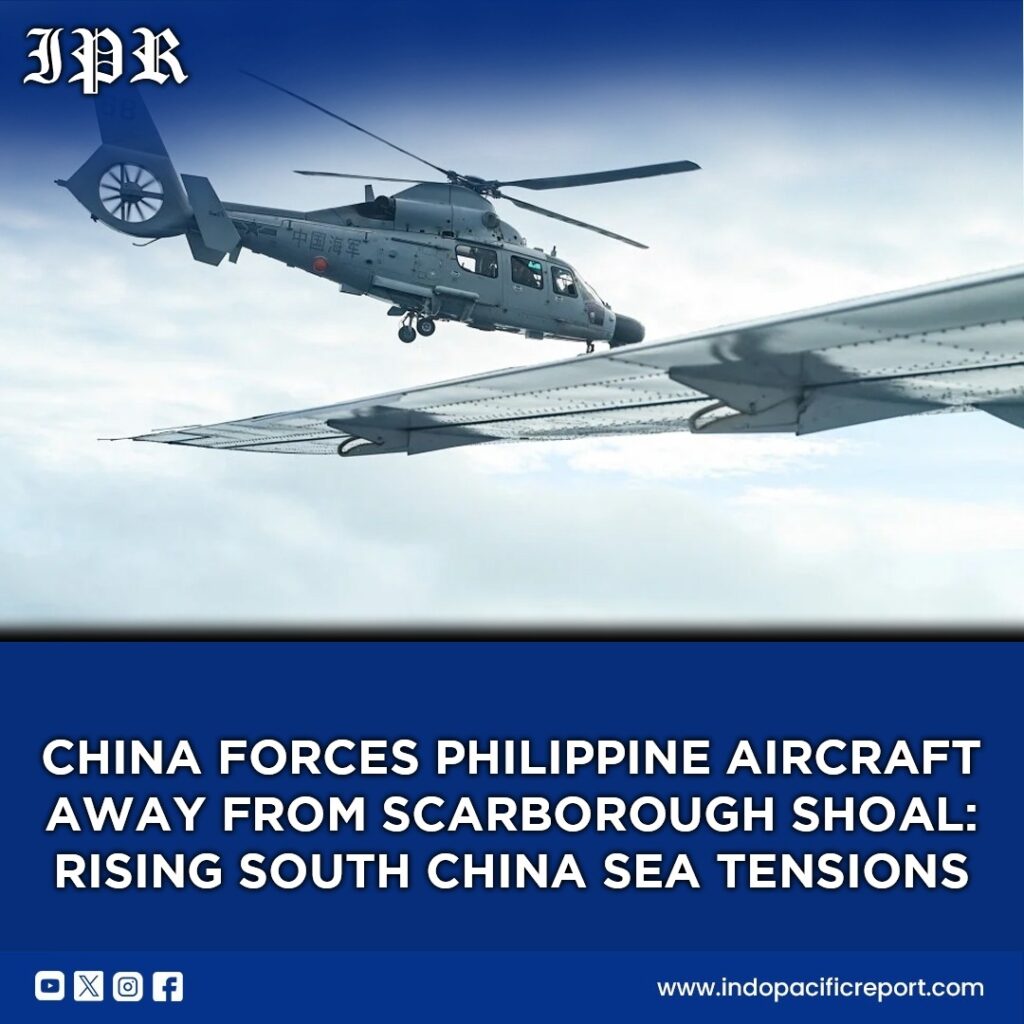
On March 18, 2026, Chinese forces deployed naval and air assets to intercept and expel two Philippine aircraft operating over Scarborough Shoal, a disputed feature in the South China Sea. Beijing’s Southern Theatre Command labeled the Philippine flights as an “illegal intrusion,” issuing a stern warning to Manila to cease provocations. The Philippines’ embassy in Beijing did not immediately respond to requests for comment. While the encounter involved only two aircraft, it underscores the persistent tensions in maritime Asia and highlights the increasingly assertive posture of China in contested waters.
From the perspective of great-power competition, this incident reflects China’s ongoing effort to consolidate control over strategic maritime space. Scarborough Shoal lies near key sea lanes and within the broader Luzon Strait–South China Sea corridor, a choke point for global trade and regional naval movements. By actively contesting Philippine operations, Beijing signals its willingness to enforce territorial claims even against Southeast Asian states allied with the United States. The confrontation is a reminder that China views maritime sovereignty and access control as central to its regional influence, projecting power in both kinetic and symbolic ways.
The event also highlights the vulnerabilities in regional security architecture. The Philippines, while a treaty ally of the United States under the Mutual Defense Treaty (MDT), lacks the capacity to deter Chinese air or naval action independently. This limits Manila’s operational flexibility over contested maritime zones. For ASEAN and other regional institutions, the incident demonstrates the challenge of maintaining a rules-based order in areas where territorial claims overlap with strategic corridors. Without robust multilateral enforcement mechanisms, small states remain exposed to coercive tactics from larger powers.
Alliance dynamics are equally critical. While the US maintains defense partnerships and conducts freedom-of-navigation operations in the South China Sea, the Philippines’ recent moves—such as joint exercises near the Bashi Channel—illustrate a dual strategy: leveraging American deterrence while remaining sensitive to Chinese reprisals. The Scarborough Shoal encounter may influence Manila to recalibrate the pace and visibility of its patrols and aerial missions, highlighting the delicate balance of deterrence versus provocation in US-Philippine security cooperation.
From a maritime strategy standpoint, the incident underscores the importance of surveillance, forward basing, and air-sea integration. Scarborough Shoal, though relatively small, occupies a geostrategic position along major shipping and submarine routes. Control or denial of such outposts affects regional maritime mobility, enabling China to monitor and potentially restrict allied naval operations. For the Philippines, operating near contested features is both a signal of sovereignty and a risk to aircraft and crew, emphasizing the operational trade-offs of asserting presence in high-tension zones.
Strategically, the Scarborough Shoal confrontation carries broader implications for Indo-Pacific balance of power. It reflects China’s willingness to impose costs on Southeast Asian states for exercising sovereignty, reinforcing its coercive leverage in the South China Sea. For the US and allied partners, ensuring freedom of navigation and credible deterrence requires a combination of joint patrols, force presence, and multilateral signaling. Small states’ reliance on external security guarantees will remain a cornerstone of regional strategy, even as Beijing continues to invest in surveillance and anti-access capabilities.
Forward-looking assessment: Scarborough Shoal will likely remain a flashpoint for Chinese-Philippine tensions. Future incidents may involve more sophisticated surveillance, drone activity, or expanded naval deployments. Manila’s strategy will require careful balancing of sovereignty assertion and alliance management, ensuring deterrence without escalation. For Washington and its partners, supporting the Philippines and ASEAN maritime security initiatives will be critical in maintaining strategic equilibrium across the South China Sea.
Audience Question: Can small Southeast Asian states realistically assert sovereignty in the South China Sea without triggering direct confrontation with China, or is strategic restraint the only viable path?