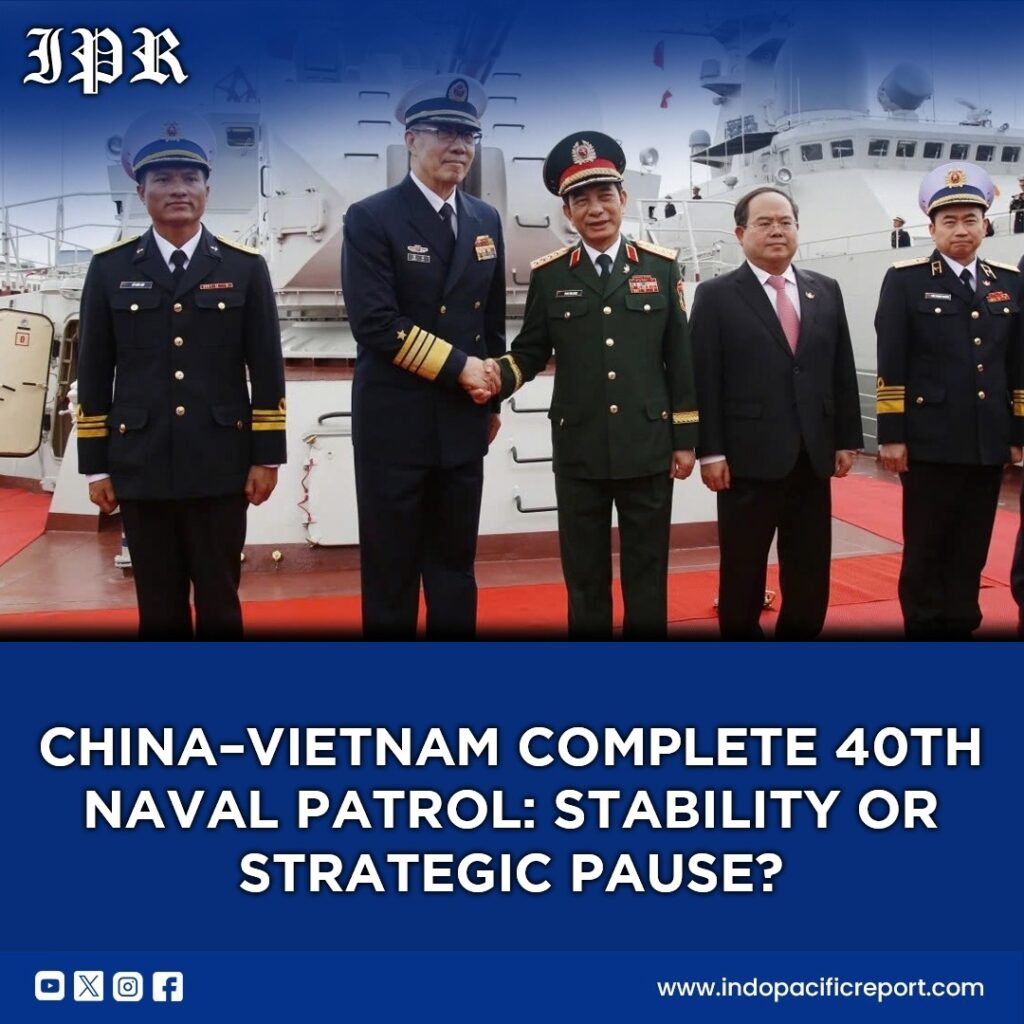
The 40th joint naval patrol in the Gulf of Tonkin between the navies of Vietnam and China, conducted alongside the broader 10th Vietnam–China Border Defence Friendship Exchange, reflects a structured attempt by two strategic neighbors to stabilize one of Asia’s most historically sensitive maritime spaces. The deployment of Vietnam’s missile frigates Tran Hung Dao and Ly Thai To, alongside China’s Hengyang and Enshi, signals more than routine cooperation. It is a calibrated form of maritime management between two states that remain both partners and competitors in the broader Indo-Pacific system.
From a great-power competition perspective, this exercise sits within China’s broader dual-track regional strategy. Beijing continues to assert its influence across the South China Sea, but it also invests in localized stability mechanisms with neighboring states. The Gulf of Tonkin is a controlled environment where China and Vietnam can demonstrate cooperation without addressing deeper territorial disputes elsewhere. This separation of “manageable seas” from “contested waters” is deliberate. It allows Beijing to reduce friction on one front while maintaining strategic pressure in others. For smaller regional actors, this creates a complex reality: cooperation with China in one zone does not necessarily translate into reduced tension elsewhere.
For Vietnam, the 40th joint patrol reflects a disciplined hedging strategy. Hanoi has no interest in open confrontation with China, but it is equally determined to avoid strategic dependence. By participating in regular joint patrols, naval training, and defence exchanges, Vietnam maintains channels of communication that reduce the risk of accidental escalation. At the same time, it continues to diversify its external security relationships with partners such as the United States, Japan, and India. This dual-track approach—engagement with China alongside external balancing—remains the core of Vietnam’s maritime strategy.
The regional security architecture in Southeast Asia is increasingly defined by these bilateral, operational mechanisms rather than broad multilateral frameworks. ASEAN continues to provide diplomatic space, but it lacks enforcement capacity in maritime security. In contrast, China–Vietnam naval coordination is practical, routine-based, and operationally focused. The Gulf of Tonkin patrol mechanism—now repeated 40 times—has evolved into a stability instrument. It is designed not to resolve sovereignty disputes, but to manage day-to-day risks such as miscommunication, fishing incidents, and naval encounters. This reflects a broader shift in Indo-Pacific security: stability is increasingly built through repetitive military interactions rather than formal treaties.
From a maritime and economic strategy perspective, the Gulf of Tonkin is more than a symbolic space. It is a key corridor for trade, fisheries, and coastal economic activity. The joint patrol structure, including formation sailing, escort operations, search and rescue, and anti-piracy drills, is intended to ensure predictable behavior in a congested maritime environment. The use of missile frigates on both sides highlights that even “cooperative” zones are militarized. This is the defining paradox of modern Indo-Pacific maritime governance: cooperation occurs, but it is conducted through military assets rather than civilian institutions.
Alliance dynamics also shape the meaning of these exercises. Vietnam is not part of a formal alliance system, but it is increasingly embedded in a network of security partnerships. China, meanwhile, uses bilateral defence diplomacy to prevent the consolidation of a unified balancing coalition against it in Southeast Asia. By maintaining structured military engagement with Vietnam, Beijing reduces incentives for Hanoi to fully align with external powers. However, this does not eliminate strategic hedging. Vietnam continues to modernize its forces and expand ties with extra-regional actors, ensuring that engagement with China does not become strategic dependency.
The implications for the Indo-Pacific balance of power are therefore nuanced. The 40th joint patrol does not represent alignment, nor does it signal détente. Instead, it reflects managed competition—where rivalry and cooperation coexist within defined operational boundaries. This model helps reduce immediate instability in the Gulf of Tonkin, but it does not resolve deeper structural tensions in the South China Sea. In effect, stability is being compartmentalized. Some maritime zones are tightly managed, while others remain highly contested.
Looking forward, the key strategic question is whether this compartmentalized stability can endure under rising regional pressure. As naval activity increases across the Indo-Pacific and great-power competition intensifies, localized mechanisms like the Gulf of Tonkin patrol will face greater strain. A crisis in a neighboring maritime theater could quickly spill over into these cooperative frameworks. For now, China and Vietnam are demonstrating that even asymmetric rivals can maintain structured naval engagement over time. But the durability of this system depends on continued restraint, predictable communication, and a shared interest in avoiding escalation.
In the broader Indo-Pacific context, the 40th joint patrol highlights a central reality: maritime stability is no longer absolute. It is managed, conditional, and repeatedly renegotiated through operational practice rather than fixed agreements.