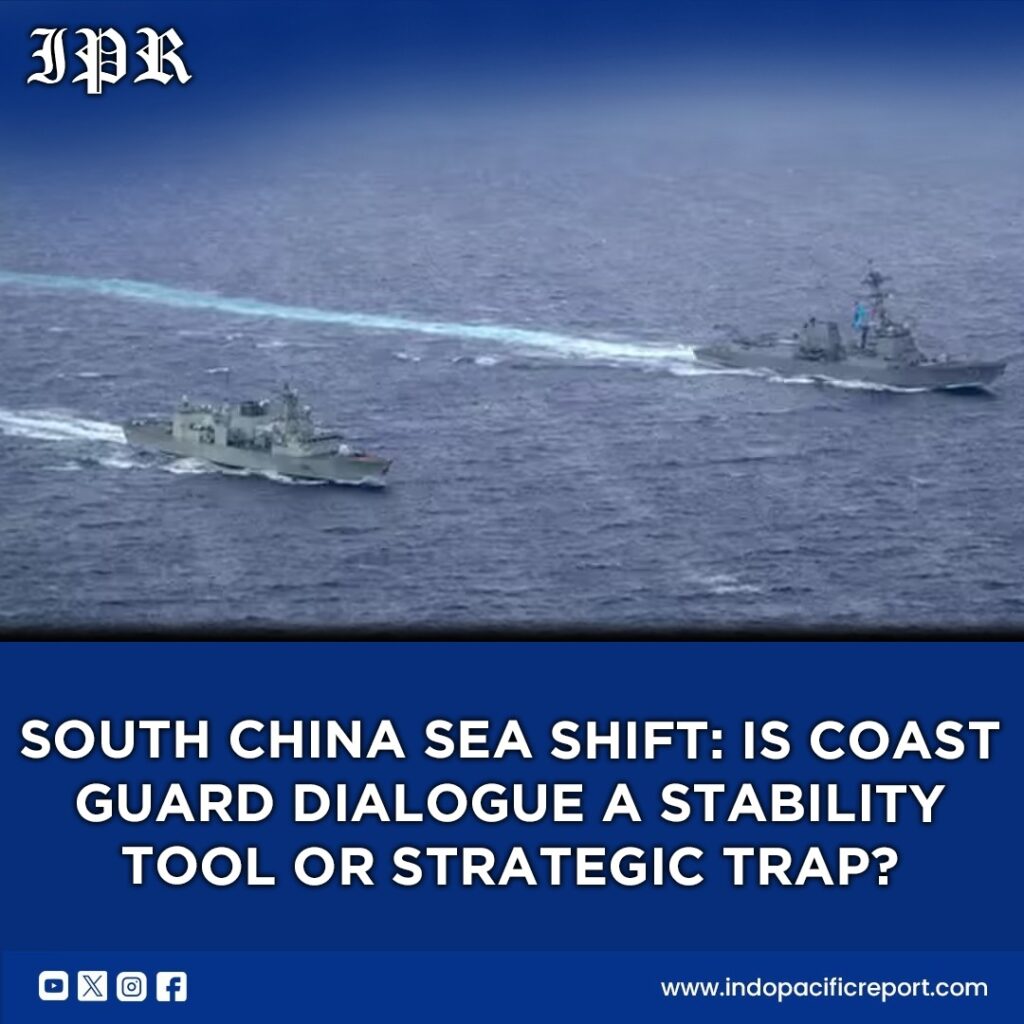
Across the West Philippine Sea, something unusual is happening. At the same time that Philippine and Chinese vessels continue to face tense and sometimes dangerous encounters at sea, both governments are also exploring a possible agreement between their coast guards. This looks contradictory at first. But in reality, it reflects a familiar pattern in modern geopolitics: states can compete fiercely at sea while still talking about limited cooperation to manage risk.
At the level of great-power competition, this development fits into China’s broader gray-zone strategy. Beijing does not need open war to advance its position in the South China Sea. Instead, it uses coast guard ships, maritime militia, and constant presence operations to gradually strengthen control over disputed waters. These actions are often below the threshold of armed conflict but still create pressure on smaller states. At the same time, China promotes selective cooperation—such as search and rescue or environmental protection—to appear responsible and reduce diplomatic backlash. This is strategic signaling, not a shift in core claims.
For the Philippines, the situation is more complex. Manila is a U.S. treaty ally and part of a wider security network in the Indo-Pacific. At the same time, it shares close geographic proximity with China and faces direct pressure in its Exclusive Economic Zone. The Philippine Coast Guard has been at the frontline of repeated confrontations, including water cannon incidents and dangerous maneuvers near resupply missions to Second Thomas Shoal. Because of this, the Department of Foreign Affairs is exploring dialogue mechanisms with Beijing, while parts of the security establishment appear cautious about formal cooperation that could legitimize China’s behavior. This shows an internal tension: diplomacy seeks de-escalation, while operational forces prioritize deterrence and sovereignty protection.
Regionally, this coast guard dialogue is part of a wider and fragile security architecture in the South China Sea. Mechanisms like the Bilateral Consultation Mechanism and ongoing ASEAN–China talks on a Code of Conduct are designed to reduce the risk of escalation. But they do not resolve the core problem: overlapping territorial and maritime claims. Instead, they function as crisis-management tools in a highly contested maritime space. In this system, communication channels matter, but they do not replace power politics. The Philippines is trying to balance bilateral talks with China, multilateral ASEAN diplomacy, and its alliance commitments—all at the same time.
At sea, the reality remains tense. Despite periodic understandings on resupply missions to grounded Filipino forces at Second Thomas Shoal, other areas like Scarborough Shoal remain highly contested. Filipino fishermen and government vessels still report harassment and restricted access. Even when incidents are managed better, the underlying strategic competition has not disappeared. Instead, it is being carefully controlled to avoid escalation while still maintaining pressure.
The key strategic question is what this “coast guard cooperation” actually produces. If narrowly defined, it may reduce accidents and miscalculation at sea. But if it expands too far, it could slowly normalize China’s stronger maritime position in disputed waters. This is the central dilemma for Manila and its partners: how to manage day-to-day stability without weakening long-term deterrence.
In the end, this is not just about coast guards. It is about how power is being managed in the Indo-Pacific—through a mix of pressure, restraint, and carefully limited cooperation. The South China Sea is becoming a space where conflict is avoided, but competition never stops.
Can limited cooperation at sea really reduce conflict, or does it risk slowly accepting an unequal status quo?