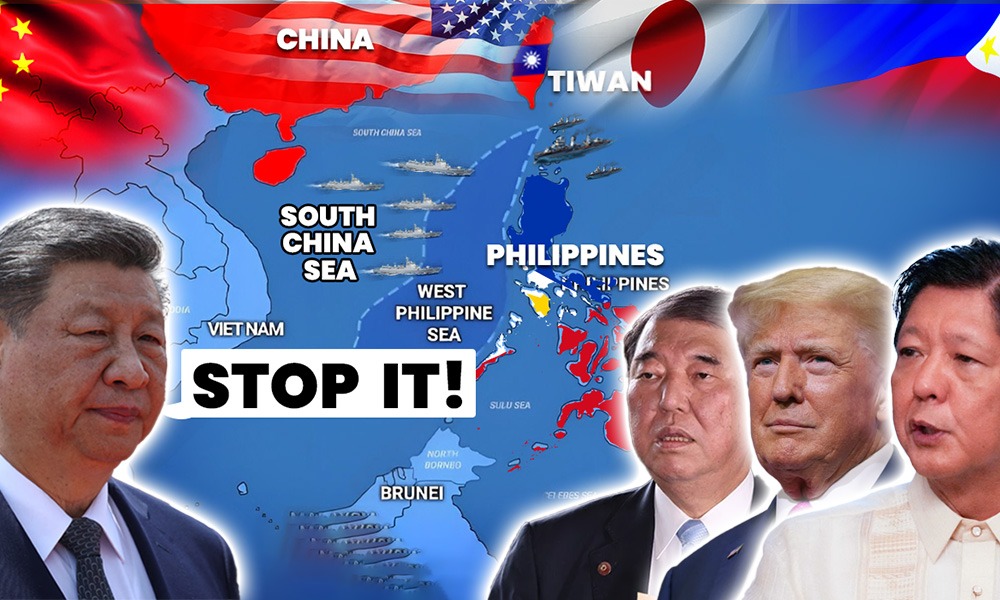
Back off or face the consequences.” That’s the sharp warning China just gave to the Philippines, as tensions rise in the hotly contested waters of the West Philippine Sea. But here’s the twist, instead of backing down, the Philippines is leaning in harder, locking arms with the United States and Japan in what Beijing sees as a direct challenge to its power.
This isn’t your usual diplomatic disagreement. It’s turning into a full-blown standoff, with warships, fighter jets, and surveillance drones now part of the equation. China claims almost the entire South China Sea using its infamous Nine-Dash Line, but international law, specifically the 2016 ruling under UNCLOS, clearly says those waters belong to the Philippines. Yet despite this, Chinese vessels keep entering our EEZ, intimidating our fishermen, blocking resupply missions, and now demanding we end military cooperation with our closest allies.
But the mood in Manila is changing. There’s a growing sense of unity and purpose. “Hindi kami magpapasindak,” a Navy officer told reporters near Palawan. “These waters are ours. We’ll defend them with or without a warning.” The recent joint drills with the U.S. and Japan are just the beginning. This year, the U.S. pledged over $100 million in military support, expanded base access under EDCA, and launched high-level defense talks aimed at modernizing the AFP. Japan, too, has stepped in, quietly but effectively, sending patrol vessels, radar systems, and training teams to help secure Philippine waters.
From the outside, this might look like a regional spat. But don’t be fooled, over $3 trillion in global trade flows through this sea. If conflict breaks out, oil prices could skyrocket, trade routes could be disrupted, and global stability will shake. This is why Washington and Tokyo are stepping in hard. For them, defending the Philippines is not just about friendship, it’s about keeping the Indo-Pacific free, open, and out of China’s grip.
Meanwhile, Beijing sees this growing triangle of cooperation, Manila, Washington, Tokyo, as a dangerous bloc. State-run media have called it “provocative” and “destabilizing,” with Chinese diplomats now warning of “serious consequences” if military drills continue. But this narrative doesn’t sit well with most Filipinos. After years of intimidation in our own backyard, the tide of public opinion is shifting. More Filipinos now support alliances that strengthen national defense, because sovereignty isn’t negotiable.
There’s a quiet strength rising in the archipelago. We’ve seen the laser incidents, the water cannon attacks, the coast guard blockades, and now, we’re seeing resolve. For the first time in years, it feels like the Philippines isn’t standing alone. And that sends a message far louder than any missile test: we’re here, we’re watching, and we won’t be pushed around.
So here’s the big question: will China escalate further or rethink its strategy? Will the West Philippine Sea become a flashpoint or a turning point? One thing’s certain: the world is watching, and the Philippines is no longer just reacting, it’s shaping the future of the region.
China’s Perspective and Warnings
From Beijing’s point of view, the West Philippine Sea isn’t up for negotiation. “It’s ours, always has been,” is the line China keeps pushing. Despite a 2016 international tribunal ruling that completely invalidated its historical claims, China still clings to the so-called Nine-Dash Line, a sweeping boundary that slices through the South China Sea like a territorial guillotine. According to China’s Foreign Ministry, these waters, including those inside the Philippines’ EEZ, fall under what they call “indisputable sovereignty.” In short: China doesn’t care what international law says, it’s sticking to its story.
And they’re not just talking, they’re ignoring the law outright. When the Permanent Court of Arbitration ruled in favor of the Philippines in 2016, calling China’s historical claims legally void and baseless, Beijing responded with a flat-out rejection. Fast forward to 2025, and nothing’s changed. “The ruling is null and void, and non-binding,” declared Foreign Ministry Spokesperson Guo Jiakun just days ago. In China’s eyes, the entire South China Sea dispute is a domestic issue. So when the U.S. and Japan join Philippine military drills? China sees it not as diplomacy but as foreign interference.
Lately, China’s tone has sharpened and the warnings are no longer subtle. In official statements released this July, Beijing has been filing formal diplomatic protests against joint PH-US-Japan exercises. These aren’t mere press releases, they’re full-on rebukes, accusing the three countries of “provoking confrontation” and “undermining regional peace.” Chinese Defense Ministry spokesperson Jiang Bin even called the alliance a “dangerous small circle” language meant to divide, discredit, and intimidate.
And then there’s the classic veiled threat. In one statement, China warned the Philippines against “colluding with other countries to act as scaremongers.” Translation? Stop working with the US and Japan or expect consequences. That’s how China plays: not always loud, but always calculated. Every word has weight. Every protest has a purpose.
But it’s not just rhetoric. On the water, China’s already showing its hand. More coast guard vessels. More military ships. More “swarming” tactics near Second Thomas Shoal and Scarborough. Just weeks ago, Filipino supply boats were harassed again, blocked, shadowed, and even hit with water cannons. These aren’t isolated incidents. They’re signals, messages written in waves and steel.
China is flexing with its own large-scale military exercises in the South China Sea, drills designed to intimidate, project power, and remind everyone: we’re here, and we’re watching. These war games aren’t just for training. They’re psychological warfare, aimed straight at the Philippines and its allies.
Then there’s the economic pressure card, one China hasn’t fully played in this case but has used in the past. When countries speak out against Beijing or strengthen ties with the U.S., Beijing has quietly pulled investment, slowed trade, or applied regulatory pressure. It’s soft power with hard edges and it works.
China’s message is loud and clear: “We will not tolerate a triangle of military cooperation in what we claim as our backyard.” But the world, especially Filipinos, has heard this tone before. The difference now? We’re not just listening. We’re pushing back.
The Philippines’ Strategic Reorientation and Assertiveness
After years of walking a tightrope between China and the West, the Philippines is making a bold move and this time, it’s unmistakable: we’re turning back to our old allies, and we’re turning strong. Under President Ferdinand Marcos Jr., the country is shedding the ambiguity of the Duterte era and going all-in on a strategy that places national defense and international partnership front and center.
This isn’t just a diplomatic reset. It’s a full-on military and strategic overhaul. President Marcos Jr. made it clear during his visit to the U.S. earlier this year: the South China Sea situation is changing fast, and the Philippines is changing with it. Gone is the appeasement strategy; in its place is a $35-billion modernization plan to turn the Armed Forces of the Philippines into a credible, high-tech defense force. Think advanced naval ships, fighter jets, missiles, cyber defense, even Japanese Abukuma-class destroyer escorts are now part of the picture.
And it’s not just hardware. It’s about who’s standing beside us when the pressure builds. The U.S.-Philippine alliance is no longer just symbolic. It’s operational, growing, and loud. The Mutual Defense Treaty (MDT) has been reaffirmed, with both sides now stating clearly: if the Philippines is attacked in the South China Sea, the U.S. will respond. That’s a red line. And it’s being underlined with boots, drills, and real-time readiness.
The Enhanced Defense Cooperation Agreement (EDCA) is expanding rapidly. More U.S. troops rotating through more bases across Luzon, Palawan, and other key locations. Why? To train shoulder-to-shoulder with Filipino troops and ensure rapid response capabilities in case of emergencies. The Balikatan and Kamandag joint exercises aren’t just getting bigger, they’re evolving. Now they include cyber warfare simulations, space defense training, and HIMARS missile system deployments. This is no longer symbolic, it’s a strategic muscle. “Modernizing our military is a direct response to the changing situation in the South China Sea,” President Marcos Jr. said during his U.S. visit. And that message is resonating both in Washington and across the Philippine archipelago.
But it’s not just the U.S. stepping up, Japan has entered the chat, and with serious intent. In a major policy shift, Tokyo has signed a new defense pact allowing Japanese troops to join joint drills on Philippine soil, something unthinkable just a few years ago. Their support isn’t just symbolic either. Through their Official Security Assistance (OSA) program, Japan is providing patrol boats, radars, surveillance equipment, and the tools we need to actually monitor and protect our seas.
And the numbers speak volumes. In 2023, Japan’s OSA assistance for the Philippines was around $13.8 million. For FY2025? It jumped to $56 million. That’s not aid, that’s investment in a mutual defense vision for a free and open Indo-Pacific.
Trump Sparks Global Trade War with Sweeping Tariffs on Canada, China, and Mexico
There’s now a visible strategic convergence between Manila, Washington, and Tokyo, all three committed to upholding international law, deterring aggression, and making sure China doesn’t get a blank check to rewrite maritime boundaries. This isn’t just policy, it’s a shared defense of principles that affect not only the Philippines’ sovereignty but also the future of the Indo-Pacific.
So here’s the big takeaway: the Philippines is no longer sitting on the fence. We’re planting our flag, rebuilding our strength, and standing beside allies who are willing to stand beside us. In this high-stakes game, assertiveness isn’t just a strategy, it’s a necessity.
Geopolitical Implications and Dynamics
As the waves of the West Philippine Sea shimmer under the sun, what’s hidden beneath is far more dangerous: a rising tide of tension, a geopolitical chessboard where one wrong move could ignite a regional crisis. With every passing week, the sea becomes more crowded, warships, coast guard vessels, maritime militias. One spark. One collision. One bad decision, and the whole region could be dragged into conflict. That’s the chilling reality today.
We’re now in what strategists call a “gray zone” conflict, not quite war, not quite peace. China’s tactics here are subtle but strategic: ramming fishing boats, flashing lasers, blocking supply ships, all using non-military vessels to stay below the threshold of armed retaliation. At the same time, China’s been busy militarizing artificial islands across the Spratlys. Radar stations. Runways. Missile silos. These aren’t just rocks anymore. They’re floating fortresses.
And while all this unfolds, ASEAN, the region’s supposed pillar of peace, is struggling to stay relevant. On paper, ASEAN wants to mediate, maintain neutrality, and finalize a long-delayed Code of Conduct for the South China Sea. But inside the bloc, there’s a quiet division. Countries like Vietnam, Malaysia, and Brunei have their own territorial disputes with China, while others, like Cambodia and Laos, lean heavily toward Beijing for trade and investment. It’s like trying to row a boat with oars pulling in different directions.
The Philippines: Southeast Asia’s Hidden Economic Giant Set to Soar by 2039!
That fractured response has made it hard to present a united front. The Philippines may have international law on its side, especially the 2016 arbitral ruling that legally invalidated China’s sweeping claims, but when China ignores the ruling, the burden falls on others to enforce it. And that’s the core dilemma: international law only works when countries are willing to respect it. As one analyst put it, “the effectiveness of legal rulings ultimately depends on political will.” And right now, China’s will is proving stronger than many expected.
But the U.S. and its allies aren’t staying silent. They’ve launched regular Freedom of Navigation Operations (FONOPs), sending destroyers and carriers through contested waters to challenge China’s excessive maritime claims and send a clear message: the sea doesn’t belong to one country. These aren’t just symbolic. They’re strategic assertions of global norms and China sees them as direct provocations.
Beyond the politics and patrols, though, there’s another layer, the economic stakes. The South China Sea isn’t just water. It’s one of the most critical shipping routes in the world. Roughly 20 to 33% of all global trade flows through it. That’s trillions of dollars’ worth of goods, fuel, food, and raw materials, every single year. Disruptions here don’t just affect the region. They affect the entire global economy.
A recent case study showed just how devastating a regional conflict could be. If tensions escalated to the point of a blockade around Taiwan, global losses could hit $2.7 trillion, in just the first year. That would cripple economies from Singapore to Silicon Valley. And countries like the Philippines, Malaysia, Vietnam, and even the U.S. would feel the shockwaves instantly, in everything from supply chains to fuel prices to GDP slumps.
And don’t forget what’s underneath those waters, oil and natural gas, tons of it. The South China Sea isn’t just about ships and sovereignty. It’s about energy security, with massive reserves that could power the future or fuel the next flashpoint.
So, this isn’t just a maritime dispute. It’s a slow-burning standoff with massive implications. The military buildup. The legal arguments. The fragile diplomacy. The economic dominoes are waiting to fall. Everything is interconnected and everything is at stake.
Case Studies
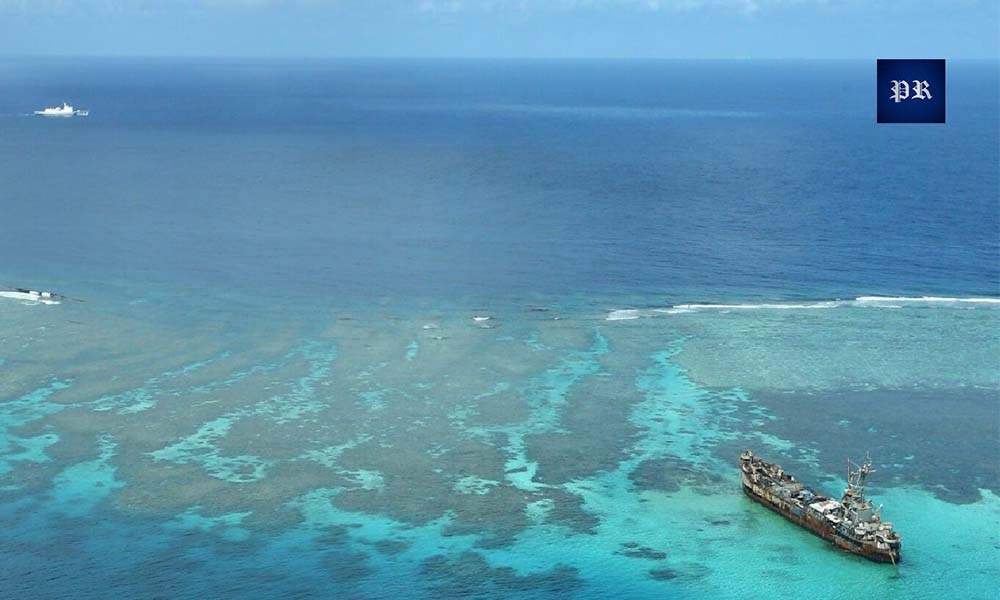
Few places capture the frontline reality of this maritime struggle like Second Thomas Shoal, locally known as Ayungin Shoal. It’s not just a disputed reef, it’s the site of ongoing maritime confrontation. Filipino troops stationed aboard the rusty BRP Sierra Madre face constant pressure from Chinese vessels. Supply missions get blocked, shadowed, even sprayed with water cannons. This is where China’s gray zone tactics play out daily, no missiles, no bullets, just relentless psychological warfare on the sea. And yet, Filipino sailors keep going. They stand their ground, deliver supplies, and show the world: “We’re not leaving.”
Then there’s Scarborough Shoal, or Panatag Shoal, a haunting example of what happens when China asserts control unchecked. Filipino fishermen used to rely on these rich fishing grounds for their livelihood. Today? Many are turned away, harassed, or forced to share space under Chinese watch. No shots fired, but the result is the same: displaced communities, lost income, and rising anger. It’s a daily reminder that territorial disputes aren’t abstract, they affect real people, real families, and entire coastal economies.
But the Philippines isn’t facing this alone. Just look at the joint military exercises now unfolding across the region. The Balikatan and Kamandag drills have grown massively in scope and firepower, and now include interoperability with Japan, too. This year’s Talisman Sabre 25 took it even further, simulating multi-domain warfare with cutting-edge tech. Think cybersecurity defense, space-based surveillance, information warfare, and even live-fire deployment of the U.S. Army’s powerful HIMARS missile systems. These aren’t just exercises. They’re messages, to China, to ASEAN, to the world: the Philippines and its allies are preparing for any scenario.
Meanwhile, Japan’s support goes beyond training. Through its Official Security Assistance (OSA) program, Japan is now directly equipping the Philippines with radar systems, patrol boats, and maritime domain awareness tech. In real terms, this means the AFP is getting tools to actually monitor its waters, not just symbolically, but tactically. And it’s not just us, Japan’s OSA program is rapidly expanding across the Indo-Pacific, from Southeast Asia to the Pacific Islands, creating a defensive shield of partnerships built on shared values and regional security.
Future Outlook and Policy Considerations
As we look ahead, the West Philippine Sea stands at a critical crossroads. One path leads to deeper military escalation, where patrols, drills, and standoffs become so routine that even a small misstep could spiral into conflict. The other path leans toward diplomacy, a renewed push for a binding Code of Conduct in the South China Sea, something ASEAN has been trying to finalize for over two decades. But the clock is ticking. Every week without progress risks pushing the region closer to confrontation.
The big challenge now is deterrence without provocation. How do the Philippines, the U.S., and Japan grow stronger together, assertive enough to push back on China’s aggression, but careful not to trigger the very crisis they’re trying to avoid? It’s a tightrope walk, where showing too much force could be mistaken for a threat, and showing too little could invite more harassment. This balancing act isn’t just military, it’s strategic, diplomatic, and psychological.
Beyond the main players, the eyes of the world are turning toward the Indo-Pacific. Countries like Australia, the UK, Germany, and Canada are stepping in, sending warships, offering training, and voicing support for freedom of navigation and respect for international law. Even the European Union has begun to engage more directly, viewing stability in the South China Sea as critical to global trade and security. The message is clear: this is no longer a regional issue, it’s a global one.
But escalation isn’t inevitable. There’s still time to pull back from the brink, and it starts with policy choices. First, there must be universal respect for UNCLOS, especially the 2016 arbitration ruling that reaffirmed the Philippines’ sovereign rights. Without adherence to international law, dialogue becomes meaningless. Second, all sides need open and transparent communication, especially between militaries, to prevent misunderstandings from turning into tragedies. A hotline can stop a war before it starts.
Next, we need stronger multilateral diplomacy. ASEAN must be empowered, and pressured, to finalize the Code of Conduct. The region can’t afford more half-measures. Dialogue needs to include all stakeholders, big and small. And finally, countries like the Philippines must be supported, not sidelined. That means helping build real capacity, more maritime patrols, better radar, stronger coast guards, all within the framework of international law.
At the heart of all this lies one unavoidable truth: the Philippines is defending more than territory. It’s defending the idea that might doesn’t make right. Those rules matter. That smaller nations have the same rights as powerful ones. And in that fight, the world is watching, and slowly, it seems, choosing to stand alongside us.
This entire dispute from Ayungin Shoal to the halls of the UN, is a living test of whether a rules-based order can survive in the 21st century. It’s not just about one country’s claim over a reef. It’s about whether the law can still stand up to force. Whether alliances can prevent aggression. Whether peace can be preserved without war.
And make no mistake: what happens in the West Philippine Sea will shape not just Southeast Asia, but the future of the Indo-Pacific, and the century that follows. The decisions made now will echo for decades. The sea may be vast, but so is the responsibility. We can either sail into chaos or steer toward stability. The choice is ours. And it starts today.