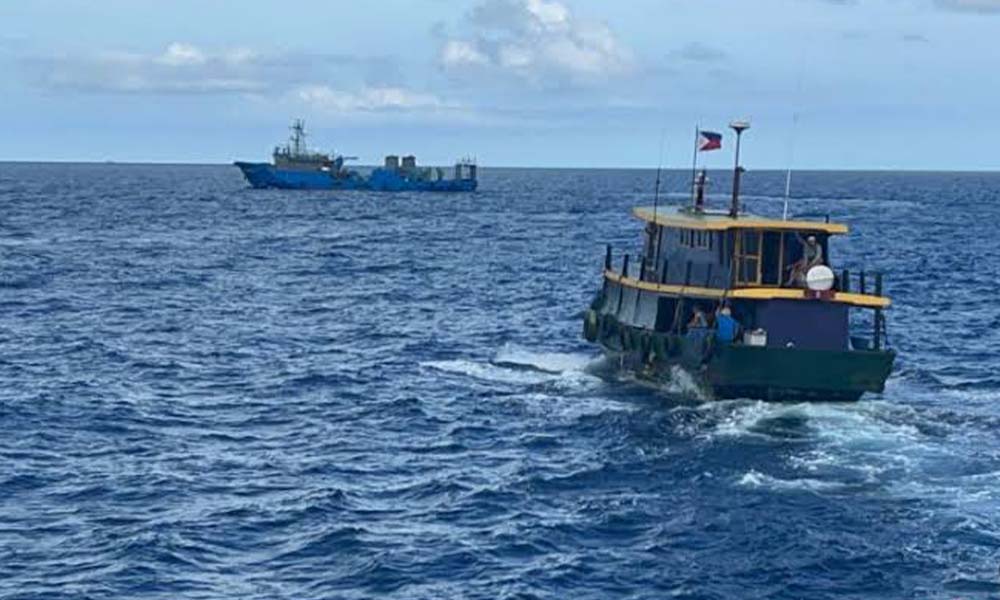
Footage just dropped: two small Filipino boats approaching Chinese Coast Guard vessels near Ren’ai Jiao or Second Thomas Shoal. The incident at Ren’ai Jiao unfolded in mid-August 2025, another chapter in the ever-tense standoff over the Second Thomas Shoal. To understand why every confrontation at Ren’ai Jiao feels like a spark in a powder keg, we have to look back at history, starting with the BRP Sierra Madre, a grounded World War II-era ship that has become both a symbol of defiance and a focal point of confrontation. What happened at Ren’ai Jiao doesn’t stay at Ren’ai Jiao. Every clash at sea ripples far beyond the reef, shaping the balance of power, the credibility of alliances, and the stability of an entire region. The video released by the China Coast Guard is more than just a clip of boats at sea, it’s a propaganda tool in a deepening dispute, a narrative battle layered over a clash of legal claims and historical grievances.
Taken together, these opening lines frame the story of Ren’ai Jiao as more than a minor skirmish. They show us a confrontation caught on camera, an incident rooted in history, a standoff heavy with risk, and a dispute whose consequences extend far beyond the reef itself. This is not just about a boat and a shoal. It is about the fault lines of law and power in the South China Sea, the fragility of alliances, and the danger that one “routine” encounter could ignite something far larger.
The Immediate Incident: A Detailed Case Study
The incident at Ren’ai Jiao unfolded in mid-August 2025, another chapter in the ever-tense standoff over the Second Thomas Shoal. According to the China Coast Guard, two small Philippine boats approached their vessels, ignoring what Beijing describes as “repeated, clear warnings.” In the video released by the CCG, the boats are shown maneuvering close, which the Chinese side framed as “unprofessional and dangerous behavior.” The official statement claimed that Chinese vessels then carried out what they called “control measures,” insisting they acted in accordance with Chinese law to “drive them away without using force.” To Beijing, the narrative was clear: this was Manila’s provocation, and China’s reaction was measured.
But the Philippines tells a very different story. Manila’s military quickly countered that the incident was not an isolated event but part of a broader pattern of Chinese escalation. Officials highlighted what they described as a sharp increase in the number of Chinese vessels surrounding the shoal, everything from China Coast Guard ships to swarms of maritime militia boats. They further accused Beijing of deploying newly “upgraded” fast boats, some equipped with mounted weapons, escalating the threat to Filipino resupply and patrol missions. To the Philippines, the story wasn’t about “reckless” behavior by its crews, it was about standing firm against illegal harassment in its own exclusive economic zone.
Key actors quickly went public with their positions. Gan Yu, spokesperson for the China Coast Guard, issued a stern warning, demanding that Manila “immediately stop all acts of infringement, provocation, and propaganda hype.” In Beijing’s state-run Global Times, the incident was framed as premeditated, accusing the Philippines of staging the encounter in order to “deliberately frame China’s normal law enforcement operations as offensive.” The tone was one of righteous indignation, China as the victim of manipulation. In Manila, however, officials called China’s moves “illegal” and “aggressive,” doubling down on the position that every blockade, every shadowing maneuver, and every water cannon blast represents a violation of both international law and Philippine sovereignty.
The data paints an even clearer picture of the mounting tension. The Philippine military claims that since 2023, it has conducted more than 20 resupply or patrol operations per month to the Sierra Madre, and that nearly every one of those has faced Chinese interference. At the time of the August incident, reports indicated that at least five China Coast Guard vessels, 11 fast boats, and nine maritime militia ships were in the waters around the shoal, creating an overwhelming show of force against the two much smaller Philippine craft. This numerical imbalance, the sheer scale of China’s presence versus the handful of Filipino boats, highlights the asymmetry of the conflict, and why even a single grainy video clip can ignite international headlines.
This clash, like so many before it, comes down to two competing narratives: China insists it is enforcing “law and order” in what it considers its waters, while the Philippines insists it is simply exercising its rights under international law. The truth may lie not in the claims themselves, but in the dangerous space between them, a space where every maneuver, every collision, and every broadcasted video increases the risk that one “routine” standoff could spiral into something far bigger.
Historical Context and Underlying Issues
To understand why every confrontation at Ren’ai Jiao feels like a spark in a powder keg, we have to look back at history, starting with the BRP Sierra Madre. The ship is not just rusting steel on a reef; it is a World War II-era landing vessel, intentionally grounded by the Philippines in 1999. At the time, Manila made the calculated decision to turn the decrepit warship into a permanent outpost, planting sovereignty on contested ground. For more than two decades, a small, rotating detachment of Filipino marines has lived aboard the Sierra Madre, enduring harsh conditions, supplied only by risky missions through waters thick with Chinese vessels. The ship has become both a symbol of defiance and the focal point of confrontation.
Over the years, China has accused the Philippines of breaking so-called “gentleman’s agreements.” Beijing insists that previous Philippine presidents had quietly promised to remove the Sierra Madre, only for Manila to renege on those deals. The Philippines, for its part, has largely denied any binding commitments, framing the allegations as part of Beijing’s effort to weaken its claim. Today, the Sierra Madre remains exactly where Manila intended it: a rusting fortress, held together by steel, willpower, and symbolism. For China, it is an irritant. For the Philippines, it is a frontline of sovereignty.
The tension, however, is not only about one ship. It’s about law, legitimacy, and two starkly different narratives. China asserts what it calls “indisputable sovereignty” over the South China Sea, including Ren’ai Jiao, rooted in its sweeping “nine-dash line” and claims of “historical rights.” Beijing has outright rejected the 2016 Permanent Court of Arbitration ruling, which invalidated those claims as inconsistent with international law. For China, history trumps rulings; power enforces rights.
The Philippines sees it differently. Its case rests on the United Nations Convention on the Law of the Sea (UNCLOS), which grants every coastal state sovereign rights to resources within a 200-nautical-mile Exclusive Economic Zone. The 2016 arbitral tribunal explicitly sided with Manila, declaring that China’s so-called historical rights had no legal basis. From the Philippines’ perspective, every resupply run to the Sierra Madre isn’t provocation, it’s enforcement of international law. From Beijing’s perspective, every nail hammered into that rusting hull is a violation of sovereignty. That clash between history and law, symbolism and sovereignty, is what keeps Ren’ai Jiao at the center of the South China Sea storm.
A-10 Thunderbolts in Philippines Clark Air Base a Game Changer Against China
Broader Implications and Future Effects
What happened at Ren’ai Jiao doesn’t stay at Ren’ai Jiao. Every clash at sea ripples far beyond the reef, shaping the balance of power, the credibility of alliances, and the stability of an entire region. Take Scarborough Shoal. Just weeks before the Ren’ai Jiao video surfaced, the world watched footage of a Chinese naval vessel colliding with a China Coast Guard ship in the heat of a chase with the Philippine BRP Suluan. The incident, near Scarborough, wasn’t just another accident, it was proof of a dangerous pattern. With massive ships shadowing smaller Philippine vessels at close quarters, the margin for error has shrunk to almost nothing. Each maneuver carries the risk of miscalculation, and one wrong turn could escalate from a standoff to a regional crisis.
Beijing sees these events through its own lens. Chinese state media often accuses Manila of playing what they call the “infringement-hype-victim” playbook: provoking an incident, capturing it on video, and then using global headlines to paint China as the aggressor while rallying sympathy from allies. Manila rejects that narrative outright, insisting its actions are about resupplying its troops and asserting rights under international law. But whichever version you believe, the cycle itself, incident, video, accusation, counter-accusation, fuels instability, inching the region closer to confrontation.
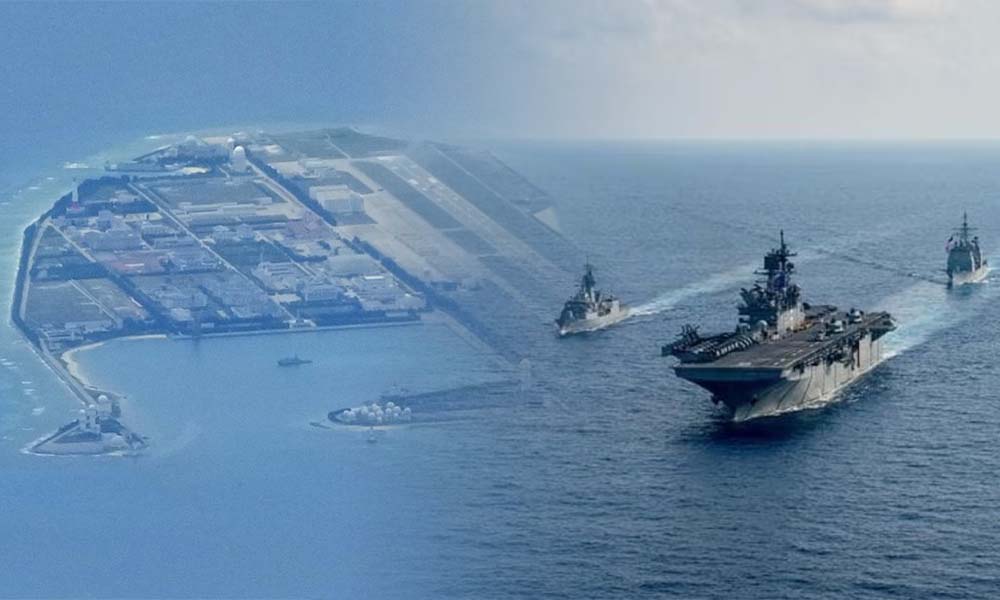
That’s where external powers come in. The United States–Philippines Mutual Defense Treaty remains the anchor of Manila’s security. Washington has reiterated time and again that an armed attack on Philippine armed forces, public vessels, or aircraft including those in the South China Sea, would trigger the treaty. That’s not just rhetoric: U.S. warships have deployed to the region, signaling both reassurance to Manila and deterrence to Beijing. Australia, too, has stepped up, signing new defense pacts with the Philippines and joining joint patrols, adding another layer of international presence in contested waters. From Beijing’s perspective, this is all part of a U.S.-led “Indo-Pacific Strategy” to contain China, with Manila as the tip of the spear. From Washington’s view, it’s about deterrence and keeping sea lanes open.
And the stakes aren’t only military, they’re economic and diplomatic. The South China Sea is one of the world’s busiest trade arteries, carrying trillions of dollars in goods each year. Any disruption threatens global commerce, not just local fishermen or naval patrols. At the same time, every confrontation strains China–Philippines relations, already fraying under the weight of repeated maritime clashes. Diplomatically, the disputes divide ASEAN itself, some members calling for unity and adherence to international law, others cautious not to antagonize Beijing. The issue has become a fixture in global forums, from the United Nations to the G7, a reminder that the South China Sea is not a local quarrel but a global fault line.
In the end, the broader implications are stark: dangerous maneuvers and collisions show how close the region is to crisis; alliances and treaties guarantee that any clash could draw in outside powers; and the economic and diplomatic fallout ensures that what happens in the South China Sea will affect not just Asia, but the entire world. Ren’ai Jiao may be one reef but it sits at the center of a storm that could reshape the Indo-Pacific.
U.S. Philippines Approve 500 Military Drills for 2026 | China Shocked!
Conclusion: A Precarious Standoff
The video released by the China Coast Guard is more than just a clip of boats at sea, it’s a propaganda tool in a deepening dispute, a narrative battle layered over a clash of legal claims and historical grievances. At its core, Ren’ai Jiao embodies two irreconcilable visions: Beijing’s sweeping “nine-dash line” and the Philippines’ UNCLOS-backed right to its own Exclusive Economic Zone. And with every incident, every accusation, and every broadcast, those narratives collide not just in words, but in steel and saltwater.
Looking ahead, the outlook is anything but calm. The Philippines, buoyed by its alliances with the United States, Australia, Japan, and now even the European Union, will not step back from asserting its rights. Every resupply mission to the BRP Sierra Madre becomes a statement of sovereignty. On the other side, China shows no sign of retreat. Its “lawful” patrols, Coast Guard deployments, and maritime militia swarms will continue to enforce what it insists is indisputable sovereignty. The cycle of challenge and response is set to repeat, and each repetition carries more risk than the last.
That’s why Ren’ai Jiao is not just a local maritime spat, it is a precarious flashpoint. Here, in the shallow waters of a single reef, lies the potential to spark something far greater. The actions of a few small boats, the snap of a water cannon, the scrape of steel against steel, any of these could trigger a chain reaction that pulls in navies, tests treaties, and rattles the global economy. The South China Sea has always been about more than maps and reefs. It’s about order, law, and the fragile balance of peace. And at Ren’ai Jiao, that balance has never looked more fragile.