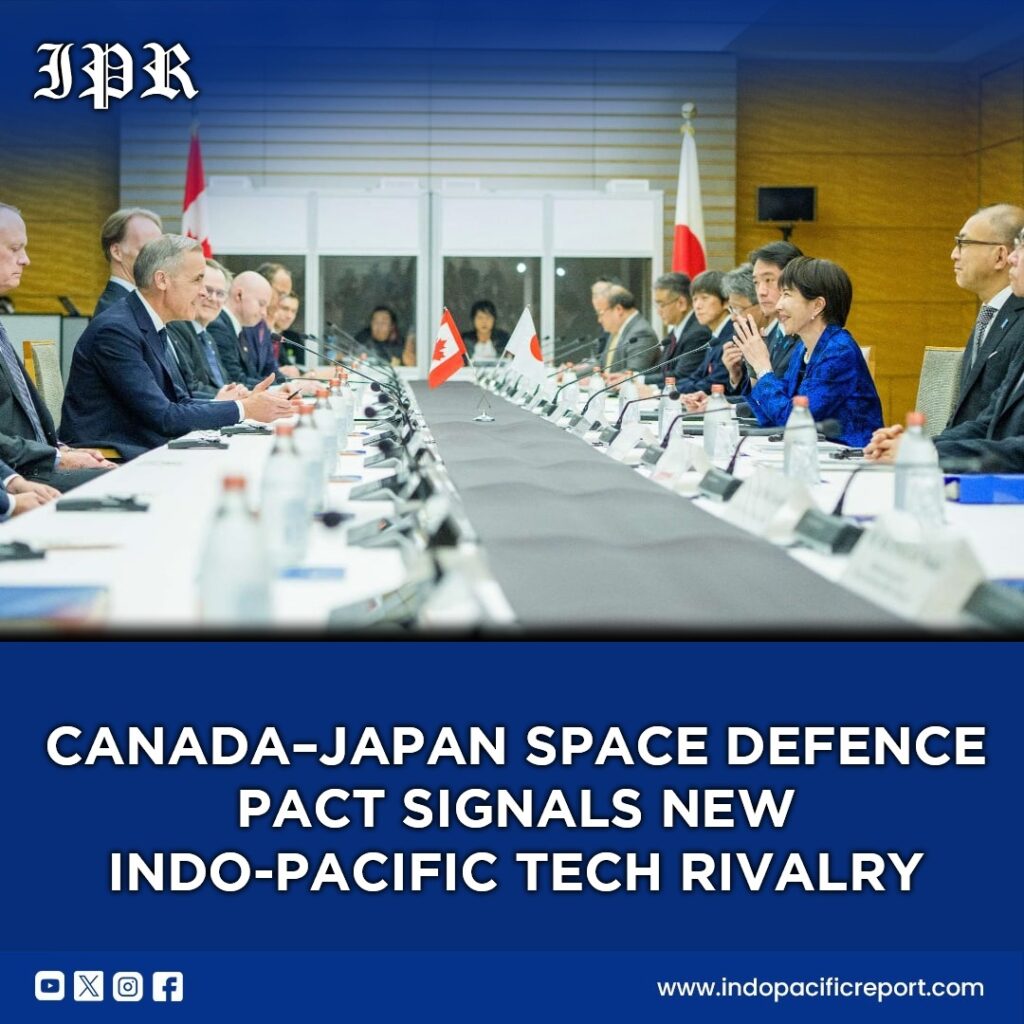
The new “Comprehensive Strategic Partnership” between Mark Carney and Sanae Takaichi marks a quiet but important shift in Indo-Pacific geopolitics. At its core, the agreement moves Canada and Japan beyond traditional scientific space cooperation into the field of dual-use defence technology. Space communications, artificial intelligence, and autonomous systems are no longer treated as purely civilian or exploratory tools. They are now being integrated into defence planning and security architecture. This reflects a broader global trend: space is becoming a contested strategic domain, not just a domain of innovation.
From a great-power competition perspective, this development is closely linked to the structural rivalry shaping the Indo-Pacific. The United States and its partners are increasingly concerned about the militarisation of space by major powers, particularly China and Russia. In response, middle powers like Canada and Japan are aligning their industrial and technological ecosystems to maintain strategic relevance. The emphasis on “sovereign orbital infrastructure” is important. It signals an understanding that future military and economic power will depend on secure access to space-based systems such as satellites, navigation networks, and communications constellations. In simple terms, control of space is becoming as important as control of sea lanes.
The shift also reflects a deeper change in regional security architecture. Traditionally, space cooperation between Canada and Japan—through agencies like the Canadian Space Agency (CSA) and Japan Aerospace Exploration Agency—focused on peaceful uses such as lunar exploration and climate monitoring. The new agreement moves this cooperation into the defence domain, including the Department of National Defence and Japan’s security establishment. This is a structural transformation. Space is no longer separate from security policy. It is now embedded within it. This blurring of civilian and military boundaries is a defining feature of modern strategic competition.
Alliance dynamics are also evolving through this partnership. Japan is already strengthening its defence posture under a more assertive security strategy, driven by regional threats and its shifting political environment. Canada, while geographically distant from the Indo-Pacific, is increasingly positioning itself as a relevant Indo-Pacific actor through technology, defence cooperation, and industrial partnerships. The agreement creates a bridge between a European-Atlantic middle power and an Indo-Pacific frontline state. It shows how alliances today are not only military in nature, but also technological and industrial. Defence cooperation is now being built through shared innovation pipelines, not just joint exercises or treaties.
From a maritime and economic strategy perspective, the agreement highlights how space capabilities directly support naval and economic power. Satellite communications, AI-driven surveillance, and autonomous systems are essential for modern maritime awareness. In contested regions like the Indo-Pacific, these tools provide real-time intelligence over vast ocean spaces. For Japan, which depends heavily on maritime trade routes, resilient space infrastructure is a strategic necessity. For Canada, this partnership opens access to Indo-Pacific defence supply chains and strengthens its domestic aerospace sector. The dual-use framing is key: civilian innovation is being directly linked to military readiness and economic competitiveness.
The broader implications for the Indo-Pacific balance of power are significant, even if indirect. While this is not a hard military alliance, it contributes to the gradual formation of a technological-security network among like-minded states. These networks are becoming just as important as formal alliances. They create interoperability in critical domains such as AI, satellite systems, and autonomous platforms. Over time, this strengthens deterrence by increasing resilience and reducing dependence on any single actor. At the same time, it also deepens fragmentation in the global space domain, where competing blocs are developing separate technological ecosystems.
Looking ahead, the most important strategic implication is the normalization of space as a defence domain among middle powers. Canada and Japan are not leading superpowers, but their cooperation shows how medium-sized states are adapting to great-power competition. They are investing in resilience, technology sharing, and dual-use innovation to protect their strategic autonomy. However, this also raises the risk of further militarisation of space, where civilian and military functions become indistinguishable. As more countries integrate space into defence planning, the strategic environment will become more competitive, more opaque, and more tightly interconnected with terrestrial conflicts.
In the long run, this partnership signals a broader truth about Indo-Pacific geopolitics: power is no longer defined only at sea or on land, but increasingly in orbit. Those who control and protect space infrastructure will shape the balance of power below it.Is the militarisation of space through dual-use technology a necessary step for deterrence, or a new source of instability in global politics?