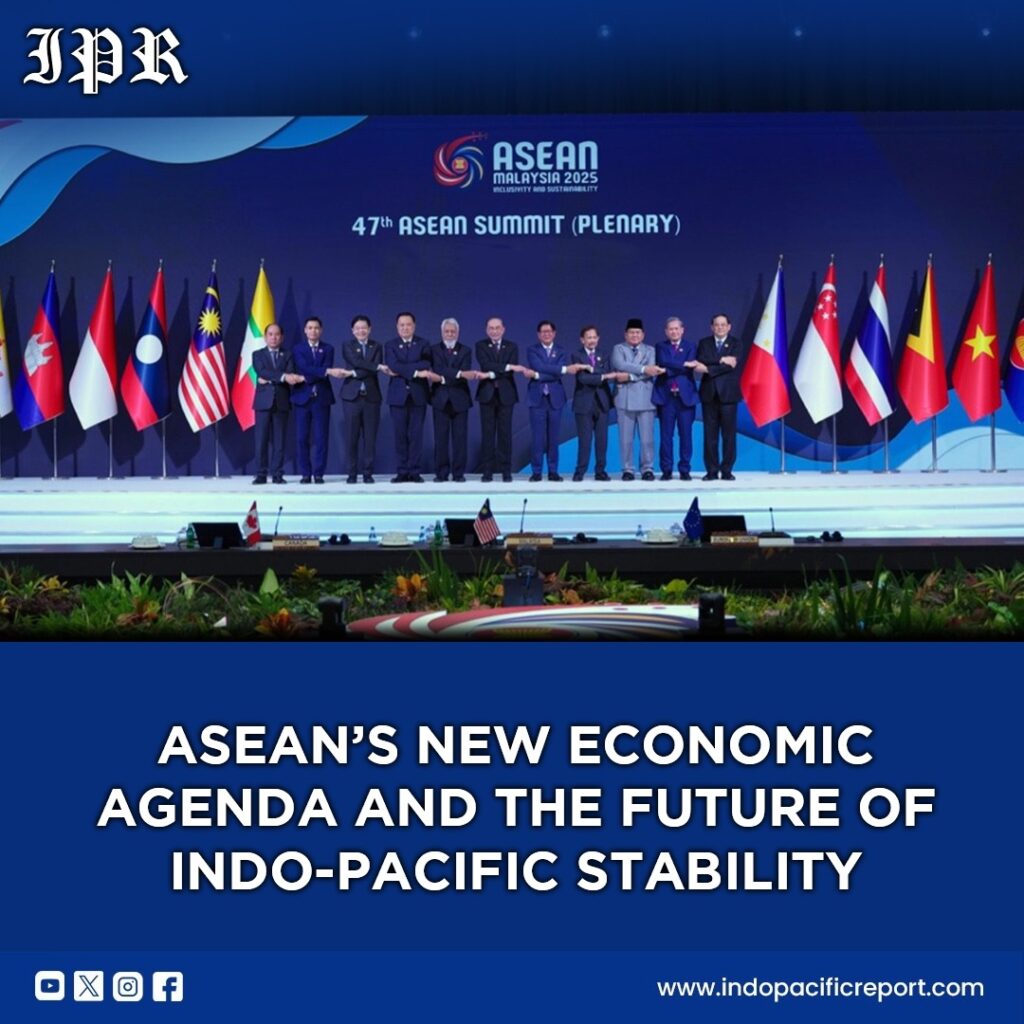
The 32nd ASEAN Economic Ministers’ Retreat held in Taguig, Philippines, reflects a deeper effort by Southeast Asia to adapt to an increasingly uncertain global economic and geopolitical landscape. The meeting brought together regional economic leaders under the Philippines’ 2026 ASEAN chairmanship, with participation from ASEAN Secretary-General Kao Kim Hourn and chaired by Philippine Trade Secretary Ma. Christina A. Roque. Under the theme “Navigating Our Future, Together,” the retreat focused on strengthening the Association of Southeast Asian Nations economic agenda, including discussions on the ASEAN Economic Community, negotiations for the ASEAN Digital Economy Framework Agreement, and Timor-Leste’s potential accession to ASEAN economic mechanisms. Yet beneath the formal agenda lies a broader strategic reality: Southeast Asia is quietly reorganizing its economic architecture to navigate intensifying great-power competition and growing uncertainty in global trade.
At its core, the ASEAN Economic Ministers’ Retreat underscores the region’s attempt to maintain economic cohesion amid intensifying rivalry between the United States and China. Southeast Asia sits at the center of global manufacturing networks and maritime trade routes, making it highly sensitive to disruptions in supply chains and strategic competition. ASEAN’s effort to strengthen economic coordination reflects a recognition that fragmented regional markets would leave smaller economies more vulnerable to external pressure. By focusing on digital integration, performance monitoring within the ASEAN Economic Community, and deeper economic cooperation, the bloc is attempting to preserve its collective bargaining power. In geopolitical terms, economic integration functions as a form of strategic insulation, allowing ASEAN states to engage both major powers without becoming overly dependent on either.
The digital dimension of the ASEAN agenda is particularly significant. Negotiations on the ASEAN Digital Economy Framework Agreement represent an attempt to establish common standards for digital trade, data governance, and cross-border e-commerce across Southeast Asia. In a region where digital markets are expanding rapidly, such frameworks will shape the technological architecture of the Indo-Pacific. The strategic implications are substantial. If ASEAN succeeds in establishing a coherent digital economic space, it could emerge as one of the world’s largest integrated digital markets, influencing how global technology firms and governments interact with the region. This would give ASEAN a stronger voice in the global competition over digital standards—a competition increasingly dominated by the United States and China.
Beyond digital policy, the retreat also highlighted ASEAN’s long-term ambition to expand and consolidate its economic community. Discussions on Timor-Leste’s accession to ASEAN economic agreements signal a continued effort to broaden the organization’s institutional reach. For ASEAN, enlargement carries both political and strategic significance. Expanding the bloc strengthens its regional legitimacy while reinforcing Southeast Asia’s identity as a cohesive geopolitical space. In an era of shifting alliances and rising nationalism, maintaining a unified regional identity becomes a strategic asset. It allows ASEAN to function as a stabilizing center of gravity in the Indo-Pacific, providing a diplomatic platform where competing powers can interact without escalating tensions.
The economic retreat also intersected with broader regional security dynamics. Although ASEAN meetings often focus on trade and development, economic resilience is closely linked to strategic stability. A region that is economically integrated and prosperous is less susceptible to coercion and political fragmentation. By strengthening its internal economic mechanisms, ASEAN indirectly contributes to deterrence. The organization may lack the military cohesion of formal alliances, but its collective economic weight creates a form of strategic leverage. In practice, this allows ASEAN states to maintain autonomy while navigating the pressures of great-power rivalry in surrounding maritime spaces such as the South China Sea.
Another notable aspect of the retreat was the involvement of external policy and research institutions such as the ASEAN Business Advisory Council, the Economic Research Institute for ASEAN and East Asia, and the Asian Development Bank. Their participation reflects the growing importance of multi-stakeholder governance in shaping Southeast Asia’s economic future. In practical terms, economic strategy in the Indo-Pacific is no longer defined solely by governments. It is shaped by a complex ecosystem of businesses, financial institutions, research organizations, and regional development banks. This ecosystem strengthens ASEAN’s institutional capacity and helps translate economic vision into actionable policy.
The broader strategic implication of the Taguig retreat is that ASEAN is increasingly aware of the need to adapt to structural changes in the global economy. Trade fragmentation, technological competition, and shifting supply chains are reshaping the Indo-Pacific landscape. For Southeast Asia, the challenge is to remain open and interconnected while avoiding strategic overdependence on any single external power. Economic cooperation within ASEAN therefore becomes a form of geopolitical balancing. By deepening internal integration, the bloc enhances its ability to negotiate with larger powers on more equal terms.
Looking ahead, the success of ASEAN’s economic strategy will depend on its ability to translate political commitments into tangible outcomes. Initiatives such as the Digital Economy Framework Agreement, enhanced economic monitoring, and expanded regional partnerships must move beyond declarations and into implementation. If ASEAN can achieve this, it will strengthen its role as a central pillar of the Indo-Pacific order. But if internal divisions persist or reforms stall, the region risks becoming a battleground for competing economic spheres of influence. The stakes are therefore high. The future of Southeast Asia’s strategic autonomy may depend on whether ASEAN can transform economic cooperation into genuine geopolitical resilience.