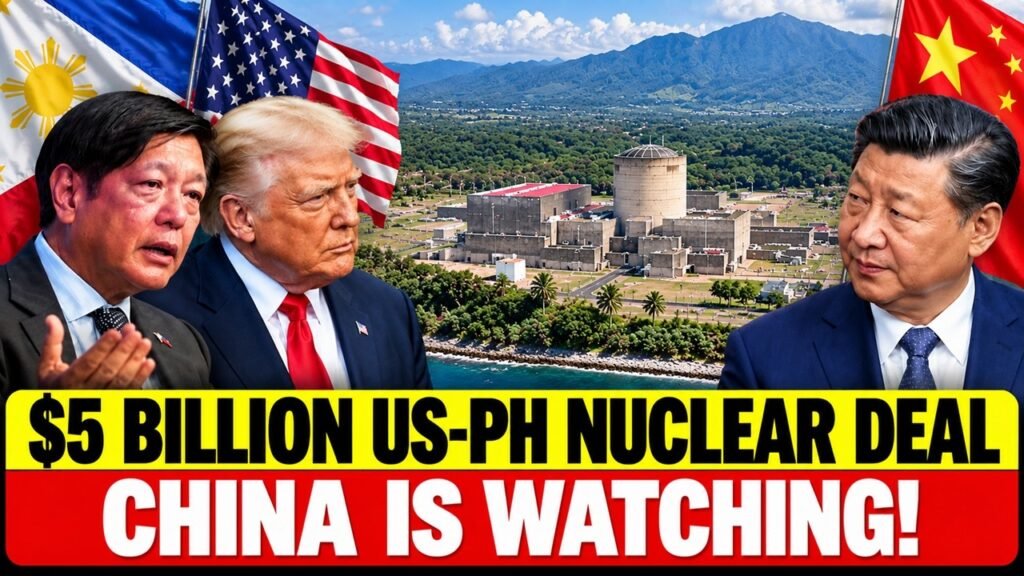
US Offers Philippines $5 Billion for Nuclear Power — China Is Watching!
The United States may provide up to $5 billion in financing to support nuclear power development in the Philippines, potentially giving Manila a major opportunity to strengthen its energy security and reduce its dependence on imported fuels. For a country facing rising electricity demand, fluctuating international fuel prices, and the high cost of building new power plants, nuclear energy could become an important part of its long-term energy strategy. However, the proposal is still at the financing discussion stage. It is not a signed $5 billion loan, and the Philippines has not yet committed to its first nuclear power project.
Reports published on October 27, 2026, by Gulf News and BusinessMirror described discussions involving the US International Development Finance Corporation (DFC). Philippine Energy Undersecretary Giovanni Carlo Bacordo indicated that potential debt financing could reach $5 billion, with repayment terms extending up to 25 years. The proposed support is intended for private companies interested in developing nuclear electricity generation rather than being a direct loan to the Philippine government. The final interest rates, fees, financing conditions, and allocation of funds have not yet been established. The proposal raises an important question for Manila: can international financing help the country build a reliable nuclear power industry, or will financial, regulatory, and construction challenges prevent it from achieving its ambitions? The answer will depend on more than the availability of money. The Philippines must select a suitable technology, attract credible investors, strengthen nuclear regulation, and ensure that any future plant produces electricity at a competitive cost.
Why the Philippines Needs Another Source of Electricity
Energy security has become an important economic concern for the Philippines because the country remains heavily dependent on imported fossil fuels. International changes in oil and coal prices can affect electricity generation, transportation, manufacturing, and household expenses. When fuel prices increase, the financial pressure can spread throughout the economy, making energy affordability a challenge for businesses and ordinary consumers. At the Philippine International Nuclear Energy Forum in October 2026, Energy Secretary Sharon Garin reported that net energy imports accounted for 51.5 percent of the country’s total primary energy supply. She also stated that the Philippines imported 85 percent of its coal and 95 percent of its diesel. These figures describe the country’s broader energy dependence rather than the percentage of electricity generated from imported fuels, but they demonstrate the scale of its exposure to international energy markets.
Reducing this dependence will require a diversified energy system rather than reliance on a single alternative. Nuclear power could contribute to that goal by providing dependable, low-carbon electricity without requiring the continuous purchase of large quantities of fossil fuels. Although nuclear plants require fuel supplies, maintenance, and specialist services, their operating model differs significantly from that of coal- and gas-fired power stations. Electricity demand is another reason the government is exploring nuclear development. The Philippines reported peak electricity demand of approximately 20.1 gigawatts in 2026, while installed generating capacity stood at 32.5 gigawatts as of July. These figures measure different things. Peak demand represents the highest level of electricity consumption at a particular time, while installed capacity refers to the rated output of generating facilities. Not every power plant is available at full capacity whenever electricity is needed, and transmission limitations can prevent available electricity from reaching consumers efficiently.
U.S. Activates Guam Missile Defense near Philippines as China’s Threat Grows
Nuclear energy could help meet future demand by adding firm generation to the electricity mix. Unlike solar and wind power, nuclear generation does not directly depend on weather conditions, although nuclear plants still require maintenance and can experience unexpected outages. When properly integrated with renewable energy, storage, hydropower, geothermal resources, and other generating technologies, nuclear power could support a more balanced and resilient electricity system. However, nuclear energy is not an immediate solution to every electricity problem. It cannot independently eliminate transmission bottlenecks, distribution failures, or inadequate generating reserves. The Philippines must therefore consider nuclear development as part of a broader energy strategy designed to improve reliability, affordability, and long-term supply security.
How the US $5 Billion Nuclear Financing Proposal Could Work
The US International Development Finance Corporation is the institution associated with the proposed debt support for private-sector nuclear projects. The Philippine Department of Energy has also approached the US Export-Import Bank, commonly known as EXIM, regarding engineering assistance for feasibility studies and design services. Meanwhile, Manila has been engaging with the Asian Development Bank about possible credit enhancements that could help make nuclear projects more attractive to lenders. These discussions could improve the financing options available to potential developers, but they should not be confused with final financial commitments. The involvement of several institutions does not mean that each organization has approved funding for a particular Philippine nuclear project. The exact financing structure, eligibility requirements, interest rates, fees, and repayment conditions still need to be established.
One important detail is the proposed repayment period of up to 25 years. A longer repayment period can spread financial obligations over time, potentially making a project easier to finance. However, the length of the repayment period does not automatically make a loan affordable. The total cost will depend on interest rates, fees, the amount borrowed, the timing of repayments, and the project’s ability to generate enough revenue to meet its obligations. Construction delays could create another serious problem. Nuclear plants require substantial investment before they begin producing electricity, and unexpected engineering issues, regulatory changes, or supply-chain difficulties can increase project costs. If a plant takes longer than expected to enter commercial operation, financing expenses may accumulate while the project generates no electricity revenue.
The Philippine government has indicated a preference for private-sector-led development without sovereign guarantees, according to the supplied reporting. Such an approach could limit direct government exposure to project debt, but it would not eliminate every public financial risk. Depending on the final contracts, electricity purchasing arrangements, and any public support mechanisms, consumers or taxpayers could still face indirect costs. For this reason, the most important milestone will be a binding financing agreement connected to a specific, approved project. Until such an agreement exists, the $5 billion should be understood as potential financing rather than money that has already been secured for construction.
Bataan Nuclear Power Plant: A Costly Lesson for the Philippines
The history of the Bataan Nuclear Power Plant demonstrates why financing and construction alone cannot guarantee successful nuclear development. The Philippines began constructing the plant in 1976 following the 1973 oil crisis, hoping to reduce its exposure to imported energy and establish a domestic source of nuclear electricity. The facility’s single 621-megawatt reactor was completed in 1984, but the plant never entered commercial operation. The project became associated with financial controversy, political disputes, and concerns about safety, including questions about earthquake risks. Following the Chernobyl nuclear disaster in 1986, the administration of President Corazon Aquino decided to mothball the facility. As a result, the country was left with an expensive nuclear installation that never supplied commercial electricity to the national grid. The estimated cost of the Bataan project varies across sources and reporting periods. The World Nuclear Association has reported a construction cost of approximately $1.9 billion, while other accounts have cited figures closer to $2.3 billion. Although these estimates are not identical, both illustrate the scale of the investment involved in a project that failed to achieve its intended purpose.
Bataan does not prove that nuclear energy cannot work in the Philippines. Instead, it demonstrates the importance of credible engineering assessments, transparent financial arrangements, independent safety oversight, and consistent project management. A country can spend billions on a major infrastructure project and still fail to receive the benefits it expected if essential technical and institutional challenges are not resolved. The site has attracted renewed attention as the Philippines considers its future nuclear options. South Korea’s Korea Hydro & Nuclear Power has been involved in feasibility work concerning possible refurbishment, while the government has also explored the possibility of small modular reactors. However, refurbishing the existing Bataan facility and constructing a new nuclear plant would involve different technical and financial decisions. Any refurbishment proposal would require a detailed assessment of the facility’s current condition, safety systems, remaining useful life, and the cost of meeting modern regulatory requirements. A new plant would require its own site assessment, design selection, licensing, construction, and grid integration.
Can the Philippines Meet Its 2032 Nuclear Power Target?
The Philippine government has established ambitious targets for nuclear development. It aims to achieve 1,200 megawatts of nuclear capacity by 2032, increase that figure to 2,400 megawatts by 2035, and reach 4,800 megawatts by 2050. These targets indicate the government’s long-term interest in nuclear energy, but they should not be interpreted as guaranteed delivery dates. The first deadline is particularly challenging because the Philippines is still developing the procurement arrangements needed to select its first nuclear generation project. On September 29, 2026, the Department of Energy reported progress on proposed guidelines for competitive nuclear power procurement. The draft framework addresses matters such as project delivery schedules, electricity pricing, grid readiness, and connection arrangements. Developing procurement rules is an important step, but it represents only one part of the process. A nuclear power project must undergo site assessments, environmental reviews, technology selection, financing arrangements, regulatory licensing, construction, commissioning, and final connection to the electricity grid. Each stage requires technical work, funding, and coordination between public authorities and private developers.
Delays at any point could affect the overall schedule. A proposed location may not meet the necessary safety requirements, financing may remain incomplete, or a selected reactor design may require further technical review. The electricity grid may also need upgrades before it can safely accommodate a new generating facility. Industry representatives have discussed indicative timelines around 2028 for micro-modular reactors and around 2030 for small modular reactors. However, these are preliminary indications rather than confirmed construction or operating schedules for a selected Philippine project. The World Nuclear Association’s October 2026 assessment noted that the Philippines had advanced its nuclear policy framework but had not committed to a first project or finalized the necessary financing and delivery arrangements. The assessment also considered the 2032 target unlikely to be achieved under the conditions then prevailing.
This makes it important to distinguish political ambition from practical progress. The government can continue working toward its 2032 target, but the credibility of that deadline will depend on the selection of a viable project, binding financing, completed regulatory requirements, and a construction schedule supported by independent technical assessments. For Manila, the priority should be establishing a realistic and transparent development process. A carefully planned nuclear project that enters operation safely and delivers electricity at a sustainable cost would provide greater long-term value than a rushed programme built around an unrealistic deadline.
Bataan Revival or Small Modular Reactors
One of the most important decisions facing the Philippines is whether to pursue the possible revival of the Bataan Nuclear Power Plant or focus on a new facility using conventional or small modular reactor technology. Each option presents different opportunities, costs, and risks, and the government must evaluate them according to their practical ability to supply electricity. Small modular reactors, commonly known as SMRs, are designed around smaller individual generating units than many conventional nuclear plants. Their potential advantages include the possibility of adding generating capacity in stages and matching plant size to the requirements of a particular electricity grid. Some designs also aim to use factory-based manufacturing to simplify parts of the construction process. However, smaller reactors are not automatically cheaper or faster to build. First-of-a-kind projects can face high engineering costs, licensing challenges, financing difficulties, and limited operating experience. Whether an SMR provides an economic advantage will depend on its particular design, construction process, supply chain, financing terms, and long-term operating costs.
Conventional large reactors offer a different set of advantages and challenges. A single large facility can provide substantial generating capacity, potentially supporting a significant share of electricity demand. However, such projects generally require major upfront investment and careful planning to ensure that the electricity grid can accommodate the plant’s output. The Philippines has reportedly considered six potential locations for nuclear development: Bataan, Batangas, Masbate, Pangasinan, Palawan, and Camarines Norte. These locations should be understood as candidates rather than six approved nuclear projects. Each would require detailed assessment of geological conditions, earthquake exposure, flooding risks, cooling-water availability, environmental effects, transmission infrastructure, and community concerns. Companies including Meralco, Aboitiz Power, San Miguel Power, and Prime Infra have expressed interest in exploring nuclear opportunities. However, interest in a potential project does not necessarily mean a company has made a final investment decision or committed to construction. Bataan also faces additional local political considerations. The municipality of Morong approved a local ordinance declaring itself a non-nuclear zone in June 2026, creating another issue that would need to be examined for any proposal involving the area.
Nuclear Safety, Regulation, and Public Trust
The success of the Philippine nuclear programme will depend heavily on the strength of its regulatory institutions. Nuclear power requires independent authorities capable of reviewing reactor designs, granting licences, inspecting facilities, enforcing safety standards, and responding to problems without being influenced by commercial or political pressure. The Philippines has taken steps to strengthen its regulatory framework. The Philippine National Nuclear Energy Safety Act, signed in 2025, established the Philippine Atomic Energy Regulatory Authority, known as PhilATOM, as an independent nuclear regulator. However, establishing a regulatory body is only the beginning. Its effectiveness will depend on funding, technical expertise, qualified personnel, operating procedures, and the ability to make independent decisions. The International Atomic Energy Agency’s Milestones Approach identifies 19 infrastructure issues that countries need to address when developing a nuclear power programme. These include nuclear legislation, safety, financing, electricity grid readiness, workforce development, environmental protection, emergency planning, and radioactive waste management.
For the Philippines, site-specific risks require particularly careful attention. Earthquakes, flooding, coastal hazards, cooling-water requirements, and environmental conditions must be assessed for every proposed location. The history of the Bataan Nuclear Power Plant makes independent and transparent technical assessments especially important. Radioactive waste and spent nuclear fuel also require long-term planning. The government and project developers must establish how these materials will be managed, which institutions will be responsible for maintaining safety, and how the associated costs will be funded. These responsibilities do not end when construction is completed or when a plant stops operating. Developing a skilled workforce is equally important. A functioning nuclear industry needs qualified engineers, plant operators, maintenance specialists, radiation-protection experts, inspectors, and emergency-response personnel. Foreign companies may provide technology and training, but the Philippines will need to develop sufficient domestic expertise to regulate and operate its nuclear facilities effectively. Public trust will also influence the future of the programme. Communities near proposed sites need clear information about safety, environmental effects, emergency procedures, project costs, and long-term responsibilities. Transparent consultation can help the public understand the potential benefits and risks before major decisions are made.
Conclusion
The potential US $5 billion nuclear financing offer could become an important part of the Philippines’ effort to strengthen its energy security. By supporting private-sector investment and improving access to long-term capital, it could help the country explore nuclear generation as part of a broader strategy to diversify electricity supply and reduce dependence on imported fossil fuels.
Yet the country’s experience with the Bataan Nuclear Power Plant demonstrates why financial commitments and political targets must be supported by careful planning, independent regulation, and credible implementation. The Philippines must determine which technology and location offer the strongest combination of safety, affordability, reliability, and practical feasibility. It must also ensure that the financial risks are properly managed and that consumers are not left carrying unreasonable costs. The government should continue comparing nuclear power with renewable energy, storage, grid improvements, and other available options. These technologies are not necessarily competitors in every situation. When planned effectively, they can complement one another and contribute to a more resilient electricity system.
About Indo-Pacific Report
For more geopolitical analysis, strategy coverage, and Indo-Pacific security reporting, visit Indo-Pacific Report:
Website
Facebook
YouTube