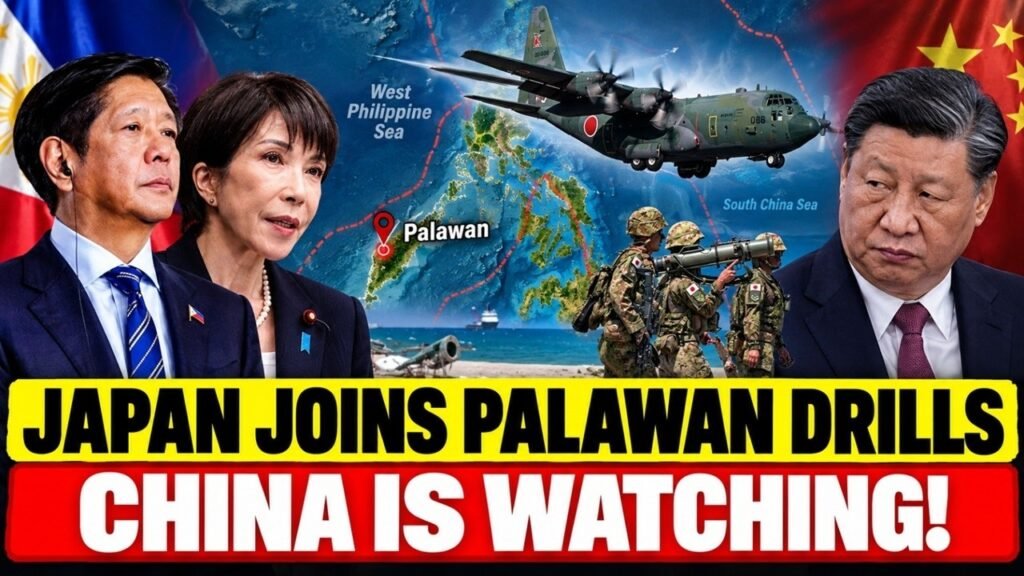
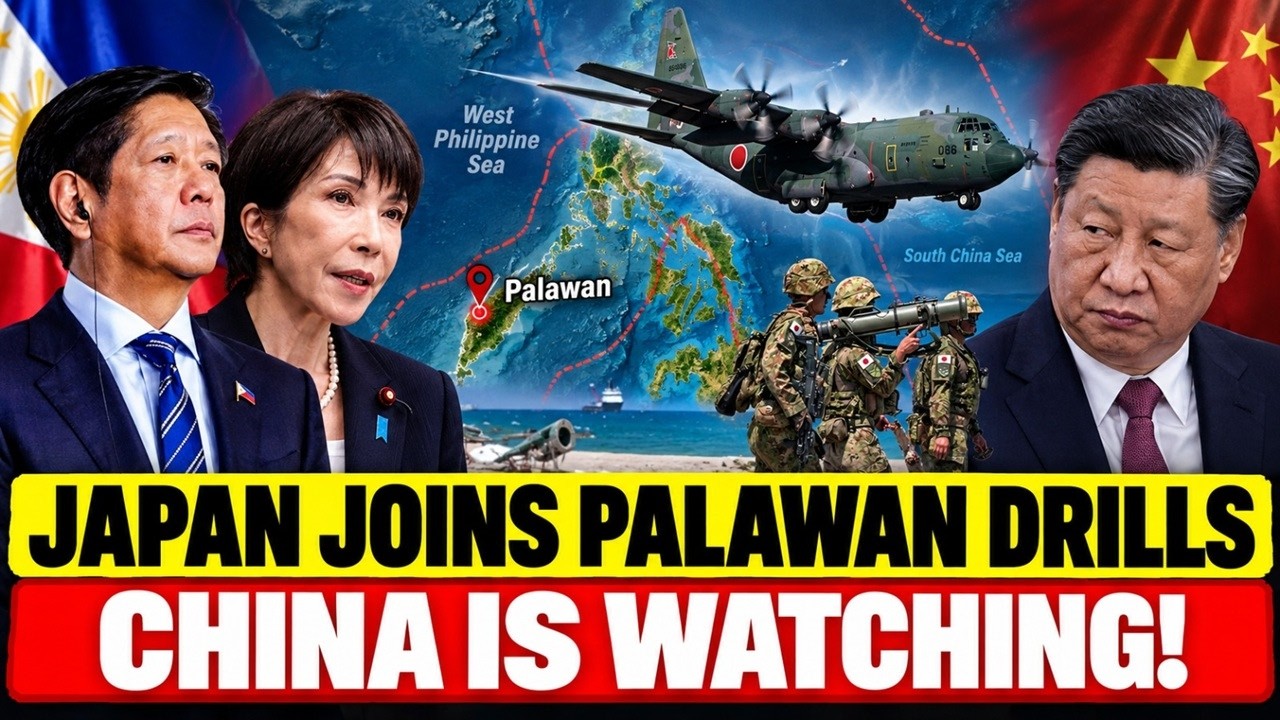
Japan Joins Philippines in Palawan Defense Drills | China Is Watching!
Japan and the Philippines have just started another joint exercise, and officially, this is about humanitarian assistance and disaster relief. Japanese and Philippine forces are training to move supplies, conduct airdrops, evacuate casualties and respond to disasters across several Philippine locations. But there is one detail that makes this exercise much more interesting. One of those locations is Puerto Princesa in Palawan, facing the West Philippine Sea, while Japan is deploying a KC-130H aircraft and around 40 personnel and the Philippine Air Force is operating its own C-130H. The exercise runs from October 4 to 9 and is the sixth Doshin-Bayanihan exercise between the two countries. But the biggest development may not be the aircraft at all. For the first time, Japan and the Philippines are applying their Acquisition and Cross-Servicing Agreement, or ACSA, with the Philippine Air Force providing fuel to a Japanese aircraft. Japan’s defense minister has described this first application as an important step showing that bilateral defense cooperation has entered a new phase.
And that changes the way this exercise should be viewed. Japan is not simply sending an aircraft to participate in a Philippine training event. The two countries are practicing how to operate together, how to support each other and, increasingly, how to make that cooperation work in practical terms on Philippine territory. That does not mean this is a war exercise, and it does not mean Japan is preparing to fight China from Palawan. But it does mean that a relationship that once centered heavily on individual exercises is becoming more institutionalized. There are now agreements governing access, agreements governing logistical support, repeated training, defense equipment cooperation and growing maritime-security coordination. And when that process reaches Palawan, a location facing the West Philippine Sea, the strategic context becomes much harder to ignore.
What Japan and the Philippines are actually doing
Before looking at the geopolitics, it is important to understand what is actually happening during Doshin-Bayanihan 6-26. The exercise is being conducted at Mactan-Benito Ebuen Air Base in Cebu, Daniel Z. Romualdez Airport in Leyte and Puerto Princesa International Airport in Palawan. Japan’s Air Self-Defense Force has deployed a KC-130H and personnel from its Air Support Command, while the Philippine Air Force is participating with a C-130H and its own personnel. The training includes airdrop operations, loading and unloading activities, takeoff and landing using night-vision goggles, mass-casualty response and aeromedical evacuation. The exercise is officially focused on humanitarian assistance and disaster relief, and that purpose matters because both Japan and the Philippines regularly face natural disasters that require rapid movement of aircraft, personnel, medical teams and supplies.
But look at what these activities actually require. Two air forces cannot simply place aircraft on the same runway and call themselves interoperable. They need compatible procedures. They need communication. They need people who understand how the other side operates. They need aircraft-handling procedures, loading procedures, medical coordination and logistics. They need to know what happens when an aircraft arrives, where it goes, who handles it, how supplies are moved and how personnel coordinate under pressure. That is why repeated exercises can become more important over time. The first exercise establishes familiarity. The next one builds repetition. Later exercises begin testing whether the two forces can perform increasingly complicated tasks together. In this case, the visible part is a Japanese KC-130H and a Philippine C-130H. The less visible part is the network of procedures developing underneath them.
Why Cebu, Leyte and Palawan change the story
There is another detail that deserves much more attention: the exercise is not happening at one location. It is spread across Cebu, Leyte and Palawan. That matters because the Philippines is an archipelago. Its military and civilian authorities have to operate across widely separated islands, airports and maritime areas. Moving an aircraft from one location to another is not simply a matter of distance. It involves fuel, communications, air traffic procedures, logistics, personnel, supplies and the ability to coordinate operations across different parts of the country. That makes a multi-location HADR exercise useful even without considering the geopolitical dimension.
But then look at where those locations sit. Cebu is a major central Philippine hub. Leyte sits farther east and is an important location for disaster-response operations. Palawan stretches westward toward the South China Sea, and Puerto Princesa provides a major point of access to the province. The geography means that Japan and the Philippines are not simply practicing together at one familiar airbase. They are building experience operating across different parts of the Philippine archipelago. That is what makes the exercise more interesting from an operational perspective. It develops distributed experience: moving people, aircraft, supplies and medical support across multiple locations rather than concentrating everything in one place.
And Palawan adds another layer. The presence of the exercise there does not prove Japanese military intent, and there is no basis for claiming that Japan is preparing to conduct combat operations from Puerto Princesa. But geography still matters. Palawan faces the West Philippine Sea, and that means any increase in practical Japan-Philippines cooperation in this part of the country takes place within a strategically sensitive maritime environment. The location does not tell us what the two governments intend to do in a future conflict. What it does tell us is where they are developing operational familiarity today.
Why Palawan matters to Japan and the Philippines
For the Philippines, Palawan is strategically important because of its position along the country’s western side and its proximity to the West Philippine Sea. Philippine forces operating from Palawan have to deal with a maritime environment where fishing, coast guard activity, naval operations, surveillance and territorial disputes all intersect. The province is therefore not simply another piece of Philippine geography. It is one of the country’s most important western-facing areas.
For Japan, the connection is different but also significant. Japan is a maritime nation whose economy depends heavily on sea lanes linking the Japanese archipelago with the wider Indo-Pacific. The Philippines sits at an important point along those broader maritime routes, and Japanese officials have repeatedly described the Philippines as strategically important to Japan. In May 2026, Japanese and Philippine defense ministers highlighted the progress of operational-level cooperation and discussed maritime-domain awareness, deterrence and regional security. Japan’s defense minister has also described the Philippines as strategically important because of its position on Japan’s sea lanes and as a fellow maritime nation. That creates a simple strategic triangle: Japan, the Philippines and the waters surrounding the Philippines. But it is important not to turn that triangle into a claim that Japan is preparing to fight China from Palawan. The evidence does not support such a conclusion. The stronger argument is more measured. Japan and the Philippines are developing operational familiarity in a geographically sensitive part of the Philippine archipelago, and that cooperation is becoming more practical over time. For China, the relevant issue is therefore not whether this particular HADR exercise is aimed at China. It is what the cumulative development of Japan-Philippines cooperation could mean for the regional security environment.
This relationship has been building for years
The most revealing part of the story appears when you stop looking at Doshin-Bayanihan 6-26 as a single event and instead look backward. The first Doshin-Bayanihan exercise took place in 2021. At that stage, the emphasis was straightforward: Japan and the Philippines wanted to improve humanitarian assistance and disaster-relief capabilities and strengthen cooperation between their air forces. Then the exercises continued. Procedures were repeated. Personnel became more familiar with each other. Aircraft operations became more routine. And the relationship gradually moved beyond simply demonstrating that the two countries could train together.
Then came 2025. The fifth Doshin-Bayanihan exercise became the first application of the Japan-Philippines Reciprocal Access Agreement, or RAA. The agreement had entered into force on September 11, 2025, and established procedures and legal arrangements for forces from one country to visit the other for cooperative activities. During the 2025 exercise, the RAA was also used in connection with the delivery of support goods following the earthquake in Cebu. That was an important demonstration of the agreement’s practical value because it showed that a framework designed to facilitate defense cooperation could also support actual disaster response.
Now, in 2026, the relationship has moved another step. The Acquisition and Cross-Servicing Agreement was signed on January 15, 2026. Unlike the RAA, which addresses access and the legal framework for visiting forces, the ACSA establishes a framework for the reciprocal provision of supplies and services between the Japanese Self-Defense Forces and the Armed Forces of the Philippines. Japan’s Foreign Ministry says the agreement is designed to facilitate the smooth and prompt provision of supplies and services between the two forces. And now, for the first time, that agreement is being used during Doshin-Bayanihan 6-26. So the progression is important. In 2021, the two countries were building training familiarity. In 2025, they began applying reciprocal access arrangements. In 2026, they are putting a logistics agreement into practice. That is a much more meaningful story than simply saying that Japan has joined another Philippine exercise.
The biggest development is not the Japanese aircraft — it is the ACSA
This may be the most important part of the entire exercise. A Japanese KC-130H is easy to notice. So is a Philippine C-130H. Cameras can capture the aircraft taking off, landing and conducting airdrop training. But the aircraft are only the visible layer. The ACSA addresses what happens around them. The Japan-Philippines ACSA was signed in January and entered into force in August 2026. Japan’s defense ministry says Doshin-Bayanihan 6-26 is the first exercise to apply the agreement, with the Philippine Air Force expected to provide aircraft fuel to Japan’s Air Self-Defense Force. The agreement allows the two militaries to facilitate the reciprocal provision of supplies and services, and Japan’s defense minister specifically described the first application as a significant step showing that bilateral defense cooperation had entered a new phase.
That is the key distinction. Before, the basic question was whether Japan and the Philippines could train together. Now another question is being tested: can they support each other while training together? Fuel is not glamorous, but it is essential. An aircraft that cannot refuel cannot keep operating. A disaster-response mission that cannot move supplies cannot accomplish its objective. A medical evacuation aircraft needs ground support, communications, medical coordination and logistics. Once you start thinking about military or humanitarian operations this way, logistics becomes much more important than the aircraft itself. And this is why the ACSA matters. It creates a framework for the exchange of supplies and services instead of leaving every individual requirement to be negotiated from scratch. That does not mean Japan and the Philippines can automatically conduct every kind of joint military operation. It does not. But it does mean the institutional framework for supporting one another has become more developed.
what make cooperation real
Imagine the Japanese KC-130H arriving in the Philippines. The aircraft is visible. The personnel are visible. The exercise is visible. But then ask the less obvious question: what happens after it lands? Who provides the fuel? Who handles the aircraft? How are supplies moved? How are the Japanese and Philippine personnel coordinated? What happens if a mass-casualty scenario requires medical evacuation? Can aircraft operate at different airports under a common set of procedures? Can the two sides communicate effectively? Can they move equipment between locations? These are the practical questions that determine whether two forces are merely training side by side or actually becoming capable of supporting each other.
Philippines Maps Thitu Island in the South China Sea — China Is Watching
That is why the Philippine Air Force’s provision of fuel to a Japanese aircraft is more significant than it may appear. It turns an abstract agreement into something tangible. The ACSA is no longer just a document signed in Manila. It is being used in an actual exercise. That is the difference between an agreement existing on paper and an agreement becoming part of military practice. And this is also where the story becomes relevant beyond humanitarian assistance. HADR exercises are designed for disaster response, but the skills they develop — airlift, logistics, medical evacuation, communications and coordination — are useful across a range of operational environments. That does not mean the exercise secretly becomes a war drill. It means the same organizational skills that make disaster response effective can also contribute to broader military interoperability. That is why governments take these exercises seriously.
Japan’s Philippines relationship is moving from access to interoperability
Look at the sequence over the last several years and another pattern becomes visible. The RAA created a framework for reciprocal access. The ACSA created a framework for reciprocal supplies and services. Repeated Doshin-Bayanihan exercises created familiarity. Japan also participated in the Philippines-U.S. Balikatan exercise under the RAA in 2026, and Japanese forces conducted a live-fire surface-to-ship missile exercise in the Philippines for the first time. Japan and the Philippines have also expanded maritime cooperation, defense equipment discussions and information-sharing arrangements. Each development is different, but together they show a relationship becoming more operational. Access allows forces to enter and conduct activities. Training allows them to practice together. Logistics allows them to support one another. Repetition builds familiarity. Equipment and technology cooperation can add capabilities. Maritime-domain awareness connects the relationship to the surrounding waters. This is why interoperability is the better word for understanding the trajectory.
Interoperability does not mean the two militaries have become one force. They have not. Japan and the Philippines remain separate militaries with separate chains of command and separate national policies. But interoperability means they are becoming more capable of coordinating certain activities because they understand each other’s procedures and have agreements that make cooperation easier. That is a meaningful development in any military relationship. And the fact that this cooperation is taking place in multiple Philippine locations matters. Japan is not simply learning how to operate with the Philippines at one base. It is gaining experience working across an archipelago. That matters for disaster relief, but it also creates a broader level of operational familiarity with Philippine geography.
So what exactly is China watching?
This is where the title becomes important, but it also needs to be handled carefully. We cannot claim to know what Chinese officials or military planners are privately thinking unless they publicly say so. We should not say China is frightened, that Beijing will retaliate or that Japan is preparing for war with China. Those claims go beyond the evidence. But we can ask a more useful question: what would a Chinese strategic planner reasonably notice about the evolution of Japan-Philippines cooperation? First, Japan is increasingly able to operate with Philippine forces on Philippine territory. Second, the two countries are conducting repeated exercises rather than one-off visits. Third, the RAA has already been used. Fourth, the ACSA is now being applied. Fifth, Japan and the Philippines are developing procedures for logistical support. Sixth, Japan is participating in broader multilateral exercises in the Philippines. And seventh, part of this cooperation is now taking place in Palawan, facing the West Philippine Sea. One individual exercise does not change the regional military balance. But repeated exercises can change the level of coordination that exists before a crisis begins. That is the more defensible meaning behind the phrase “China is watching.” The point is not to claim a reaction that we cannot see. The point is that the strategic environment is changing through repeated practical cooperation, and China is one of the major powers with a direct interest in that environment.
Palawan gives the whole story a different weight
There is a reason Palawan makes this particular exercise more interesting than a routine bilateral HADR drill held at a single central Philippine base. Palawan sits on the western side of the Philippine archipelago, facing the West Philippine Sea. The Philippines has extensive maritime interests in these waters, and the region includes some of the most important and contested areas of the South China Sea. That does not turn Puerto Princesa into a Japanese military base. It does not mean Japanese forces are establishing a permanent combat presence there. And it does not mean Doshin-Bayanihan has become a South China Sea war exercise. The exercise remains officially focused on humanitarian assistance and disaster relief. But geography matters because capabilities developed in one location can eventually have relevance in another. Training in Palawan gives Japanese and Philippine personnel experience operating in a part of the country that has a direct connection to the western maritime environment. This is particularly relevant because Japan’s own defense leadership has described the Philippines as strategically important to Japan’s sea lanes and as a fellow maritime nation. The two governments have also explicitly discussed the South China Sea and regional security in their defense cooperation. So when humanitarian exercises, reciprocal access, logistics agreements and maritime cooperation begin overlapping geographically, the relationship becomes more strategically significant even when each individual activity has a stated non-combat purpose.
The most important change is happening before any crisis
This is perhaps the biggest lesson from the exercise. Military cooperation is often discussed as if its importance only appears when a crisis begins. In reality, much of the value is created before the crisis. People learn each other’s procedures. Officers build relationships. Technicians learn how to handle unfamiliar equipment. Logistics personnel understand supply requirements. Pilots become familiar with airfields. Communications procedures are tested. Agreements are used in practice. Problems are discovered during training instead of during an emergency. That is what makes repeated exercises valuable. If Japan and the Philippines only met after a major disaster had already occurred, they would have to solve all of these problems under pressure. By exercising repeatedly, they can identify weaknesses beforehand. The same principle applies to military interoperability. Training cannot guarantee how countries would respond to a future crisis, but it can reduce some of the uncertainty about how their forces work together.
There is a tendency to measure defense relationships through major weapons systems. Fighter jets. Missiles. Warships. Radar systems. But strategic partnerships are also built through less visible things: agreements, procedures, logistics and repeated interaction. Japan and the Philippines are increasingly developing all of these layers. The RAA created a framework for reciprocal access and cooperation. The ACSA created a framework for reciprocal supplies and services. Doshin-Bayanihan provides recurring air exercises. Balik That is why the ACSA application is arguably more important than the aircraft themselves. The aircraft demonstrate capability. The agreement demonstrates that the two governments are creating a mechanism for supporting one another. The exercise demonstrates that the mechanism can actually be used.
About Indo-Pacific Report
For more geopolitical analysis, strategy coverage, and Indo-Pacific security reporting, visit Indo-Pacific Report:
Website
Facebook
YouTube
Japan Joins Philippines in Palawan Defense Drills | China Is Watching!