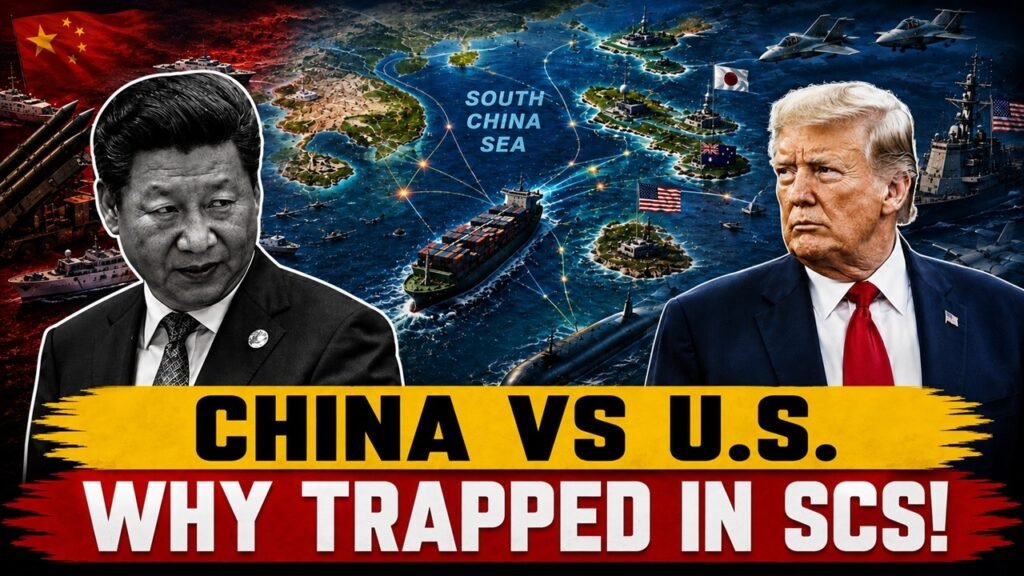
How China and the U.S are Building a Military Wall Around the South China Sea?
The South China Sea is no longer simply a maritime dispute involving competing claims over reefs, islands and fishing grounds. It has become one of the most consequential strategic spaces in the Indo-Pacific, where China, the United States and several regional powers are gradually reshaping the military geography of Asia. The sea connects the Indian and Pacific Oceans and siSouth China Sea alongside some of the world’s most strategically important states, including the Philippines, Vietnam, Malaysia, Brunei, Indonesia and China. Its proximity to Taiwan and the wider western Pacific gives developments in the region significance far beyond Southeast Asia.
For China, control and influence in the South China Sea are closely connected to national security. Beijing views the waters as part of its southern strategic approaches and as an important area for protecting maritime trade, energy supplies and access to the wider Pacific. The sea also provides the People’s Liberation Army with an operational environment from which it can monitor regional military activity and potentially project power farther from the Chinese mainland. For the United States, the same geography has a different meaning. Washington has no territorial claim in the South China Sea, but it has long argued that freedom of navigation, international law and the security of allies and partners are central to regional stability. The Philippines is a U.S. treaty ally, while Japan and Australia are major security partners. Taiwan, although not a formal treaty ally, occupies a strategically critical position between the East and South China Seas.
The result is a strategic competition in which geography itself has become a form of military power. Whoever can maintain persistent surveillance, move forces quickly, protect logistics and operate effectively across the maritime environment gains an important advantage. This is why individual developments that might appear relatively small—a new radar facility, a new runway, a military access agreement or a recurring naval patrol—can have consequences for the entire regional balance.
Why the South China Sea Matters to the Global Economy
The strategic importance of the South China Sea is partly explained by its economic geography. Major commercial shipping routes cross the wider region, linking East Asian manufacturing centers with energy suppliers and markets in Southeast Asia, South Asia, the Middle East and Europe. China, Japan, South Korea and other major economies depend heavily on maritime transportation, while Southeast Asian economies are deeply connected to the same shipping system.
The sea is also significant because of its potential energy resources and its proximity to major coastal populations. Although estimates of oil and gas reserves vary considerably and many areas remain disputed, the possibility of offshore resources adds another layer to the competition. Fishing resources are equally important for coastal communities, meaning that maritime disputes affect not only national security but also livelihoods and food security.
This combination of economic and military importance explains why governments are unwilling to ignore developments in the region. A maritime confrontation does not necessarily have to become a major war to create economic consequences. Increased insurance costs, disrupted shipping, restrictions on fishing activity or uncertainty around energy exploration could all produce wider effects. The South China Sea therefore represents a classic example of how economic geography and military geography overlap. The same waters that carry commercial ships can also carry warships, submarines, coast guard vessels and surveillance platforms. The same islands that appear small on a map can become valuable military positions when they are equipped with runways, sensors, communications systems and logistics facilities.
China Is Changing the Geography From the Inside
China’s most significant advantage in the South China Sea comes from geography and proximity. Unlike an external power that must deploy forces thousands of kilometers from home, China operates close to its mainland bases and military infrastructure. Over the past decade, Beijing has used that advantage to transform several disputed maritime features into large artificial islands. The most important examples are Fiery Cross Reef, Subi Reef and Mischief Reef in the Spratly Islands. These locations have been expanded dramatically and equipped with infrastructure capable of supporting military and maritime operations. Runways, aircraft shelters, radar and communications facilities, ports, storage areas and other structures have changed the physical appearance of the disputed features and, more importantly, their strategic utility.
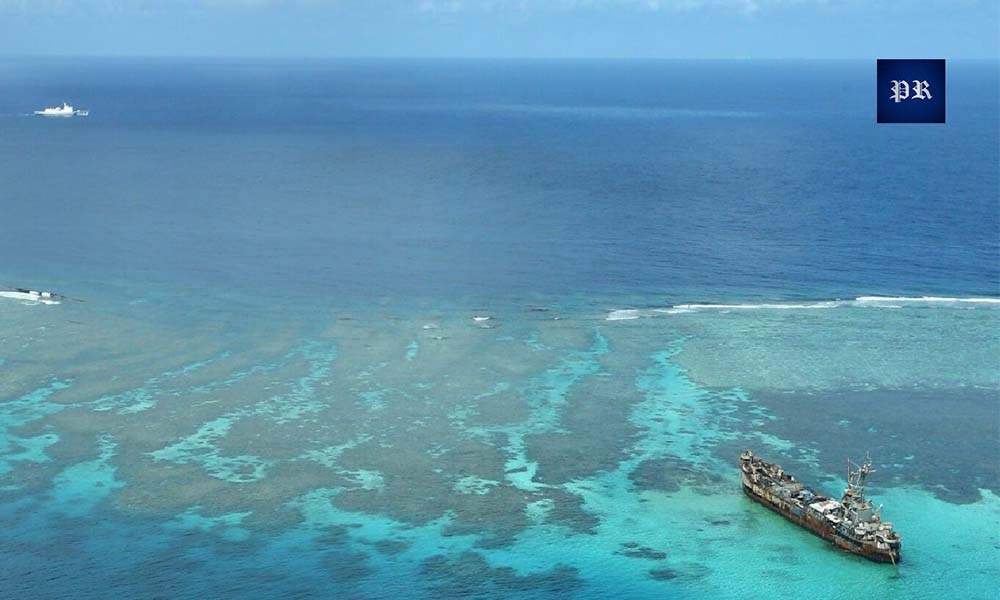
225 Chinese Ships Swarm Philippines Near Scarborough Shoal — What Is China Planning?
The significance of these facilities is not simply that China has created more places from which aircraft and ships can operate. Their greater importance comes from persistence. A naval vessel can leave an area after a patrol, but a fixed sensor, runway or communications installation remains. Infrastructure allows China to maintain a continuous presence and potentially respond more rapidly to developments across the surrounding waters. This has created a form of strategic depth inside the South China Sea. Instead of relying exclusively on mainland bases, Chinese forces can use a network of forward positions that extend surveillance and operational reach. These positions can support maritime patrols, aircraft operations, communications and potentially other military missions. The transformation also demonstrates how disputed geography can be converted into strategic infrastructure. A reef that previously had limited military significance can become considerably more important once it is connected to a larger network of bases and sensors.
Artificial Islands Are Only One Part of China’s Strategy
It would be misleading, however, to describe China’s South China Sea strategy purely in terms of artificial islands. Fixed military infrastructure is only one component of a much broader system that includes the navy, coast guard, maritime militia, law-enforcement agencies and civilian vessels. The People’s Liberation Army Navy provides China’s high-end military capability. Its surface combatants, submarines, aircraft carriers, naval aviation and other forces give Beijing the ability to escalate from maritime presence to conventional military power when necessary. But in many South China Sea confrontations, China relies on forces that operate below the traditional threshold of naval warfare.
The China Coast Guard has become particularly important. Coast guard vessels can maintain a persistent presence around disputed areas while presenting themselves as law-enforcement rather than purely military actors. This distinction can complicate the response of rival states because using military forces against coast guard vessels could create a significant political escalation. Maritime militia forces add another layer. These vessels can operate in large numbers and remain in contested waters for extended periods. Their activities can create pressure and increase the density of Chinese vessels without requiring the constant deployment of frontline naval warships. The strategic value of this layered approach is flexibility. China can choose different instruments depending on the situation. A coast guard vessel can challenge another country’s ship, maritime militia vessels can reinforce an area, and naval forces can remain farther behind as a more powerful deterrent. This creates what can be described as a maritime ladder of escalation.
Gray-Zone Competition Is Changing
The South China Sea demonstrates why modern strategic competition does not always look like conventional warfare. Much of the contest occurs in what analysts describe as the gray zone: activities that are coercive and strategically meaningful but remain below the threshold of open armed conflict. Water-cannon incidents, dangerous maneuvering, blocking actions, maritime patrols, prolonged deployments and confrontations around disputed features are examples of how pressure can be applied without formally declaring war. The advantage of gray-zone tactics is that they create ambiguity. If a confrontation does not involve conventional military force, the opposing government may find it more difficult to justify a major escalation. At the same time, repeated encounters can gradually change behavior.
Suppose a country’s vessels repeatedly encounter another country’s coast guard ships in a disputed area. Even if every individual incident remains limited, the cumulative effect can be substantial. Crews become more cautious, commanders must dedicate additional resources, and governments have to consider the possibility of escalation every time they conduct a patrol. Over months and years, that pressure can change the practical reality of the sea. This is an important aspect of China’s strategy. Beijing does not necessarily need to establish an internationally recognized blockade or physically prevent every foreign vessel from entering an area. If its presence becomes sufficiently persistent that other countries begin to reduce or modify their activities, China can gain influence without firing a shot.
Scarborough Shoal Shows the Importance of Persistent Presence
Scarborough Shoal is particularly important because of its location and because it illustrates the relationship between sovereignty disputes and military strategy. The shoal lies in a strategically significant area of the South China Sea and has become a recurring point of confrontation between China and the Philippines.
The importance of Scarborough Shoal extends beyond the immediate territorial dispute. Its location gives it potential value for surveillance and maritime control, particularly because it lies relatively close to the Philippine island of Luzon. Confrontations around the shoal have demonstrated how maritime coercion can take place through patrols, blocking maneuvers, water-cannon incidents and competing claims of law-enforcement authority. Such encounters rarely resemble traditional naval battles, but they can still affect the strategic balance.
The larger lesson is that control can sometimes be exercised through presence rather than formal occupation. A state that maintains vessels around a disputed location on a regular basis can gradually make its presence appear normal. Over time, what began as an extraordinary deployment can become routine. That is why gray-zone competition is fundamentally a contest over habits as well as territory. The side that can remain present more consistently may gain an advantage in shaping what other states consider possible or acceptable.
America Is Building a Different Kind of Military Wall
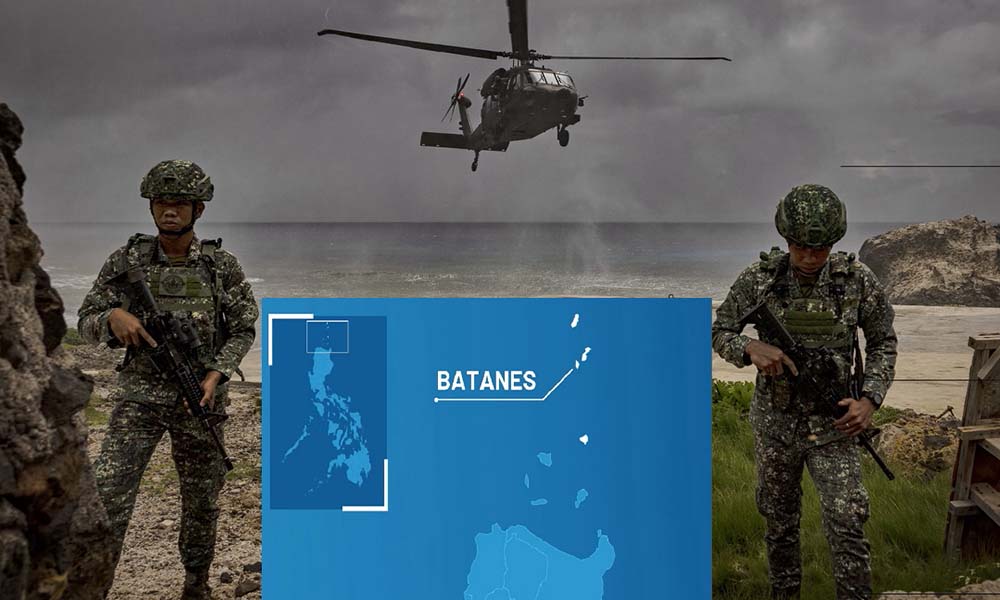
The United States is responding to China’s expanding regional presence through a fundamentally different model. Washington is not attempting to reproduce China’s artificial-island strategy. Instead, it is strengthening a network of alliances, military access arrangements, exercises, logistics hubs, surveillance capabilities and partner forces. This network stretches across a large portion of the Indo-Pacific. Japan occupies a critical position in the north, the Philippines provides access near the South China Sea and Taiwan, while Australia provides strategic depth farther south. South Korea contributes to the broader U.S. alliance architecture in Northeast Asia.
The American approach is therefore less about a single line of bases and more about distributed access. The objective is to ensure that U.S. and allied forces can operate from multiple locations rather than depending on one or two vulnerable bases.This concept has become increasingly important as modern precision weapons make concentrated military infrastructure more vulnerable. If a major conflict occurred, large fixed facilities could become targets. Distributing aircraft, ships, sensors, fuel, ammunition and command capabilities across multiple locations can make a military network harder to disrupt. The United States and its partners are therefore developing a military geography based on mobility and redundancy. China has invested heavily in fixed infrastructure inside the contested waters, while Washington is attempting to ensure that forces can move around and through the wider region.
Australia Provides Strategic Depth
Australia plays a different but complementary role. It is geographically farther from the South China Sea, yet its distance can itself be an advantage. Australia provides strategic depth, training areas, logistics opportunities and access to the southern Indo-Pacific. The Australia-U.S. security relationship has also become increasingly important as Washington seeks to distribute military capabilities across the region. Australia’s role demonstrates that the emerging strategic network is not simply a line immediately surrounding China. It is a much deeper system extending from Northeast Asia through Southeast Asia and into the Indian Ocean and southern Pacific. This matters because modern military power depends on sustainment. A force cannot remain effective merely because it can reach a theater. It needs fuel, ammunition, maintenance, intelligence, communications and secure logistics. Australia can contribute to that wider architecture.
The South China Sea competition is sometimes presented as a simple contest between China and the United States, but this overlooks the interests of Southeast Asian states. bVietnam has particularly strong reasons to monitor China’s maritime activities. It has its own territorial disputes with Beijing and has sought to strengthen its maritime capabilities and strategic relationships. Vietnam’s position is complicated. It has strong economic ties with China while simultaneously maintaining concerns about sovereignty and maritime security.
This illustrates the dilemma facing many Southeast Asian states. They do not necessarily want to choose between China and the United States. Instead, many want stronger security relationships, economic opportunities and strategic autonomy at the same time.That makes Southeast Asia less like a battlefield divided into two camps and more like a complicated diplomatic environment in which governments constantly adjust their relationships.
China Also Faces Strategic Constraints
China’s position is powerful, but Beijing also faces significant constraints. The first is geography. China enjoys proximity to the South China Sea, but moving beyond its immediate waters exposes Chinese forces to a broader network of foreign surveillance and military capabilities. The second challenge is diplomacy. Aggressive actions that alarm neighboring countries can encourage those countries to deepen security relationships with the United States, Japan, Australia and one another. This creates a strategic paradox for Beijing. Pressure can produce short-term gains, but excessive pressure can strengthen the coalition that China ultimately wants to prevent. The third challenge is operational complexity. Sustaining military forces far from home requires logistics, maintenance, communications and reliable access. A navy can conduct occasional distant deployments more easily than it can sustain continuous high-intensity operations far from its main bases. China’s long-term strategy must therefore balance ambition with sustainability.
Modern military competition in the South China Sea is not only about ships, missiles and aircraft. Increasingly, the most important capability may be the ability to see and understand what is happening across the maritime environment. Radar, satellites, unmanned systems, aircraft, coastal sensors and intelligence-sharing networks allow countries to develop a more complete picture of maritime activity. This creates an information competition. A country that can detect another country’s ships earlier has more time to respond. A military that can combine satellite information with aircraft and surface sensors can monitor a much larger area. A coalition that shares intelligence can potentially see threats that an individual country would struggle to detect alone. This is one reason the U.S. alliance system can be powerful even when American forces are not physically present everywhere. Information shared among allies can create a network effect. China is also investing heavily in surveillance and reconnaissance capabilities, meaning that the information contest is likely to become even more intense.
Conclusion
The South China Sea is becoming much more than a dispute over reefs and maritime boundaries; it is emerging as a test of military geography, strategic endurance, alliances and regional autonomy. China is attempting to turn its geographic proximity to the region into durable strategic influence through artificial islands, military infrastructure, coast guard patrols, maritime militia activity and expanding naval power. Its objective is not necessarily to fight a conventional war, but rather to maintain such a persistent presence that other countries must increasingly account for Chinese forces in their daily maritime operations. The United States is responding through a different model, strengthening a distributed network of allies and partners rather than attempting to dominate the sea from a single position, with the Philippines, Japan and Australia serving as particularly important components of this system while Taiwan remains central to the broader strategic geography of the western Pacific.
These factors may determine the future of the South China Sea more than any individual ship, island or confrontation. The central issue is therefore not simply whether China or the United States possesses greater military power, but whether either side can transform military presence into durable strategic influence without provoking a regional reaction that undermines its own objectives. For Southeast Asian countries such as the Philippines and Vietnam, this distinction is crucial because they do not necessarily want to become instruments of great-power rivalry; instead, they seek security, sovereignty, economic stability and freedom of strategic choice. The future South China Sea may therefore become neither a Chinese lake nor an American-controlled maritime zone, but rather a permanently contested frontier where several powers operate simultaneously, each attempting to shape the rules and strategic balance while avoiding a direct conflict that could destabilize the wider Indo-Pacific. That competition is likely to remain one of the most important security questions shaping the Indo-Pacific for years to come.
About Indo-Pacific Report
For more geopolitical analysis, strategy coverage, and Indo-Pacific security reporting, visit Indo-Pacific Report:
Website
Facebook
YouTube
How China and the U.S are Building a Military Wall Around the South China Sea?