China Is Turning a Antelope Reef Into a Military Outpost in the South China Sea
China Is Building Again Satellite imagery has revealed something many believed had ended years ago.
China has resumed large scale land reclamation in the South China Sea. But this time, the construction isn’t taking place at one of Beijing’s well-known military outposts.
Instead, it’s happening at Antelope Reef, a little-known feature in the Paracel Islands that, until recently, was little more than a submerged coral reef.
Today, it’s being transformed at an extraordinary pace.
According to satellite analysis by the Asia Maritime Transparency Initiative and the Open Source Centre, Beijing began large-scale dredging at Antelope Reef in October 2025. If construction continues at its current pace, the reef could become China’s largest artificial feature in the entire South China Sea, rivaling—or even surpassing—Mischief Reef, Beijing’s largest outpost in the Spratly Islands.
That’s why military analysts are watching this project so closely.
Because this isn’t just another land reclamation effort.
It’s China’s first major island-building campaign in the South China Sea since 2017, raising fresh questions about Beijing’s long-term ambitions in one of the world’s most contested maritime regions.
But this story isn’t really about a single reef.
It’s about what happens when a submerged coral formation is transformed into a strategic outpost capable of supporting ships, aircraft, surveillance systems, and potentially much more.
Because once you understand why Antelope Reef is changing…
you’ll understand why the balance of power in the South China Sea may be changing with it.
The Reef Nobody Was Watching
The question is, why did China choose Antelope Reef?
If Antelope Reef could become China’s largest artificial island in the South China Sea, the next question is obvious.
Why this reef?
To answer that, we first need to understand where it is.
At first glance, Antelope Reef doesn’t seem particularly important. It’s a small coral reef in the Crescent Group of the Paracel Islands, a chain of islands and reefs in the northern South China Sea. For decades, it attracted little international attention compared with flashpoints like the Spratly Islands or Scarborough Shoal.
But in geopolitics, location often matters more than size.
Located about 300 kilometers southeast of China’s Hainan Island and roughly 330 kilometers east of Da Nang, Vietnam, Antelope Reef sits near major sea lanes linking Northeast Asia with Southeast Asia and beyond. These waters carry a significant share of global maritime trade and have long been at the center of competing territorial claims and military activity.
The Paracel Islands are controlled by China but are also claimed by Vietnam and Taiwan. Since taking full control of the islands in 1974, Beijing has steadily expanded its presence with ports, airfields, radar stations, and other military infrastructure. Antelope Reef now appears to be the latest addition to that growing network.
Its location offers another strategic advantage. From the Paracels, Chinese Coast Guard ships, naval vessels, and aircraft can operate more effectively across the northern South China Sea, allowing Beijing to maintain a more persistent presence in waters it claims.
In other words, Antelope Reef isn’t valuable because of what it was.
It’s valuable because of where it is.
Its position strengthens an existing chain of Chinese outposts while extending operational reach across one of the world’s most strategically important maritime regions.
But location alone doesn’t explain the scale of what’s happening here.
So what exactly are the satellites revealing—and how did this quiet reef change so dramatically in less than a year?
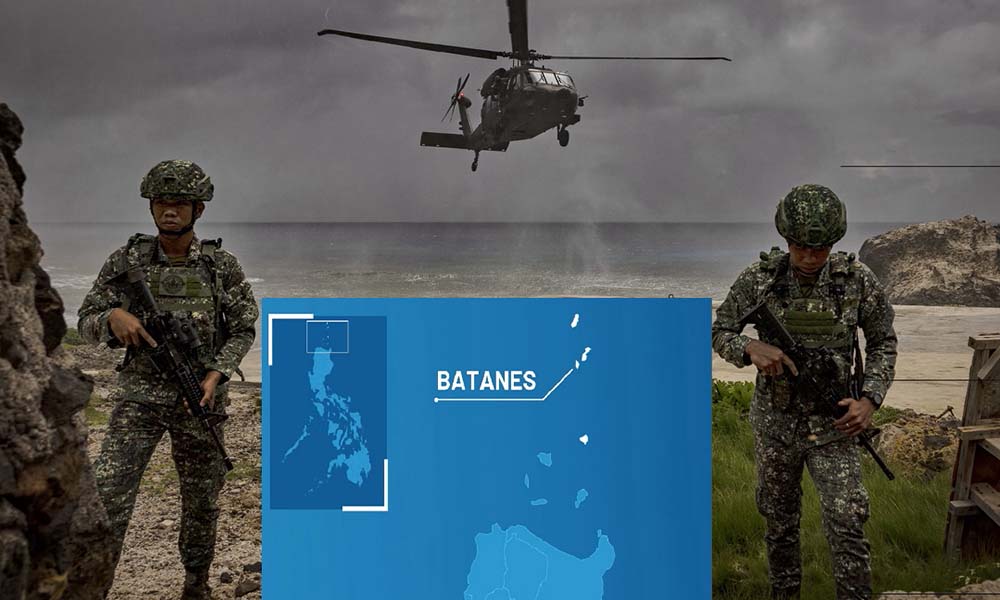
China Just Claimed New Part of Philippines in Batanes of South China Sea!
What the Satellites Reveal
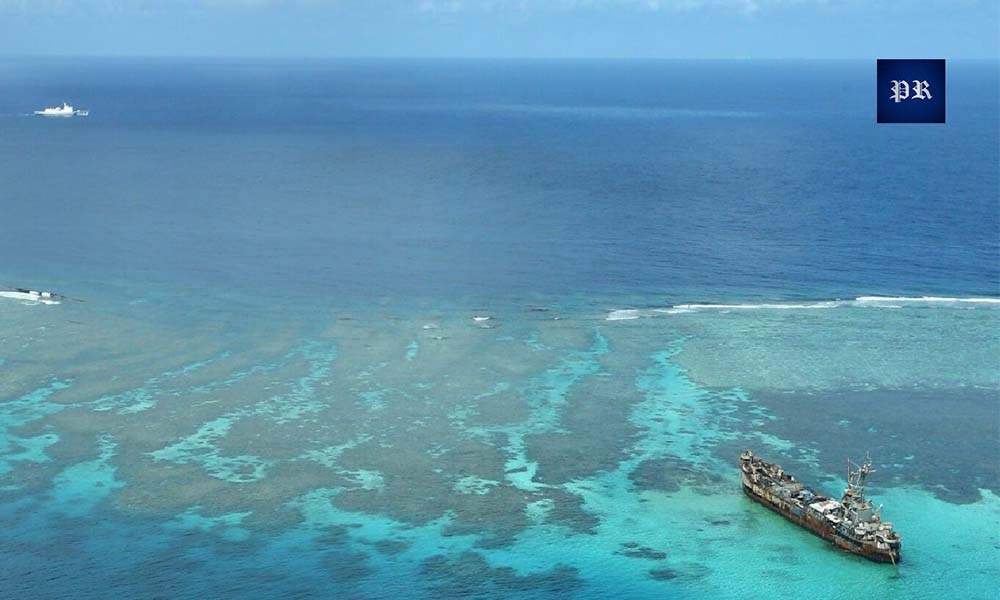
Until late 2025, Antelope Reef looked much like countless other coral reefs scattered across the South China Sea. Most of it disappeared beneath the water at high tide, with only small sections visible above the surface.
Then everything changed.
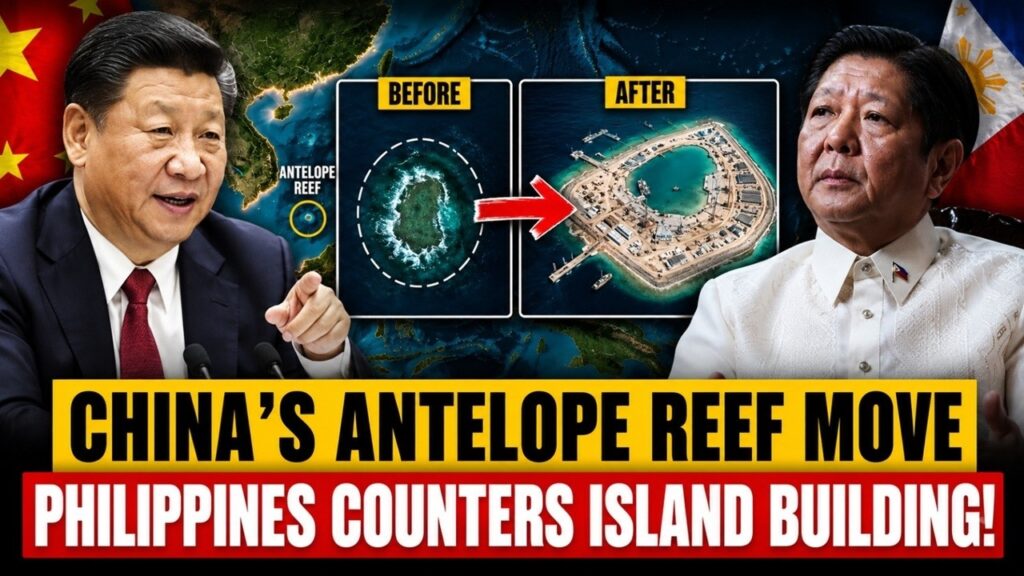
Satellite imagery analyzed by the Asia Maritime Transparency Initiative (AMTI) shows that large-scale dredging began around October 2025. Specialized dredging vessels started extracting sand from the surrounding seabed and pumping it onto the reef—a method China has used before to create artificial islands.
Over the following months, the transformation accelerated.
Fresh satellite images show vast areas of newly reclaimed land replacing what was once open water. A protected lagoon began to take shape, while a causeway connected different parts of the growing island. New roll-on/roll-off berths appeared along the shoreline, allowing heavy vehicles and construction equipment to move directly between ships and land.
The images also reveal concrete batching plants, worker accommodations, construction materials, and expanding support facilities—all strong signs that the project remains in an active construction phase rather than nearing completion.
But perhaps the most striking change is its sheer scale.
Based on the current pace of reclamation and the planned footprint visible in satellite imagery, AMTI analysts estimate that Antelope Reef could eventually cover about 603 hectares, or roughly 1,490 acres.
If that estimate proves accurate, Antelope Reef would become the largest artificial feature China has ever built in the South China Sea, surpassing even Mischief Reef, the largest island created during Beijing’s reclamation campaign between 2013 and 2017.
And all of this has happened in less than a year.
What was once a barely visible reef is rapidly becoming a permanent man-made island capable of supporting far more than construction crews alone.
But building an island on this scale demands enormous resources, advanced engineering, and years of planning.
So why invest so much in a single reef?
Why Build This Reef?
Building an artificial island in the middle of the sea is an enormous undertaking. It requires specialized dredging fleets, thousands of workers, massive amounts of sand and concrete, and months of continuous construction.
So why invest so much in a reef that, until recently, was barely visible above the water?
The answer lies in what an artificial island makes possible.
Unlike a natural reef, a reclaimed island creates space for infrastructure. And in strategic terms, infrastructure creates options.
A protected harbor allows ships to refuel and resupply without returning to the mainland. Fuel, food, spare parts, and construction materials can all be stored much closer to where they’re needed.
Permanent facilities also allow the China Coast Guard and, potentially, China’s maritime militia to maintain a more sustained presence in nearby waters. Instead of operating from distant bases, vessels can stay at sea longer, increasing patrols and reducing response times.
The same principle applies to surveillance.
An artificial island can host radar systems, communications equipment, and intelligence, surveillance, and reconnaissance—or ISR—assets. Together, these systems improve maritime awareness by tracking ships and aircraft across a much wider area.
Helicopter landing facilities could extend that reach even further, allowing personnel, supplies, and emergency assistance to move quickly between outposts. Analysts also note that if land reclamation continues, the island could eventually be large enough to support additional infrastructure, including a runway. However, there is currently no confirmed evidence that China is building—or has announced plans to build—an airstrip at Antelope Reef.
But the bigger story isn’t any single facility.
It’s the flexibility they create.
Every new capability—whether it’s a pier, a radar installation, or a communications site—expands the range of missions the island can support. Over time, that gives both military and civilian authorities more options during routine patrols, humanitarian operations, law enforcement missions, or periods of heightened tension.
Viewed on its own, Antelope Reef is just one reclaimed island.
But connected to China’s existing outposts across the South China Sea, it becomes part of something much bigger.
So how does this new island fit into Beijing’s growing network of bases and outposts?
China’s Expanding Network
Viewed on its own, Antelope Reef is simply another reclaimed island in the South China Sea.
But military infrastructure is rarely built to operate alone.
Over the past decade, China has developed a network of outposts across the South China Sea, each serving a different role. Some function as administrative centers. Others have deep-water harbors, airfields, radar installations, communications systems, or logistics facilities.
In the Paracel Islands, Woody Island has become China’s main administrative and military hub, with a runway, port facilities, and permanent infrastructure.
Farther south, in the Spratly Islands, Fiery Cross Reef, Subi Reef, and Mischief Reef have each been transformed into large artificial islands equipped with airstrips, harbors, and extensive support facilities.
Now, Antelope Reef appears to be joining that network.
Rather than replacing existing outposts, it strengthens them.
Ships operating in the region gain another place to refuel and resupply. Aircraft and helicopters have another staging point. Radar and communications systems can extend coverage across a wider area. Maintenance and logistics can also be spread across multiple locations instead of relying on a single base.
In military planning, this is often called a distributed support network. The goal isn’t simply to build more bases—it’s to connect them in ways that improve endurance, resilience, and operational flexibility.
The Lowy Institute has described developments like these as “another node in a distributed architecture designed to sustain presence.” In other words, every new outpost makes the entire network stronger, allowing China to maintain a more continuous presence across a vast maritime region.
Whether supporting Coast Guard patrols, naval operations, search-and-rescue missions, or other government activities, each island becomes more valuable when it’s connected to the others.
That’s why many analysts see Antelope Reef as more than just another construction project.
They see it as another link in China’s expanding network of strategic outposts across the South China Sea.
But while Beijing sees that network as strengthening its position, many of its neighbors see something very different.
So why has Antelope Reef sparked concern across the region?
Why the Region Is Concerned
The answer depends on who’s looking at Antelope Reef.
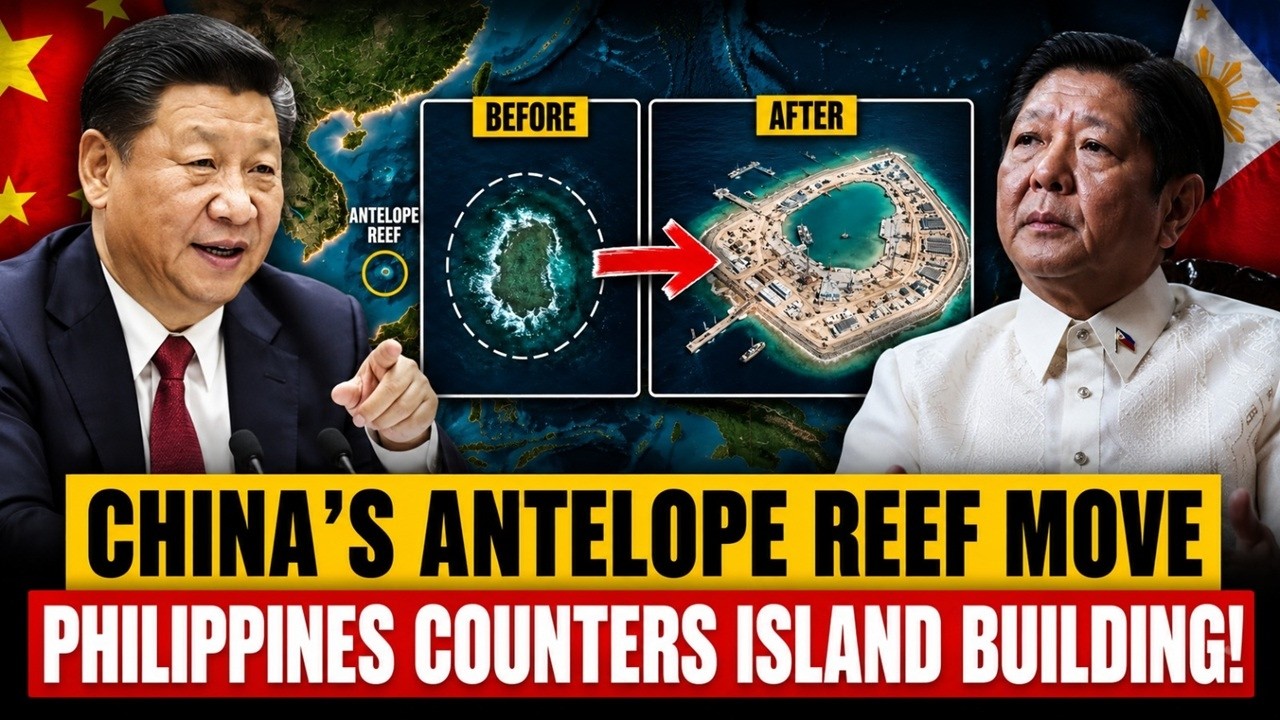
For China, the reef is part of the Paracel Islands, which Beijing has controlled since 1974. Chinese officials maintain that construction is taking place within territory under China’s administration and argue that developing infrastructure there is a matter of national sovereignty and domestic jurisdiction.
Vietnam sees it very differently.
Hanoi also claims sovereignty over the Paracel Islands and has repeatedly protested China’s construction activities in the area. Vietnamese officials describe the reclamation work as illegal, arguing that it violates Vietnam’s sovereignty and further complicates disputes in the South China Sea.
The Philippines isn’t a claimant to the Paracel Islands.
Even so, Manila is watching developments closely.
Philippine officials and security analysts often view new Chinese infrastructure through the broader lens of regional security. Their concern is that every additional outpost could improve China’s ability to sustain operations across the South China Sea, including in areas much closer to the Philippines, where maritime disputes remain active.
For the United States and several of its partners, the issue goes beyond competing territorial claims.
Washington has consistently stated that it takes no position on the sovereignty of individual land features. At the same time, it has repeat
About Indo-Pacific Report
For more geopolitical analysis, strategy coverage, and Indo-Pacific security reporting, visit Indo-Pacific Report:
Website
Facebook
YouTube
China Is Turning a Antelope Reef Into a Military Outpost in the South China Sea