Why China Says the U.S. Philippines Aren’t Ready for War in the South China Sea
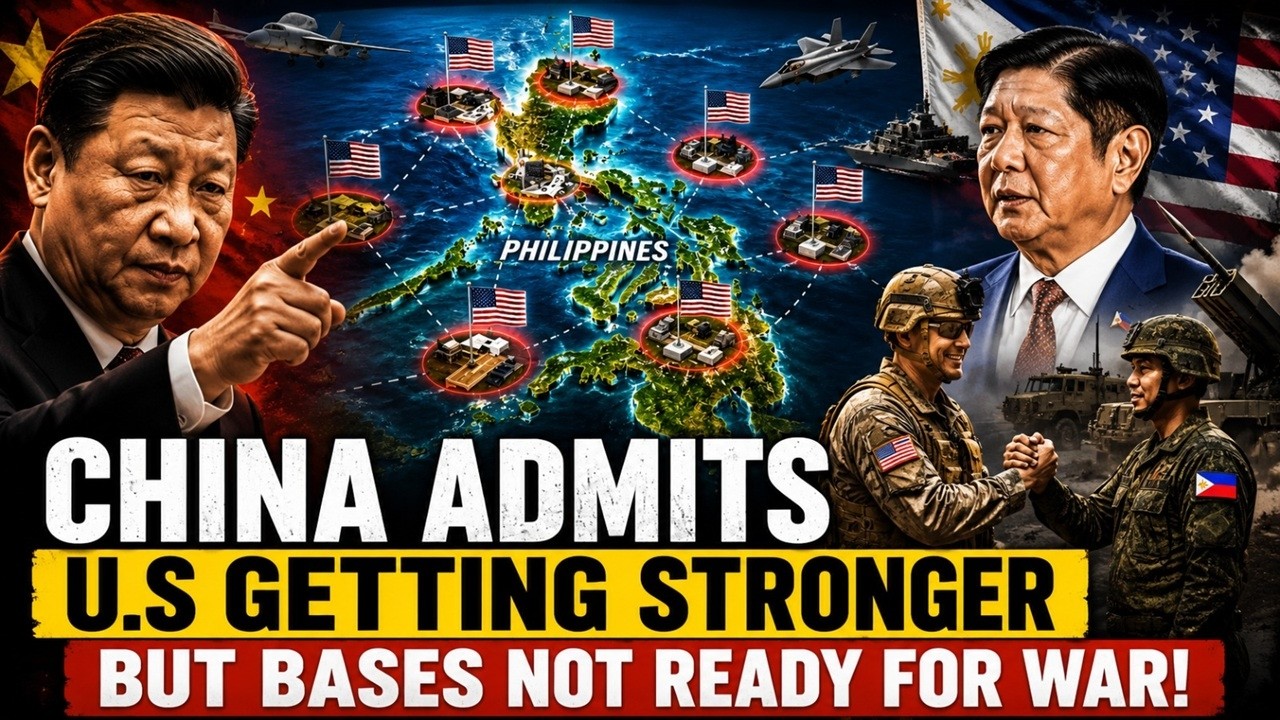
An in-depth analysis of China’s latest assessment of U.S. military expansion in the Philippines, EDCA, regional alliances, logistics, and the Indo-Pacific security landscape. China’s latest assessment of U.S. military access to Philippine bases has sparked debate across the Indo-Pacific. While Beijing argues that many Enhanced Defense Cooperation Agreement (EDCA) sites are not yet fully prepared for wartime operations, it simultaneously acknowledges that the U.S.-Philippines alliance has become significantly stronger. This article explains why these two observations are not contradictory and what they reveal about the changing regional security environment.
The discussion below has been rewritten for a broader audience with a clear, balanced and SEO-friendly structure.
China has just released an assessment that sounds surprisingly reassuring—but only at first.
According to a new report published by the South China Sea Strategic Situation Probing Initiative, a Chinese research organization that studies regional military developments, many of the U.S.-accessible military sites in the Philippines are still not ready to support a major conflict. The report argues that while construction continues under the Enhanced Defense Cooperation Agreement, or EDCA, much of the infrastructure remains incomplete and offers only limited wartime utility. As of May 2026, it says the United States has awarded roughly 125 million dollars in contracts to expand these facilities, but turning construction projects into combat-ready military hubs takes far more than pouring concrete.
But that is only half of China’s assessment.
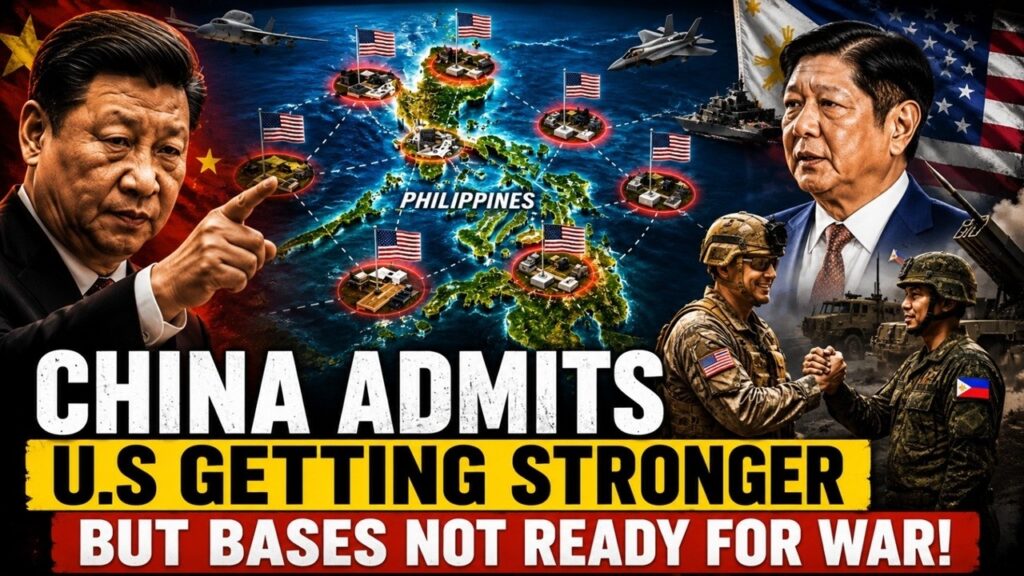
The very same report acknowledges that the United States has significantly strengthened its military position in the Philippines. Since 2023, Washington has expanded access from five EDCA sites to nine, increased rotational deployments, introduced more advanced weapons into joint exercises, and deepened military cooperation not only with Manila, but increasingly with Japan and Australia. In other words, Beijing argues that the bases may not be fully ready for war—but the alliance surrounding them is becoming much more capable.
At first glance, those two conclusions seem to contradict each other. But they don’t. In fact, understanding why China believes both statements can be true at the same time reveals how military competition in the Indo-Pacific is changing—and why the Philippines has become one of its most important frontlines.
WHAT THE CHINESE REPORT ACTUALLY SAYS
Before deciding whether China’s assessment is convincing, it’s worth looking at what the report actually documents.
Open the report, and one thing becomes immediately clear. It does not argue that American military expansion has slowed down. In fact, it argues exactly the opposite.
According to the report, Washington has steadily expanded its military footprint in the Philippines since 2022. Access under EDCA has grown from five agreed locations to nine, while new infrastructure projects continue to support joint operations, military exercises, logistics, and rotational deployments.
The report even puts a price tag on that expansion. Using what it describes as incomplete statistics, it estimates that by May 2026 the United States had awarded roughly 125 million dollars in contracts for EDCA infrastructure projects, along with another 7.3 million dollars for life-support services across American-accessible facilities. From Beijing’s perspective, those numbers point to a military buildup that is still gaining momentum—not slowing down.
But construction is only part of what caught the attention of Chinese analysts.
The report argues that American military activity has also become more sophisticated. It highlights larger live-fire exercises, greater use of autonomous weapons and unmanned platforms, and increasing interoperability between allied forces. More importantly, it describes the emergence of a broader military network linking the United States, the Philippines, Japan, and Australia—one designed to operate together during future contingencies rather than simply train together during peacetime.
Then the report shifts from construction to geography.
According to its authors, recent deployments reveal a strategic orientation in two directions at once: north toward the Taiwan Strait and south toward the South China Sea. In their view, this posture improves the ability of U.S. and allied forces to respond across both theaters, tying infrastructure, military cooperation, and geography into a single strategic framework.
Yet after documenting all of these developments, the report arrives at a conclusion that appears almost contradictory. Construction continues. Funding continues. Military cooperation is expanding. And yet, many of these facilities are still described as having limited wartime utility.
That raises an obvious question.
44 Chinese Ships Are Sitting in Philippines Waters. Is This China’s New Strategy?
If the bases are growing, the alliance is growing, and military activity is growing… why does China still believe they aren’t ready for war?
WHY LOGISTICS MATTERS MORE THAN BUILDINGS
At first glance, China’s conclusion seems difficult to understand. If the United States is investing millions of dollars, expanding military access, and conducting larger joint exercises, why would Chinese analysts still describe these facilities as having limited wartime value?
The answer lies in the difference between building infrastructure and building military capability.
A military base is not defined by its runways or its buildings alone. An airfield can have a newly paved runway, modern hangars, and freshly constructed barracks, but none of those guarantee that it can sustain combat operations. To function during a war, a base requires an entire support system operating behind the scenes. Fuel must arrive continuously. Ammunition has to be stored safely and replenished under pressure. Aircraft and vehicles require constant maintenance. Communications networks must remain secure and resilient. Engineers have to repair damaged infrastructure, air defenses must protect the base from attack, transportation networks must keep supplies moving, and medical facilities must be prepared to treat casualties.
Remove those elements, and even the most impressive military installation becomes little more than a collection of concrete and steel. It may support training and peacetime activities, but sustaining combat is an entirely different challenge.
This distinction is not unique to China’s assessment. The U.S. Department of Defense defines logistics as the planning and execution of the movement and sustainment of forces, emphasizing that military operations depend not only on deploying troops and equipment, but on continuously supplying, maintaining, protecting, and supporting them throughout a campaign. In military planning, combat power is measured not only by what a force can deploy on the first day of a conflict, but by what it can sustain on the tenth, the thirtieth, or even the hundredth day.
History reinforces that lesson. During Operation Desert Shield in 1990, the United States did not launch offensive operations immediately after Iraq invaded Kuwait. Instead, it spent months moving hundreds of thousands of troops, massive quantities of equipment, fuel, ammunition, and supplies into Saudi Arabia before combat began. That enormous logistical effort created the conditions for the coalition’s rapid success during Operation Desert Storm. The lesson was straightforward: military strength depends not only on weapons, but on the ability to sustain them.
This is precisely the distinction the Chinese report is making. It does not argue that construction has stopped or that the United States lacks access to Philippine bases. Instead, it argues that infrastructure alone does not equal operational readiness. In Beijing’s assessment, many of these facilities are still evolving from construction projects into wartime logistics hubs—a transition that requires far more than new buildings or expanded access.
THE REPORT’S BIGGEST SURPRISE
Up to this point, the Chinese report sounds like a familiar critique of American military expansion. It questions the wartime readiness of EDCA sites, argues that many facilities remain underdeveloped, and suggests that the United States still has significant logistical work to do.
But then the report makes an observation that is far more revealing than its criticism.
While questioning the readiness of individual bases, the authors also acknowledge that the United States has been steadily transforming the way it operates with its allies. According to the report, American forces are conducting larger and more realistic live-fire exercises than before, expanding rotational deployments, introducing autonomous weapons and unmanned platforms into joint training, and improving interoperability between allied militaries. Just as importantly, it argues that Washington is building what it describes as a multilateral combat system centered on the United States, the Philippines, Japan, and Australia—a network designed not simply to cooperate in peacetime, but to operate together during a crisis.
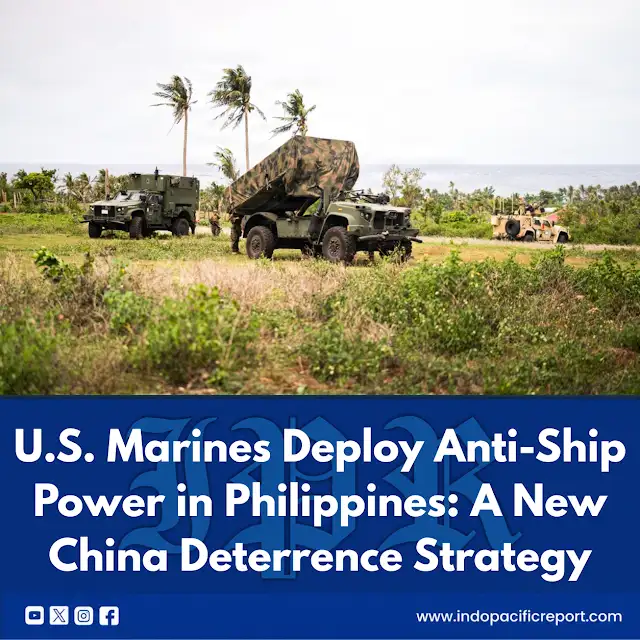
The report goes even further. It argues that the U.S. military presence in the Philippines has evolved beyond the traditional model of alliance cooperation into what it describes as a “fully functional, rapidly responsive, and tightly coordinated” military system integrated with regional partners. Through frequent rotational deployments, recurring exercises, and the repeated presence of systems such as HIMARS, the Typhon Weapon System, and the Navy-Marine Expeditionary Ship Interdiction System, or NMESIS, Chinese analysts conclude that Washington has effectively established what they describe as a quasi-permanent military presence—even without constructing traditional permanent bases.
This is the report’s most important insight.
Beijing is not simply measuring the number of runways, warehouses, or military buildings. It is measuring something much harder to build—and much harder to reverse. It is measuring the ability of allied militaries to train together, communicate together, share intelligence, move forces across national boundaries, and respond as a coordinated force when a crisis emerges.
In other words, the report suggests that America’s greatest strategic achievement in the Philippines has not been the construction of military infrastructure. It has been the construction of an alliance that is becoming progressively more integrated, more interoperable, and more capable of operating as a single military network.
And once viewed through that lens, the apparent contradiction at the heart of China’s assessment begins to disappear. The bases themselves may still be under construction, but the alliance built around them is already becoming operational.
EDCA IS NOT A BASE NETWORK. IT IS AN ACCESS NETWORK.
At this point, it’s easy to imagine EDCA as a map with nine American military bases scattered across the Philippines. But that isn’t how either Washington or Manila describes the agreement.
The Enhanced Defense Cooperation Agreement was never designed to recreate the massive permanent U.S. bases that once existed at Subic Bay or Clark Air Base during the Cold War. Instead, it creates something far more flexible. Under EDCA, the United States receives access to agreed Philippine military locations for rotational deployments, joint training, pre-positioning equipment, constructing shared military infrastructure, and improving the ability of both armed forces to operate together. The facilities remain Philippine bases, while American forces rotate through them rather than maintaining a permanent presence.
That distinction matters because flexibility has become one of the defining principles of modern military planning. Rather than concentrating personnel and equipment at a handful of large installations, today’s approach spreads logistics, infrastructure, and operational access across multiple locations. Fuel storage, ammunition depots, aircraft shelters, communications systems, maintenance facilities, and transportation networks can be expanded where needed, while troops move in and out through regular exercises and rotational deployments instead of permanent stationing.
Reuters reported in April 2026 that several EDCA sites are still affected by land and construction delays, limiting their current use. Philippine Defense Secretary Gilberto Teodoro acknowledged that project execution has been slower than expected, reinforcing the point that these locations are still developing rather than functioning as fully mature military hubs.
At the same time, the purpose of EDCA has remained remarkably consistent. U.S. officials describe it as strengthening alliance readiness, improving interoperability, supporting joint training, pre-positioning equipment, and enhancing the ability to respond not only to security challenges but also to humanitarian disasters and natural emergencies. Philippine leaders have likewise emphasized that EDCA does not authorize permanent American bases on Philippine soil.
And this brings us back to China’s assessment.
Beijing is looking beyond the legal language of EDCA and asking a different question. It is not asking whether the United States owns these bases. It is asking whether the United States can reliably access them, reinforce them, supply them, and integrate them into a wider regional military network during a crisis. From that perspective, EDCA is less about nine individual locations and more about creating a flexible architecture that can rapidly expand whenever the strategic environment demands it.
GEOGRAPHY CHANGES THE ENTIRE PICTURE
Until now, we’ve talked about infrastructure, logistics, and military cooperation. But none of those explain where these developments are taking place. And in the Indo-Pacific, geography often determines strategy long before military planners do.
This is why one sentence in the Chinese report deserves special attention. The authors argue that recent American deployments in the Philippines show “a strategic shift northward toward the Taiwan Strait and southward toward the South China Sea.” That observation reveals that Beijing is looking beyond individual bases and focusing instead on the geography that connects them.
Look at a map of the region.
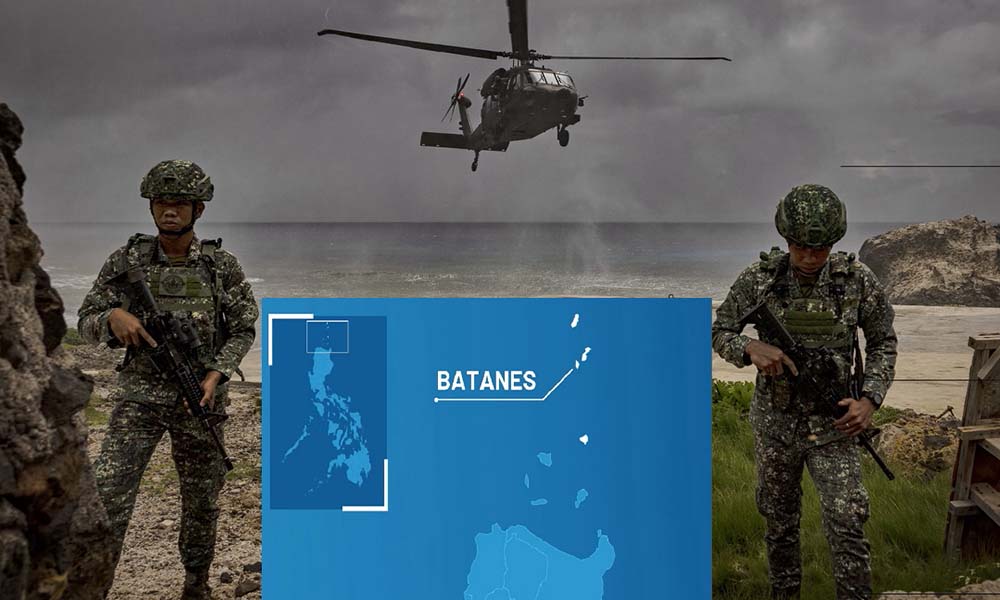
Northern Luzon, together with the Babuyan Islands and Batanes, sits only a short distance from Taiwan. To the west lies the South China Sea, one of the world’s busiest maritime corridors. Stretching beyond these waters is the First Island Chain—a natural arc running from Japan through Taiwan and the Philippines before extending toward Southeast Asia. Any military force operating in this region must contend with that geography. It cannot simply ignore it.
For Beijing, this geography presents a strategic challenge. Chinese naval forces seeking to move from the mainland into the wider Pacific must pass through a series of narrow maritime passages that cut across or around the First Island Chain. Those same waters are also vital for commercial shipping, military reinforcement, and access between the Pacific Ocean and the South China Sea. That is why locations in northern Philippines have attracted increasing strategic attention in recent years.
From Washington’s perspective, improving access to Philippine facilities enhances the ability to reinforce allies, conduct surveillance, move personnel and equipment, and respond more rapidly across multiple contingencies. From Beijing’s perspective, however, the same developments could strengthen a network positioned along one of China’s most sensitive maritime approaches. That difference in perspective helps explain why the Chinese report places such emphasis on the alliance’s northward orientation toward the Taiwan Strait and southward orientation toward the South China Sea.
In other words, the strategic importance of these sites is not determined by the size of their runways or the height of their buildings. It is determined by where they are located. Geography gives them value long before construction is complete—and that is why Beijing continues to watch every new development so closely.
WHY PUBLISH THIS REPORT NOW?
Why publish a report like this now?
The authors explain what they believe the United States is doing, but they do not explicitly explain why they chose this particular moment to present their assessment. That means any answer requires careful analysis rather than certainty. Still, the timing offers several plausible explanations.
The first may be domestic. Reports like this help demonstrate that Chinese researchers are closely monitoring changes in the regional security environment. By documenting American infrastructure projects, military exercises, and alliance activities, the report reinforces the message that Beijing understands how the strategic landscape around China is evolving. Rather than presenting the United States as an unstoppable military force, it also projects confidence by arguing that many EDCA facilities remain short of full wartime readiness.
A second possibility is strategic signaling toward Washington. Throughout the report, the authors catalogue infrastructure projects, funding levels, rotational deployments, and changes in force posture in remarkable detail. Whether intentional or not, that level of detail communicates another message: China is watching the development of every major EDCA project and evaluating not only what is being built, but how quickly those facilities are becoming operational.
The report may also be directed at audiences in the Philippines. By emphasizing that many sites still have limited wartime utility, Chinese analysts appear to draw a distinction between expanding cooperation and immediate military capability. The implication is subtle but important: while the alliance may be growing stronger, the infrastructure itself has not yet fundamentally altered the regional balance of power. Whether that assessment is accurate or not, it offers a narrative that could influence how developments are perceived inside the Philippines.
Finally, the report speaks to a wider regional audience. Across the Indo-Pacific, governments are closely following the evolution of the U.S.–Philippines alliance. By acknowledging growing military integration while simultaneously emphasizing logistical limitations, the report separates long-term strategic trends from short-term operational realities. In effect, it argues that today’s construction delays should not be confused with tomorrow’s strategic trajectory.
Of course, none of these interpretations can be stated with certainty. The report itself does not assign these motivations, and governments rarely explain every objective behind public strategic assessments. But taken together, they suggest that this document is doing more than describing military infrastructure. It is also shaping the broader strategic conversation about the future of the Indo-Pacific.
WHAT HAPPENS NEXT?
So where does this strategic competition go from here?
One possibility is that EDCA construction accelerates. As additional infrastructure is completed, logistics networks expand, fuel and ammunition storage increases, and more facilities become capable of supporting sustained military operations. If that happens, the gap between infrastructure and combat readiness that China identifies today could gradually begin to narrow.
A second possibility is that the alliance evolves even faster than the infrastructure. More joint exercises, deeper intelligence sharing, integrated missile defense, and closer operational planning could strengthen military coordination long before every construction project is finished. As this report itself suggests, an alliance does not have to wait for every building to be completed before becoming more effective.
A third possibility is that China increases pressure before these facilities fully mature. That pressure may not take the form of open conflict. It could instead involve larger military exercises, more frequent gray-zone operations, increased maritime coercion, and stronger strategic signaling designed to test the alliance while it is still developing.
Which of these scenarios unfolds will depend on decisions made not only in Washington and Manila, but also in Beijing. None of them is inevitable, and elements of all three could emerge at the same time.
What this Chinese report ultimately reveals is more nuanced than its headline suggests. It does not dismiss the growing U.S.–Philippines alliance, nor does it claim that the military balance has already shifted decisively. Instead, it draws a distinction between infrastructure and integration. Infrastructure can be delayed by budgets, engineering challenges, or political decisions. But military integration—the trust built through years of training, planning, and operating together—is far more difficult to reverse.
Beijing appears to believe that the first remains unfinished, while the second is advancing steadily. And if that assessment is correct, then the most important transformation in the Philippines is not the construction of new facilities—it is the construction of a military network that is gradually reshaping the strategic landscape of the First Island Chain.
About Indo-Pacific Report
For more geopolitical analysis, strategy coverage, and Indo-Pacific security reporting, visit Indo-Pacific Report:
Website
Facebook
YouTube
Why China Says the U.S. Philippines Aren’t Ready for War in the South China Sea