Philippine Army Prepares for Airborne and Amphibious Attacks to Deter China in the WPS!
The Philippine Army is changing. Not slowly, and not quietly.
For most of its history, the Philippine military focused on internal threats: rebels, terrorist groups, and domestic unrest. It trained for jungle operations and counterinsurgency. Defending coastlines or repelling airborne attacks was rarely the priority.
That has now shifted in a significant way. As of 2026, the Philippine Army is openly training for airborne assaults, amphibious landings, and what military planners call “multi-domain warfare” — threats arriving simultaneously from land, sea, air, cyberspace, and information networks.
Two major exercises in 2026 make this shift concrete. And the message they send to the region is unmistakable.
Why the Philippines Had to Change Its Approach
Geography explains everything. The Philippines is an archipelago of more than 7,600 islands. Any adversary trying to seize territory or project force into the country would almost certainly do it from the sea or through the air. Defending against that requires a fundamentally different military than one built for jungle counterinsurgency.
On May 13, 2026, Philippine Army spokesperson Colonel Louie Dema-ala confirmed the direction of change directly. He stated that the Army is strengthening its capacity to respond to airborne attacks, amphibious operations, and threats from multiple directions at once. This includes scenarios involving paratrooper drops, helicopter-borne assault forces, and rapid enemy seizure of key terrain across the country’s coastal zones.
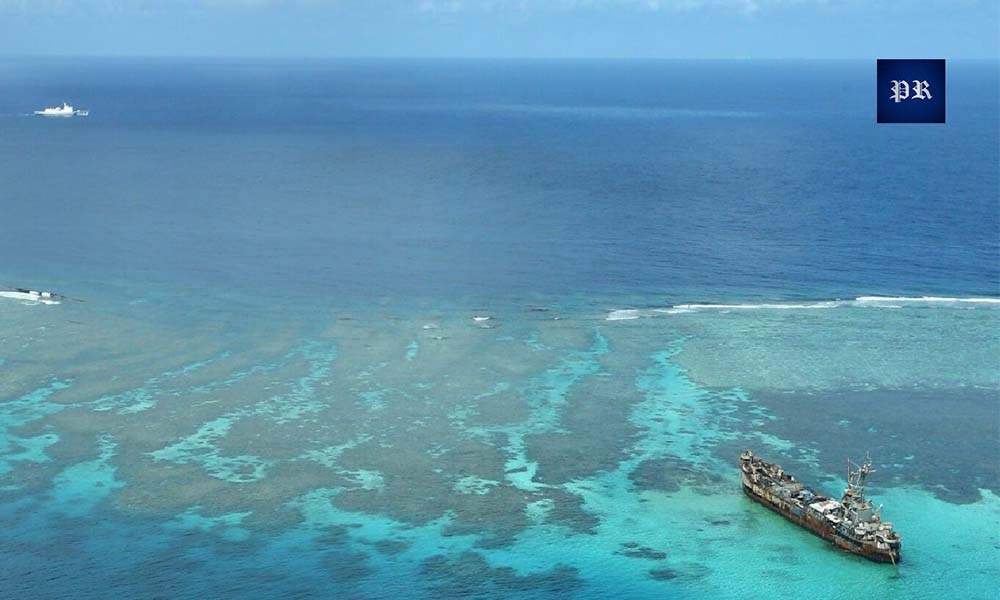
The backdrop for all of this is the South China Sea. Tensions near Scarborough Shoal, Second Thomas Shoal, and the broader West Philippine Sea have been rising for years. China and the Philippines have clashed repeatedly at sea. Pressure near Taiwan adds another layer of regional risk.
The Philippines is not trying to match China ship for ship or jet for jet. Instead, it is building something more achievable: a smarter, more mobile, and more connected defense — one that relies on terrain, speed, long-range fires, and strong alliances.
Balikatan 2026: The Largest Exercise in the Alliance’s History
Exercise Balikatan 2026, which ran from April 20 to May 8, was the largest edition of the annual Philippine-American military exercise ever held. The word “Balikatan” means “shoulder-to-shoulder” in Tagalog. This year, that meant roughly 17,000 troops from seven countries: the Philippines, the United States, Japan, Australia, New Zealand, Canada, and France.
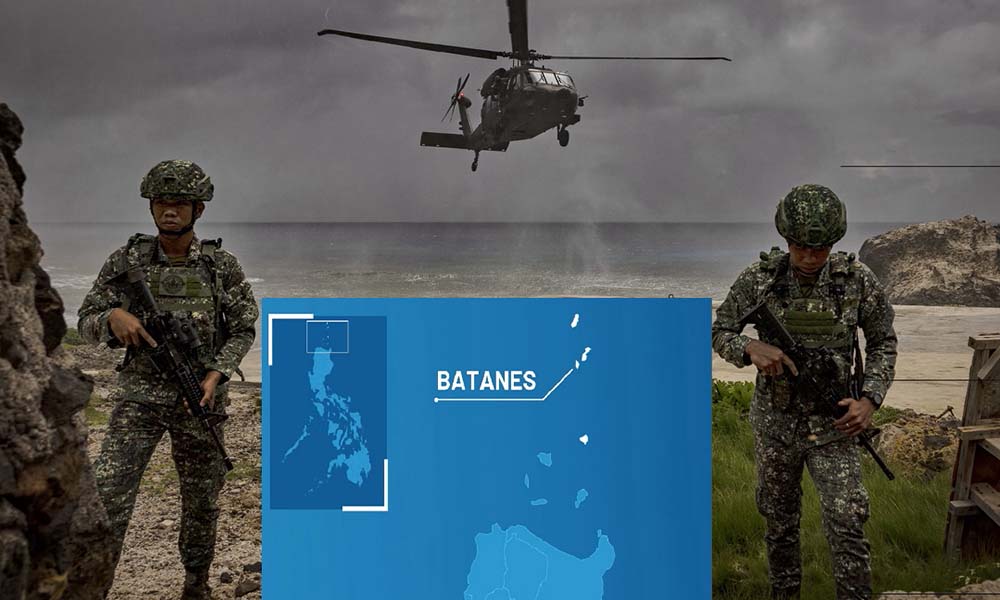
The exercises stretched across Luzon, Palawan, and the Batanes island chain — the northernmost part of the Philippines, sitting just south of Taiwan.
The Counter-Landing Drill That Got Everyone’s Attention
On May 4, 2026, allied forces conducted a major live-fire counter-landing exercise at La Paz Sand Dunes near Laoag City. The location is about 400 miles from the southern tip of Taiwan. That proximity was not a coincidence.
During the drill, drones simulating Chinese ZBD-05 amphibious assault vehicles approached the beach. American, Filipino, Japanese, and Canadian forces worked together to stop them. The force included roughly 700 U.S. soldiers and Marines, 250 Philippine troops, 60 members of Japan’s Amphibious Rapid Deployment Brigade, and 50 Canadians from the Princess Patricia’s Canadian Light Infantry.
The firepower was layered and modern. HIMARS rocket launchers hidden in the dunes fired long-range strikes at simulated enemy ships still at sea. Closer in, troops used Stinger missiles, anti-tank weapons, mortars, and small arms. Drones operated overhead while unmanned surface vessels patrolled the water.
This approach — hitting the enemy far from shore, degrading them in the water, then finishing them on the beach — is what the U.S. Army now calls “Littoral Deep Battle.” The concept draws directly from lessons Ukraine learned fighting Russia’s Black Sea Fleet. The core idea is simple: never let the enemy reach shore intact.
Major General James Bartholomees, commanding the U.S. Army 25th Infantry Division, described the exercise as demonstrating the “lethality of our combined joint force” when connected through a modern command network. Philippine Marine Corps Colonel Dennis Hernandez summed it up differently: effective beach defense requires “seamless integration across services and with allies.”
The Tomahawk Strike: A Message to the Region
On May 5, 2026, the alliance conducted a live-fire Tomahawk cruise missile strike from the ground-based Typhon launcher. The missile was launched near Tacloban in the central Philippines and hit a target at Fort Magsaysay in Nueva Ecija — a range of about 600 kilometers.
From northern Luzon, a Typhon system can strike deep across the South China Sea. China has called it a “strategic offensive weapon” and formally demanded its removal from Philippine soil. Manila has refused.
Beijing responded during Balikatan by conducting naval and air “combat readiness patrols” near Scarborough Shoal. The competing signals from both sides underline just how much military pressure has built up in this part of the world.
Salaknib 2026: Building a Fast, Flexible Army
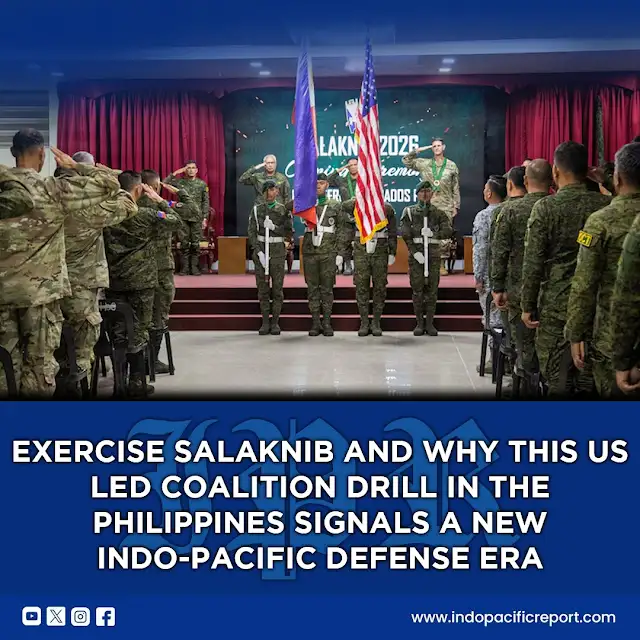
While Balikatan focused on coastal and maritime defense, Exercise Salaknib 2026 built the internal engine of the Philippine Army. It launched on April 6 at Fort Magsaysay and was the largest iteration of the exercise in history — more than 7,000 troops from the Philippines, the United States, Japan, and Australia. Japan and Australia participated as full members for the first time.
One training scene from Salaknib captured the new direction clearly. U.S. Army troops practiced sling-loading M1301 Infantry Squad Vehicles beneath CH-47 Chinook helicopters. In an archipelago country, this matters enormously.
Roads can be cut. Ports can be blocked. Airfields can be hit. Small islands can be isolated during a crisis. Heavy-lift helicopters bypass all of those constraints, allowing troops and vehicles to arrive directly in contested zones within hours. The M1301, built for speed and mobility, can then carry scouts, anti-tank teams, and communications units across terrain that would otherwise be unreachable.
This reflects the broader shift in how militaries now think about island warfare. Rather than concentrating forces at a few large bases — which become easy targets — the new approach spreads small, mobile units across many islands. A force that is dispersed and fast is harder to find, harder to isolate, and harder to destroy.

A Growing Circle of Allies
What is perhaps most significant about Balikatan and Salaknib 2026 is not the hardware or the firepower. It is who showed up.
Five years ago, these were essentially Philippine-American events. Today they look like rehearsals for a genuine regional defense network. Japan’s Amphibious Rapid Deployment Brigade trained inside the Philippines for the first time in modern history. Colonel Tomino Sho, who commanded the Japanese unit during the counter-landing exercise, described the experience as a point of pride and precision. Canada became the third-largest contributor to Balikatan after formalizing a Status of Visiting Forces Agreement with the Philippines in 2025. France and New Zealand joined as well.
Philippine Armed Forces Chief General Romeo Brawner Jr. put the meaning plainly. The real value of these exercises, he said, is in “showcasing our resolve to work together to defend the Philippine archipelago and to uphold the rules-based international order.”
Teodoro Says Defense Pacts With Canada and New Zealand Can Support Philippines Economically
What This Means — and Why It Matters
The Philippines is not building a force designed to match China in a conventional head-to-head fight. It is building a force designed to make any attack costly, complicated, and uncertain. That is the logic of deterrence.
The strategy relies on several overlapping elements: mobile ground forces that can move quickly across islands, layered coastal defenses that can hit ships before they reach shore, long-range missiles that complicate enemy planning, and a growing web of allied forces that multiply Philippine capabilities.
There is also a practical civilian benefit to this transformation. The Philippines faces typhoons, earthquakes, and floods every year. The same airlift capacity, rapid-response logistics, and multi-agency coordination built for wartime also saves lives in a disaster. That gives the Philippine military a rare dual-use value.
But the core of this shift is military, and the message it sends is deliberate.
The Philippines’ islands will not be easy to seize. They will not be easy to isolate. And the country will not face a crisis alone.
This is the most significant shift in Philippine military thinking in a generation. And through Balikatan, Salaknib, and an expanding circle of partners, that shift is now visible to the entire region.
Stay Updated — Follow Indo-Pacific Report
For in-depth analysis of military developments, security trends, and geopolitical shifts across the Indo-Pacific region, follow our coverage across platforms:
Website: indopacificreport.com — News, analysis, and original reporting on Indo-Pacific security
Facebook: Indo-Pacific Report on Facebook — Breaking updates and discussion
YouTube: @IndoPacific_Report on YouTube — Video breakdowns of key defense and security stories
© 2026 Indo-Pacific Report. All rights reserved. Article may be shared with attribution and a link back to indopacificreport.com.