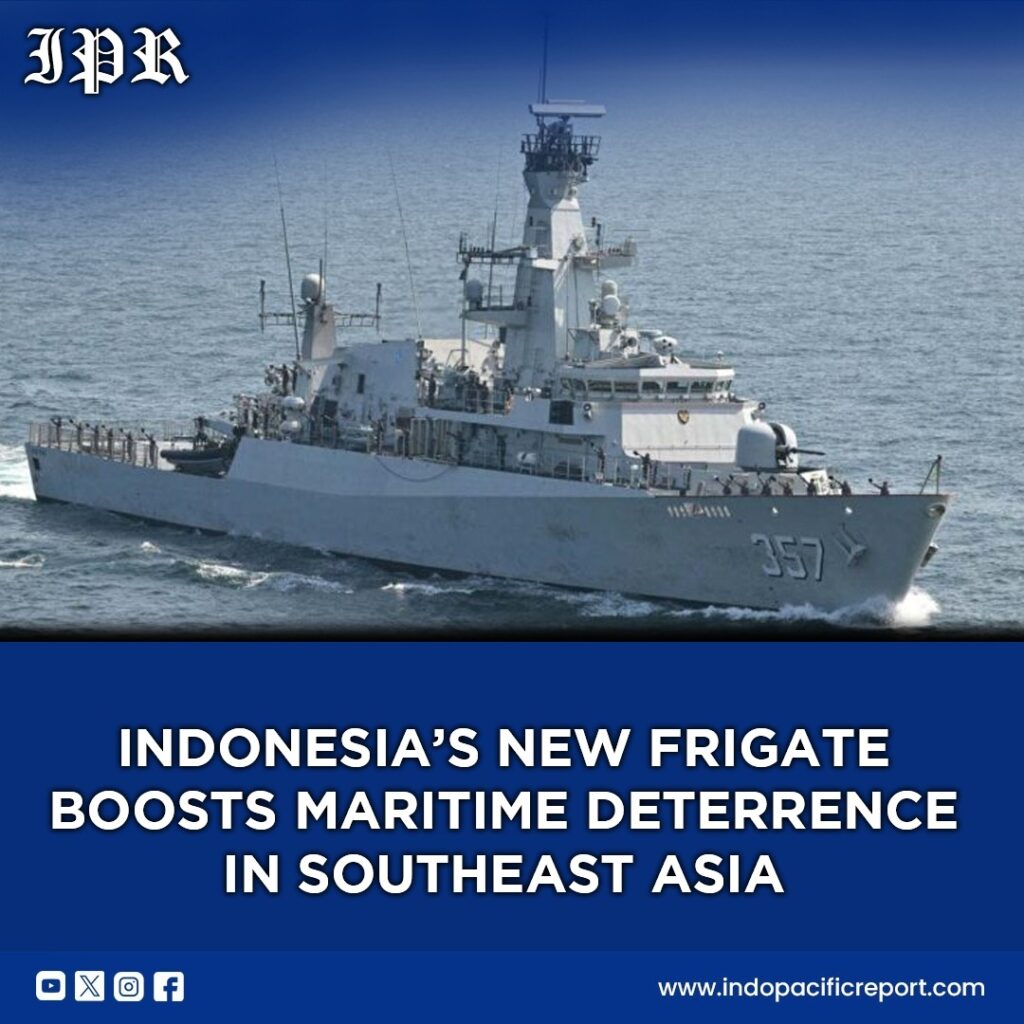
Indonesia’s second Brawijaya-class frigate, Prabu Siliwangi, has arrived in the country, marking a key step in the navy’s modernization program. Built by Fincantieri, the ship joins its sister vessel KRI Brawijaya and brings advanced capabilities, including a combined diesel and gas propulsion system that allows speeds up to 32 knots, a 127mm main gun, and a multi-layered weapons suite. With its size, endurance, and firepower, the frigate enhances Indonesia’s ability to operate across its vast archipelago and defend key maritime routes.
From the lens of great-power competition, the arrival of Prabu Siliwangi reflects Jakarta’s response to increasing naval activity in the region. As China expands its presence in the South China Sea and Indian Ocean, Indonesia is strengthening its ability to deter coercion and protect sea lanes. These frigates offer Jakarta a flexible tool for maritime presence, surveillance, and rapid response across critical waterways.
In terms of regional security architecture, the Brawijaya-class frigates enhance balance in Southeast Asian naval capabilities. They provide Indonesia with the operational depth needed to safeguard chokepoints such as the Malacca Strait, Java Sea, and Sulawesi Sea. These vessels increase Indonesia’s influence in multilateral maritime security exercises and strengthen its role as a stabilizing force in regional waters.
Alliance and procurement strategy also matter. By acquiring these frigates from Europe, Indonesia diversifies its defense partners beyond traditional U.S., Chinese, or regional suppliers. This reduces dependency, provides access to advanced European technology, and positions Indonesia to operate independently while still engaging in cooperative security activities.
From a maritime strategy perspective, these frigates allow Indonesia to protect vital sea lanes, offshore resources, and its territorial waters. In a region heavily reliant on maritime trade, capable surface combatants are essential for deterring piracy, illegal fishing, and potential coercion. With two Brawijaya-class frigates now operational, Indonesia strengthens both its defensive posture and its ability to project presence across the Indo-Pacific.
The broader implications for the regional balance of power are significant. While Indonesia is not seeking confrontation, these ships raise the baseline of naval capability in Southeast Asia. They enhance deterrence, support maritime security cooperation, and give Jakarta more strategic flexibility in responding to crises or assertive behavior in contested waters.
Forward-looking: As Indonesia continues to modernize its navy, it sets an example for other middle powers in the region: strategic deterrence is built not just through numbers but through modern, capable, and flexible platforms. The Brawijaya-class frigates position Indonesia to play a stronger role in safeguarding the Indo-Pacific’s maritime commons.
With Indonesia expanding its naval power, does this strengthen regional security or risk escalating a maritime arms race in Southeast Asia?