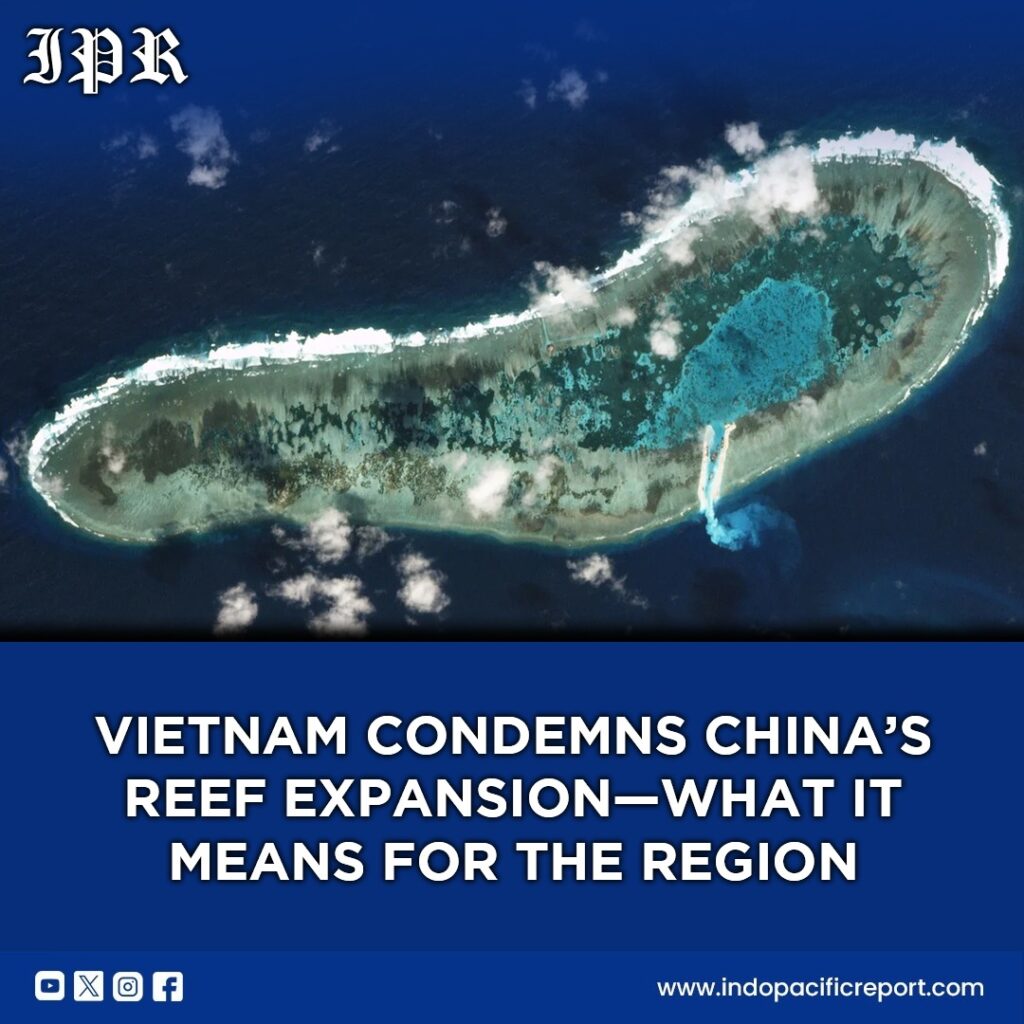
China’s land reclamation and construction at Antelope Reef in the Paracel Islands marks a major step in Beijing’s strategy to dominate the South China Sea. Satellite images show the reef expanding rapidly, with new structures, jetties, and plans for an airstrip. If completed, Antelope Reef could become China’s largest outpost in the South China Sea, surpassing even Mischief Reef in the Spratlys. Vietnam has condemned the work, calling it illegal, but Beijing’s actions demonstrate that power on the ground—or in this case, on the water—often matters more than legal arguments.
From a great-power perspective, Antelope Reef strengthens China’s ability to project military power and control regional waters. A larger reef with an airstrip and maritime facilities allows for sustained naval and coast guard operations. While international law, including UNCLOS, does not recognize artificial expansion as giving new maritime rights, the operational advantage is undeniable. China can monitor shipping lanes, station forces, and respond faster to disputes in nearby areas. This is power by presence, a classic move in maritime strategy.
The reef also exposes weaknesses in regional security architecture. ASEAN and other multilateral frameworks have limited influence over China’s construction. Vietnam’s protests highlight legal and diplomatic limits, but they cannot stop Beijing on their own. This is a reminder that law and norms are often secondary to military capability and political will in contested maritime spaces.
Alliances also play a role. The U.S., the Philippines, Japan, and other partners are watching closely. The expansion at Antelope Reef may prompt more joint naval exercises, patrols, and freedom-of-navigation operations to counterbalance China’s growing presence. For Vietnam, engaging allies could provide deterrence, but it also risks pulling Hanoi into broader U.S.-China tensions. The reef demonstrates how alliances shape both defense and diplomacy in contested seas.
Economically and strategically, Antelope Reef is in a prime location: 162 nautical miles from China’s Hainan Island and 216 nautical miles from central Vietnam. Control over the reef allows Beijing to influence shipping lanes, fisheries, and energy resources while projecting power across the Paracels. In short, this is not just a local territorial move—it is a broader regional power play.
Looking ahead, Antelope Reef will likely become a focal point for regional tension. China gains a permanent forward base, Vietnam and other claimants face increased pressure, and the U.S. and its partners must balance deterrence with diplomacy. The reef illustrates a key reality: in the Indo-Pacific, physical presence often shapes the strategic map more than legal claims.
Will China’s expansion at Antelope Reef force Vietnam and its allies to escalate militarily, or will diplomacy and alliances hold the line?