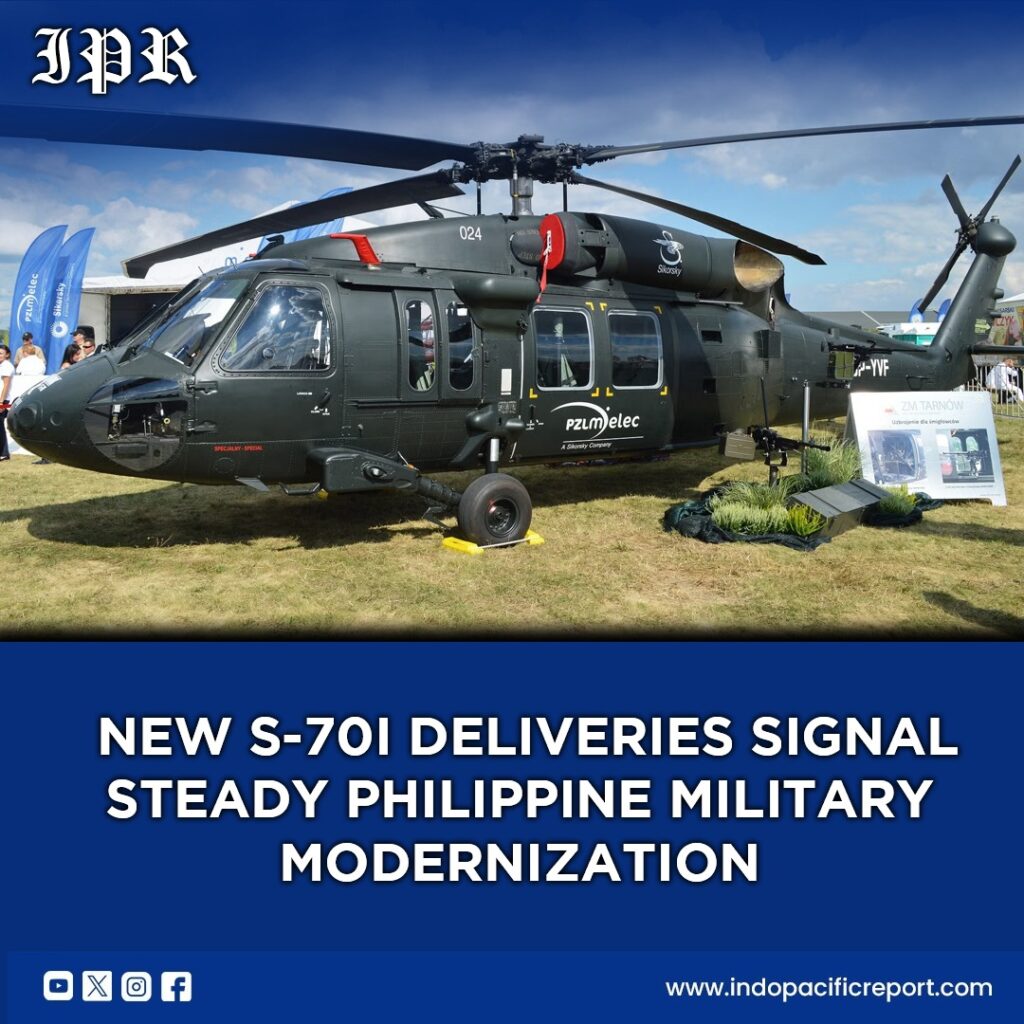
The arrival of a new batch of S-70i Black Hawk helicopters for the Philippine Air Force, currently undergoing test flights in Poland, is more than a routine defense procurement update. It reflects a deeper shift in how mid-tier Indo-Pacific states are building credible, flexible air mobility capacity in an increasingly uncertain regional security environment. This 6th batch of seven helicopters is part of a larger program of 32 additional units, which will bring the Philippine fleet to a total of 47 S-70i Black Hawks once fully delivered.
From the lens of great-power competition, this development sits within a broader pattern of military modernization across Southeast Asia. The Philippines is not simply expanding its inventory; it is improving its ability to move forces quickly across an archipelagic geography. In a region shaped by U.S.–China strategic rivalry, mobility is a form of deterrence. Helicopters like the Black Hawk are not offensive strategic weapons on their own, but they are critical enablers—supporting troop transport, disaster response, medical evacuation, and rapid deployment in contested or remote areas. In modern Indo-Pacific strategy, these capabilities strengthen state resilience under pressure.
Within the regional security architecture, the Philippines occupies a structurally sensitive position. It is located along key maritime corridors and sits close to multiple contested zones in the South China Sea. This makes internal mobility and logistics capability strategically important. The expansion of the Black Hawk fleet enhances the country’s ability to operate across dispersed islands and reinforce remote outposts. In practical terms, this improves national cohesion and reduces response time during both military contingencies and humanitarian crises. In an archipelagic state, air mobility is not a luxury—it is infrastructure for sovereignty.
From the perspective of alliance dynamics, this procurement also reflects deeper integration with Western defense ecosystems. The S-70i platform is part of the broader Black Hawk family used widely by the United States and its partners. While the helicopters are being assembled and tested in Poland, their operational logic aligns with NATO-standard interoperability. For the Philippines, which is strengthening defense cooperation with the United States, Japan, and Australia, this kind of platform compatibility matters. It allows smoother integration in joint exercises, logistics support, and potential coalition operations in the Indo-Pacific. In effect, hardware choices are becoming extensions of alliance alignment.
On the maritime and economic strategy level, the significance is indirect but important. The Philippines is a maritime nation with over 7,000 islands, where sea lanes and coastal zones define both economic activity and security exposure. Helicopter fleets like the Black Hawk strengthen the “vertical layer” of maritime security—bridging gaps between islands, ports, and remote coastal areas. This enhances not only military readiness but also disaster response capacity, which is critical in a country frequently affected by typhoons and natural disasters. In the Indo-Pacific, where climate risk and security risk increasingly overlap, dual-use mobility platforms are becoming strategic assets.
At the level of Indo-Pacific balance of power, this expansion reflects a broader trend: middle powers are investing in distributed resilience rather than high-end power projection alone. The Philippines is not trying to match major powers in scale. Instead, it is building functional capability—transport, mobility, sustainment—that allows it to remain operationally relevant in crisis scenarios. The increase to 47 Black Hawks signals a long-term shift toward a more capable, more agile Philippine defense posture, especially in a maritime theater where speed and coverage often matter more than sheer firepower.
In the long run, this development contributes to a more layered Indo-Pacific security environment. It does not change the strategic balance on its own, but it strengthens the ability of smaller states to absorb shocks, participate in coalition operations, and maintain internal stability under pressure. The key question is whether such incremental capability building across Southeast Asia will collectively enhance regional deterrence—or simply reflect a region steadily preparing for higher baseline insecurity.