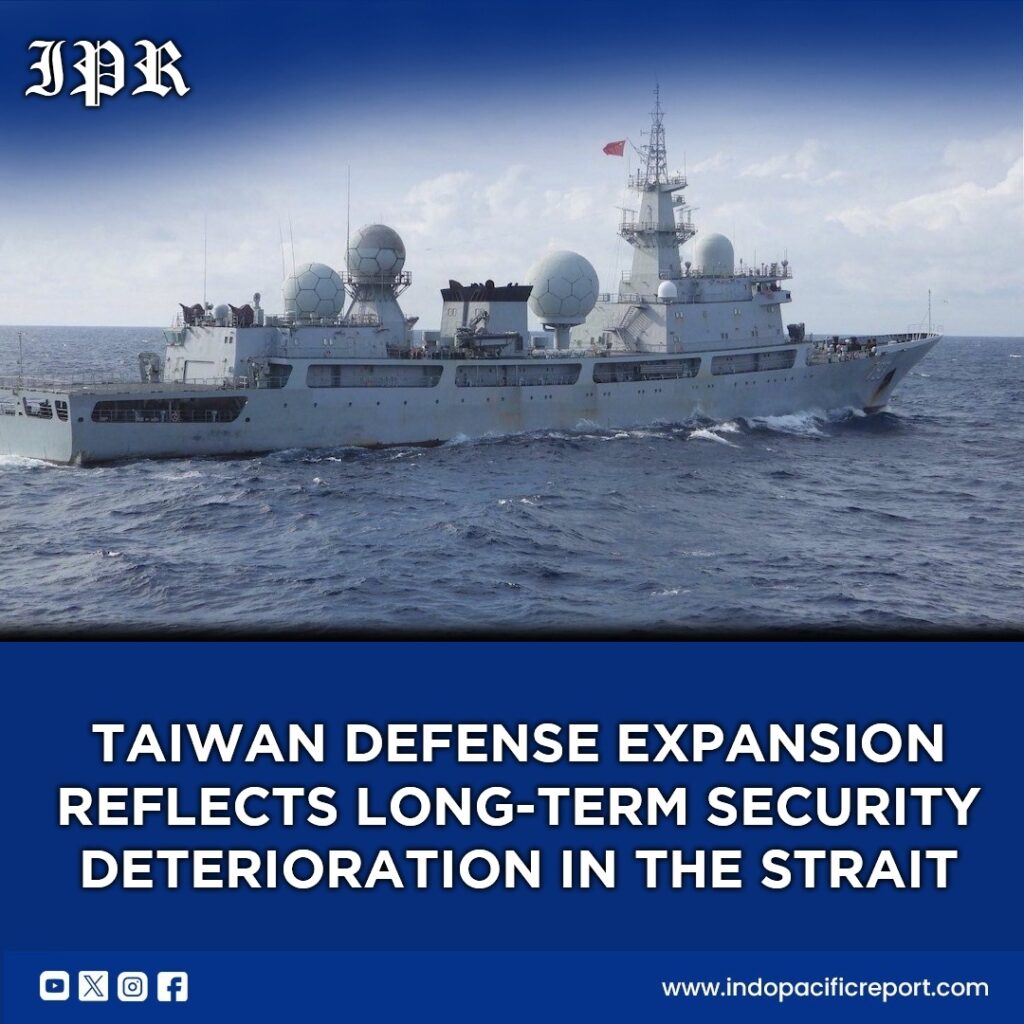
Taiwan’s reported push for roughly $40 billion in additional defense spending, paired with an open acknowledgment that China’s military buildup has not slowed, is less a surprise and more a confirmation of a long-running structural trend in the Western Pacific: the steady hardening of deterrence on both sides of the Taiwan Strait.
From a geopolitical perspective, this is classic security dilemma dynamics. As China continues to expand and modernize its military capabilities—across missiles, naval power, and air-denial systems—Taiwan responds by increasing defense investment to preserve credible deterrence. But this reaction is not happening in isolation. It is embedded in a wider Indo-Pacific environment where the United States and its regional partners are also reinforcing force posture, logistics networks, and readiness frameworks. The result is not sudden crisis, but gradual strategic compression: each side adjusts upward, and the baseline of “normal tension” shifts higher.
For great-power competition, this matters because Taiwan sits at the intersection of military geography and industrial capacity. It is not just a territorial dispute—it is a node in global semiconductor supply chains and a forward edge of U.S.–China strategic rivalry. The acknowledgment that Chinese buildup has not slowed reinforces a key reality: deterrence in the Indo-Pacific is no longer static. It is a continuous investment race in capability, readiness, and resilience. In this environment, even incremental increases in defense budgets are interpreted as signals of long-term intent rather than short-term adjustment.
From a regional security architecture perspective, Taiwan’s posture cannot be separated from broader Indo-Pacific alignment patterns. The U.S. security network—spanning Japan, Australia, and selective European engagement—has increasingly treated Taiwan’s security as a critical variable in regional stability, even without formal alliance status. This creates a semi-integrated deterrence structure: not a formal treaty bloc, but a functional security ecosystem. Within this system, Taiwan’s defense spending is not isolated national policy; it is part of a distributed deterrence architecture designed to complicate any rapid military scenario across the Strait.
On the maritime and economic strategy side, the implications extend far beyond defense budgets. The Taiwan Strait is one of the most sensitive maritime corridors in the global economy. Any escalation risk—however distant—feeds directly into supply-chain risk pricing, particularly in high-tech sectors like semiconductors, advanced electronics, and precision manufacturing. This is why your instinct about “supply-chain bets” is strategically grounded: markets are increasingly forced to price not just current stability, but potential disruption in a tightly interconnected production system centered on East Asia.
In terms of deterrence dynamics, the key shift is not just military balance, but perception of momentum. Taiwan openly recognizing sustained Chinese buildup signals that the strategic environment is not stabilizing—it is accumulating pressure over time. Even if no immediate conflict is likely, the probability distribution of friction events rises. This is how Indo-Pacific security often evolves: not through sharp breaks, but through persistent upward drift in readiness, alertness, and risk sensitivity.
Looking forward, the central strategic question is whether this trajectory leads to managed long-term deterrence stability or a high-tension equilibrium where crisis risk becomes chronic. Prediction markets may treat each headline as noise, but structurally the signal is consistent: both sides are investing in endurance, not compromise. That does not guarantee conflict—but it does mean the system is becoming less forgiving of miscalculation.