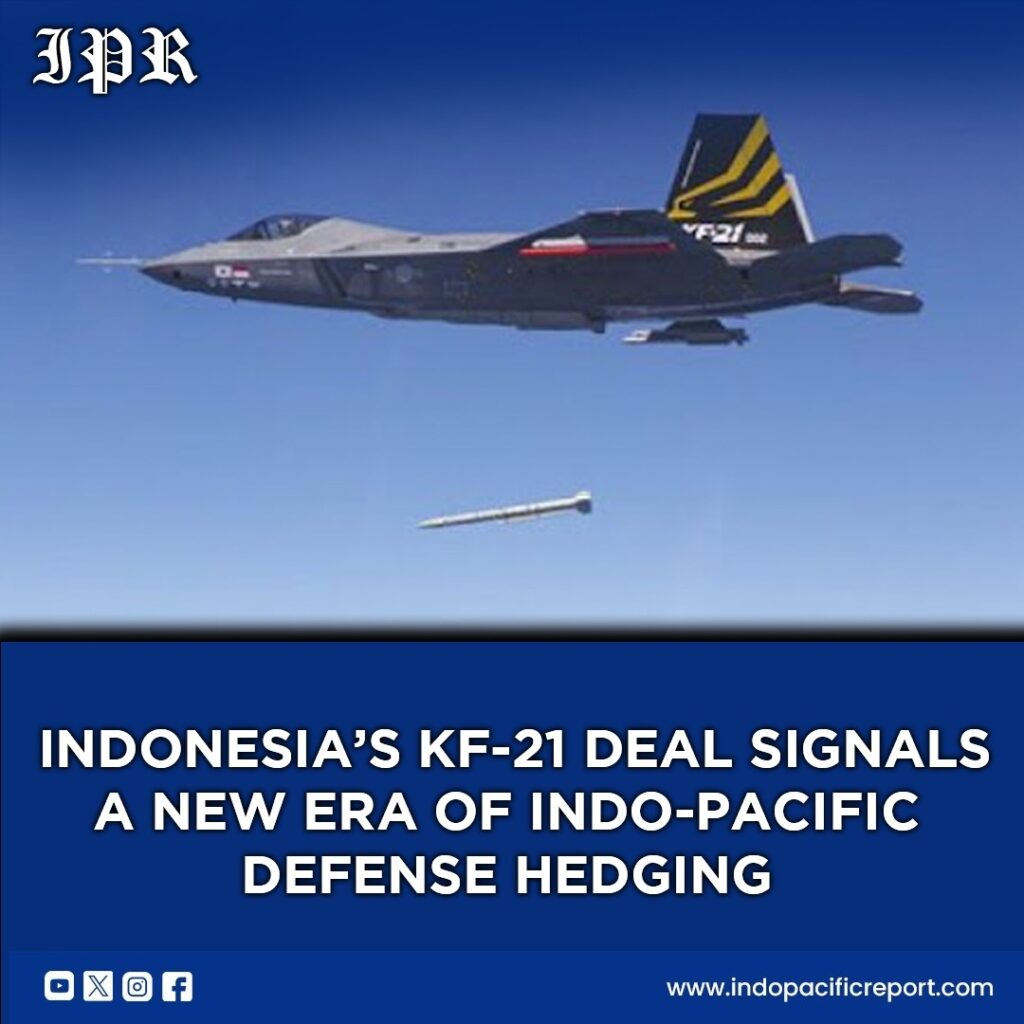
Indonesia’s reported intention to acquire 16 Korea Aerospace Industries KF-21 fighters marks more than a routine defense procurement. It reflects a deeper structural shift in Indo-Pacific military-industrial politics, where emerging middle powers are no longer passive recipients of security architecture but active portfolio managers of airpower, technology access, and strategic autonomy. If confirmed during President Prabowo Subianto’s visit to Seoul, the deal would make Indonesia the first export customer of the KF-21 program and formally anchor Jakarta inside a new tier of Asian defense-industrial cooperation.
From the perspective of great-power competition, the KF-21 transaction sits at the intersection of U.S. alliance dominance, China’s expanding defense influence, and the gradual emergence of Asian defense self-sufficiency. The KF-21 is not a full fifth-generation platform, but it represents a critical transitional capability: a “4.5-generation plus” fighter that allows regional air forces to modernize without full dependence on U.S. or European ecosystems. Indonesia’s parallel procurement strategy—acquiring Dassault Rafales from France and Turkish Kaan fighters from Türkiye while considering the KF-21—reveals a hedging behavior increasingly common among Indo-Pacific states. It is diversification, but also strategic insurance against overdependence on any single great power supplier.
The regional security architecture of Southeast Asia is therefore becoming more fragmented and multi-vector. Indonesia’s air force, historically reliant on aging U.S. F-16s, Russian Su-27/30s, and mixed Western light attack aircraft, is now transitioning into a hybrid fleet architecture that spans European, Turkish, Korean, and potentially American systems. This creates interoperability complexity but also strategic autonomy. Jakarta is not aligning fully with any bloc; instead, it is constructing a modular deterrent posture. In a maritime region defined by archipelagic geography and contested sea lanes, airpower modernization becomes essential for controlling access to critical chokepoints such as the South China Sea approaches and the broader Indonesian Throughflow.
Alliance dynamics are also evolving beneath the surface of this deal. South Korea, through Korea Aerospace Industries, is no longer merely a licensed assembler of Western systems but an emerging defense exporter in its own right. The KF-21 program, jointly developed with Indonesia since 2010, has been politically and financially unstable—marked by disputes over technology transfer, delayed payments, and even allegations of industrial espionage involving Indonesian engineers, later dismissed. The reported reset of the partnership in 2025, including reduced Indonesian financial obligations, signals a pragmatic compromise: Seoul secures export legitimacy and industrial scale, while Jakarta retains access to advanced aerospace learning curves. This is alliance behavior without formal alliance structure—a hallmark of contemporary Indo-Pacific defense economics.
From a maritime and economic strategy standpoint, Indonesia’s procurement choices reflect a classic archipelagic logic. As the world’s largest island state, Indonesia’s security is inherently maritime-air integrated. Its aging fleet of F-16s, Su-30s, Hawks, and Super Tucanos has been increasingly inadequate for sustained air surveillance across vast sea lanes. The KF-21, combined with Rafales and future Kaan fighters, would significantly improve Indonesia’s ability to project air denial over critical maritime corridors. This matters not only for national defense but also for economic security, as Indonesia sits astride some of the world’s busiest shipping routes linking the Indian and Pacific Oceans. Air superiority is therefore not abstract—it is directly tied to trade resilience, resource security, and territorial control over contested waters.
In broader Indo-Pacific balance-of-power terms, the KF-21 export deal signals the gradual diffusion of advanced aerospace capabilities beyond traditional Western suppliers. South Korea is positioning itself as a mid-tier defense industrial power, capable of shaping regional procurement ecosystems in ways previously dominated by the United States, Russia, and Europe. This diversification reduces the monopolistic leverage of any single supplier and accelerates technological pluralism in Asia. At the same time, it introduces new uncertainties. Multi-origin fleets complicate coalition interoperability in crisis scenarios and may dilute the coherence of U.S.-led defense architectures in the region.
Indonesia’s approach also reflects a deeper strategic reality: Southeast Asia is not aligning, but balancing. Jakarta is simultaneously engaging Western, European, and emerging Asian defense producers while avoiding full strategic capture by China or the United States. This hedging behavior is rational under conditions of intensifying great-power rivalry in the Indo-Pacific maritime domain. Yet it also produces a more fluid and less predictable security environment, where procurement decisions carry geopolitical signaling weight far beyond their technical specifications.
In conclusion, the prospective KF-21 export to Indonesia is not merely a defense sale—it is a marker of systemic transition in Indo-Pacific power structure. It reflects the rise of defense-industrial multipolarity, the fragmentation of alliance dependency, and the growing agency of middle powers in shaping their own deterrence architectures. Over time, such transactions will erode the binary logic of alliance versus adversary and replace it with a more complex lattice of overlapping partnerships and selective dependencies. The strategic implication is clear: Indo-Pacific security will be defined less by rigid blocs and more by fluid networks of capability exchange. In that environment, control over technology flows may matter as much as control over territory.